• Welcome to ASR. There are many reviews of audio hardware and expert members to help answer your questions. Click here to have your audio equipment measured for free!

Philharmonic BMR Monitor Semi-Objective Review - Road Show Stop 1

The comment regarding the 2-3KHz glare surprised me, esp where he comments in the written review that this would be a showstopper for him without EQ. I think guitar and female vocals sound amazing with these speakers, without EQ.

I also have not noticed anything sounding wrong around 500Hz where he suspects some kind of resonance.

Has anyone who has heard these had similar impression to what Erin describes?
I would just note that Erin listens at very high playback levels. I honestly can't hear either of these issues, and they don't show up on my measurements. However, the Klippel machine has higher resolution that any other system except perhaps those using an anechoic chamber. I can only go by my measurements and by what I hear. FWIW, this is an on-axis plot of the BMR I have on hand.

1653857239029.png
 

Attachments

  • 1653856955130.png
    1653856955130.png
    96.8 KB · Views: 126
Last edited:
Erin's review seems slanted toward trying to find issues rather than simply sitting back and enjoying the music at reasonable levels.

That's your take. I went into this expecting it to sound incredible based on my previous experience with the v1. There was one specific issue: the measurable and very audible - to me - bump around 2-3kHz that bothered me. And it turns out the fellow who loaned them to me has the same complaint. I won't "out" him here in this thread. But if he so chooses to, he can reply.

Just because I don't fawn over it, though, doesn't mean I didn't listen to it or I went into it "trying to find issues". That's nonsense. The issues were audible, I located them and I spoke about them. The same issue that the owner noticed (note: he and I didn't talk about this until after I listened to them and *before* I measured them).
 
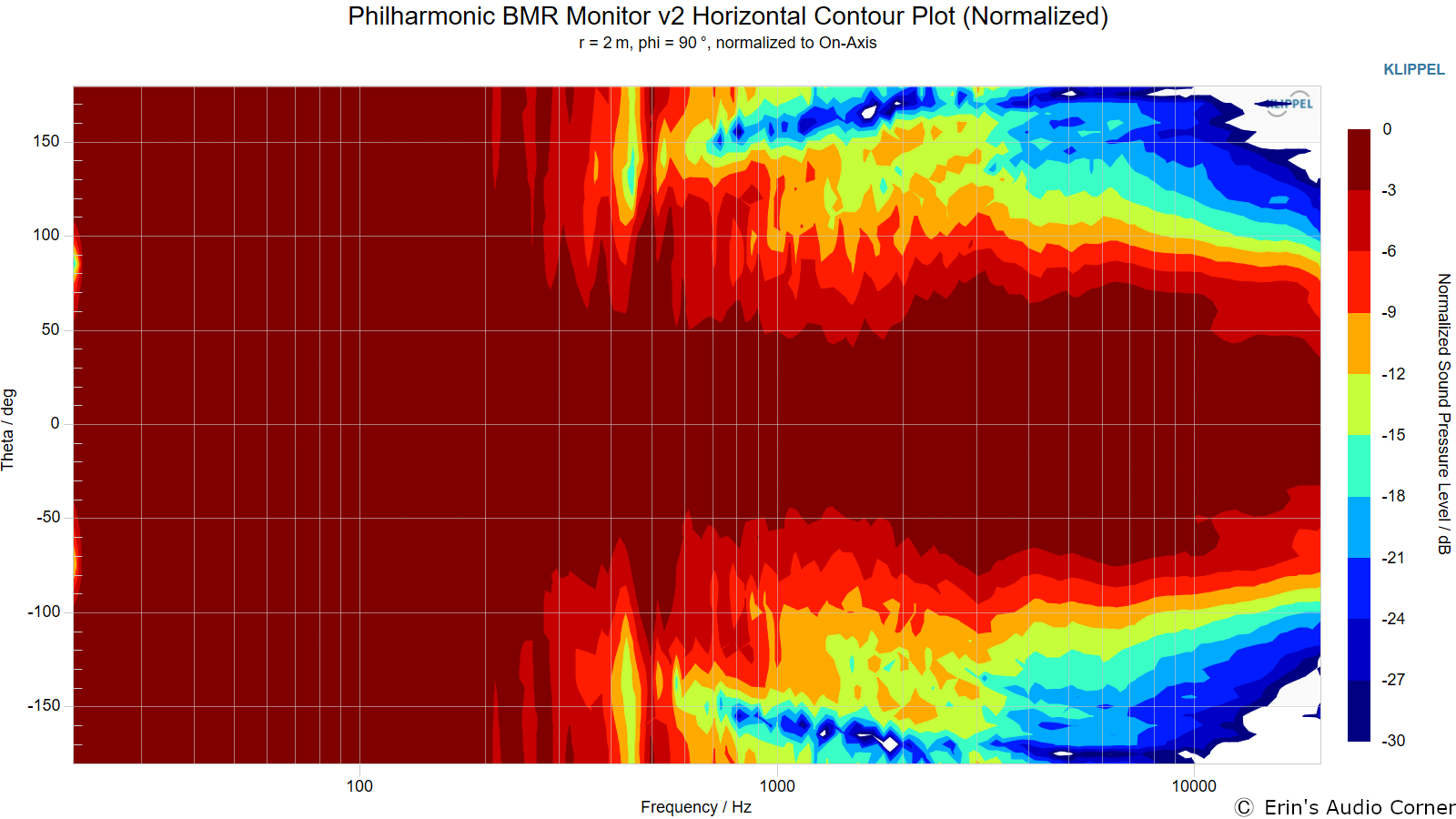
Is not this what causes the 2khz 3khz bump?
There is higher directivity at 3khz~
Philharmonic%20BMR%20Monitor%20v2%20Horizontal%20Contour%20Plot%20%28Normalized%29.png

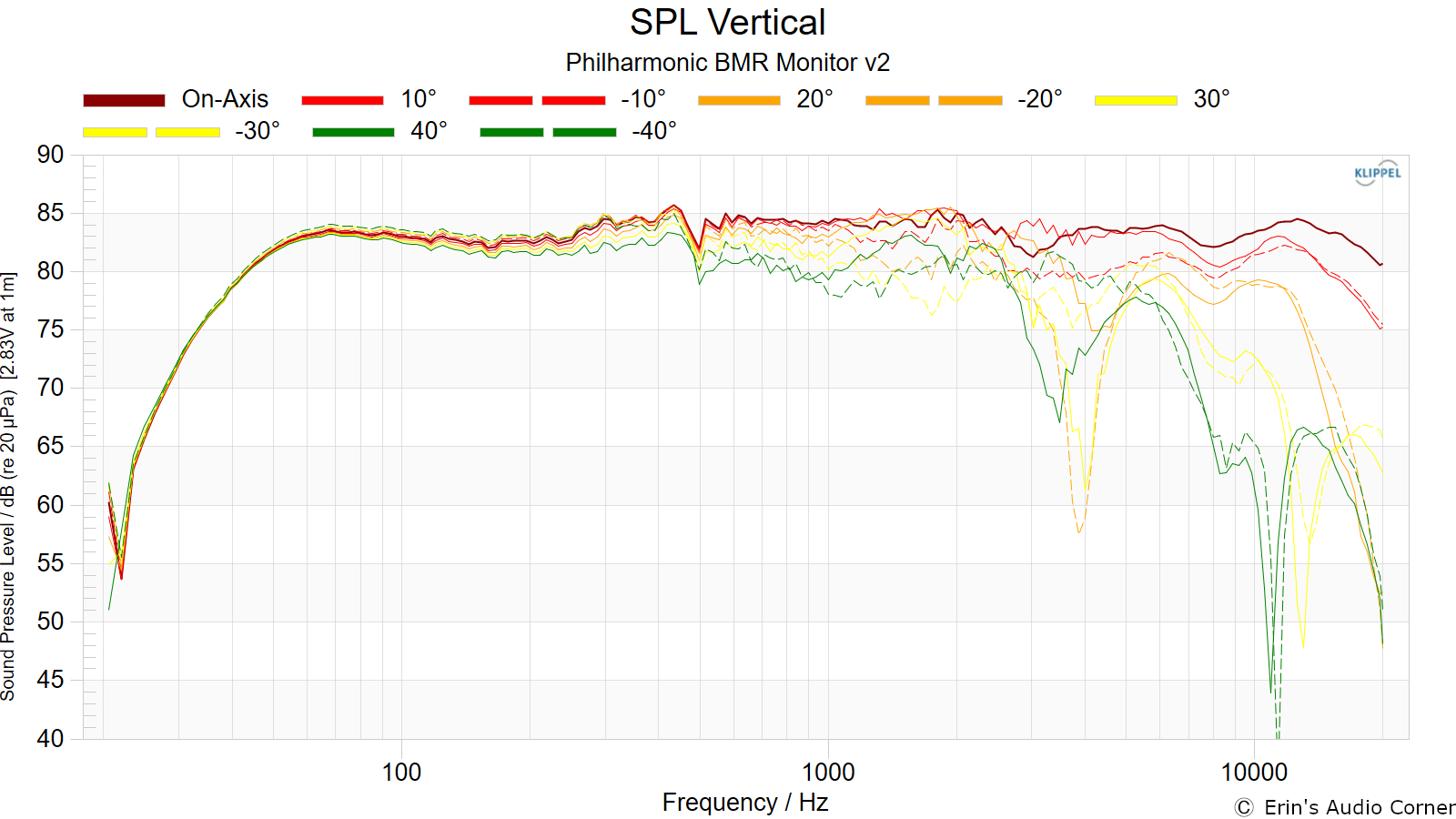
At 10° there is a small raise, enough to be audible.
SPL%20Vertical.png
 
I would just note that Erin listens at very high playback levels.

Incorrect, Dennis. You seem to think that I only listen at high volumes. I do that as part of my testing but I don't listen for any duration at high volume because I like my ears and their ability to function normally. ;)

I listened to these speakers at reasonable volume levels. And the 2-3kHz glare wasn't even at high output. In fact, *when* did *did* discuss high output listening, it was focused on the output capability of the speaker and the woofer's ability to provide bass at higher than normal levels. I talk about that *specifically* at this time stamp (6:24). And then I quantify the reason I then listened higher: "When I pushed the speaker harder - because people want to know ... "

So, do not conflate my concerns/complaints about the 2-3kHz with only high output. They are not one-in-the-same and I never attributed that issue to any particular volume. I only discussed volume wrt woofer capability.
 
It sounds like Erin may prefer a speaker that offers a narrower dispersion but for everyone else I think the BMR Monitors are a top choice in a medium size rooms.

Did you watch the video or is this based off my written review? Serious question. I discussed this specifically in my video. I talked about listening to the speaker in two entirely different rooms and that in one room the radiation was too wide and caused the imaging to not be as focused as I'd have preferred and in the other room I didn't have that issue as much. And I said this all so people will have an idea of what to expect based on their own room.

 
I would just note that Erin listens at very high playback levels. I honestly can't hear either of these issues, and they don't show up on my measurements. However, the Klippel machine has higher resolution that any other system except perhaps those using an anechoic chamber. I can only go by my measurements and by what I hear. FWIW, this is an on-axis plot of the BMR I have on hand.

View attachment 209731


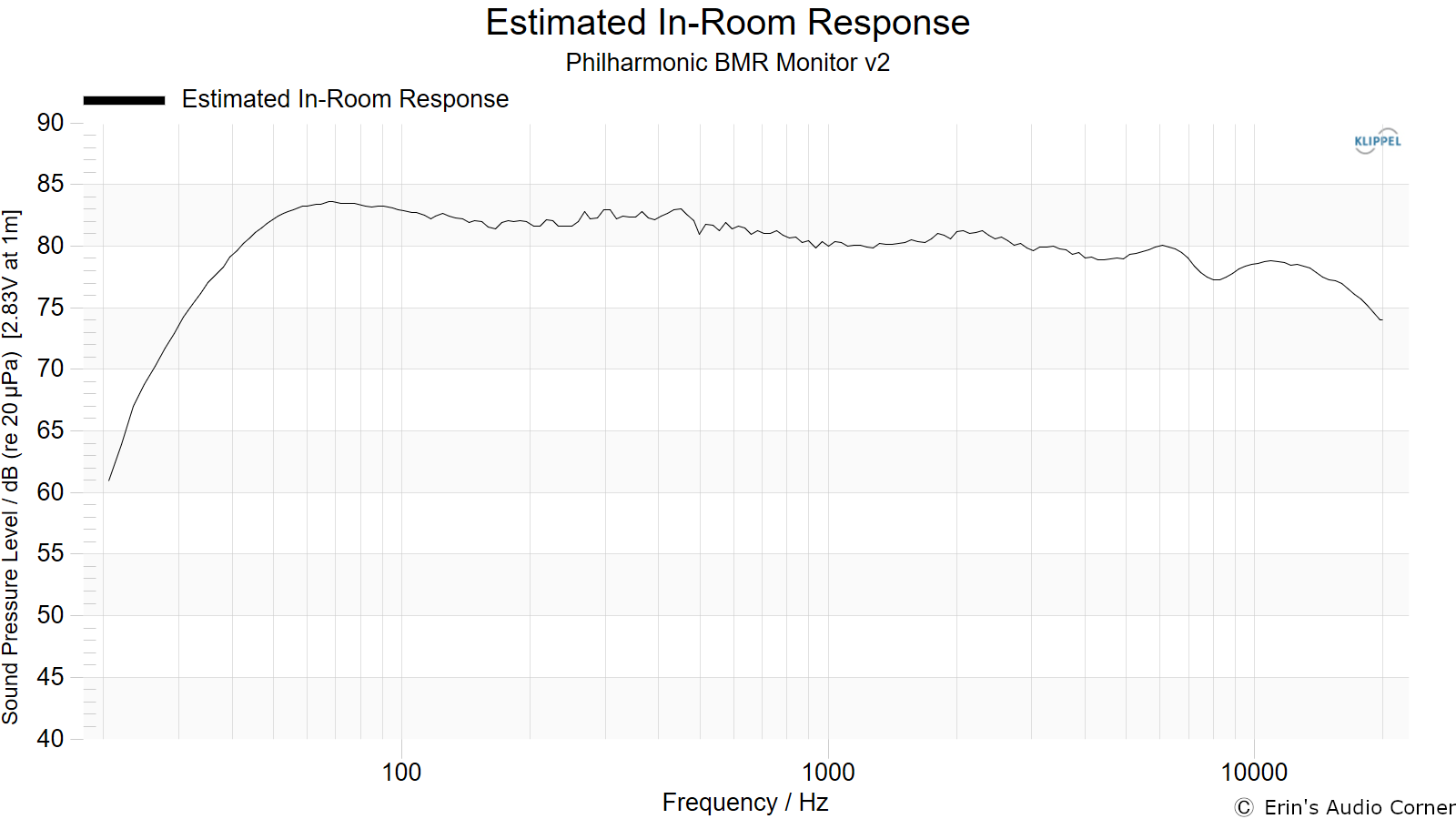
Dennis, I encourage you to not look at just the on-axis response. The off-axis response and the impact it has on the EIR is far more important. And, indeed, the EIR shows this bump. Looking at the horizontal and vertical, you can see this clearly.

I'll mention again that I had no idea what the data looked like before I measured the speaker. In fact, I PM'd the owner my "initial" comments after listening to them in my home theater. And, he echoed my sentiments about this 2-3kHz "glare".


Estimated%20In-Room%20Response.png
 
Incorrect, Dennis. You seem to think that I only listen at high volumes. I do that as part of my testing but I don't listen for any duration at high volume because I like my ears and their ability to function normally. ;)

I listened to these speakers at reasonable volume levels. And the 2-3kHz glare wasn't even at high output. In fact, *when* did *did* discuss high output listening, it was focused on the output capability of the speaker and the woofer's ability to provide bass at higher than normal levels. I talk about that *specifically* at this time stamp (6:24). And then I quantify the reason I then listened higher: "When I pushed the speaker harder - because people want to know ... "

So, do not conflate my concerns/complaints about the 2-3kHz with only high output. They are not one-in-the-same and I never attributed that issue to any particular volume. I only discussed volume wrt woofer capability.
I certainly don't want to get into an argument with you on this. I'm sure you're reporting what you heard. My main comment was an attempt to explain why you might have heard something the poster hadn't heard. That said, I'm honestly not hearing that problem, and indeed my main concern with the current BMR is the dip centered at 3 kHz which I thought some people might hear as a softening of lower treble response. Anyhow, thanks for the review, and I think it contains a wealth of good information.
 
And, let me say this:

I heard what I heard. If you don't then OK. It doesn't change my impressions and the data jives with the things I discussed. But the purpose of these reviews is to inform. You don't have to agree with me but understand that different situations/setups can result in different experiences. That's what I find more interesting than just blanket statements like "it sounds hot, dull, etc".

I also think it's still a great speaker but may be more room dependent than I would have initially thought. This is still part of the learning process. Before, I'd have told you I loved ±90° front radiation. Now, I'm not sure. I don't know if the tradeoff of image precision is "worth" the very wide radiation (for my home theater room) but I also can't say that all speakers with such wide radiation would behave the same way. I can "assume" they would but I don't *know* they would.

This is all part of the learning process. If you like your speakers then keep on liking them. But trying to cast doubt on what I heard or what the measurements show just comes off weird. The data is supposed to enlighten. Not draw ire and discontent.
 
I certainly don't want to get into an argument with you on this. I'm sure you're reporting what you heard. My main comment was an attempt to explain why you might have heard something the poster hadn't heard. That said, I'm honestly not hearing that problem, and indeed my main concern with the current BMR is the dip centered at 3 kHz which I thought some people might hear as a softening of lower treble response. Anyhow, thanks for the review, and I think it contains a wealth of good information.

That's fine.

My point was that I do not listen at high volume levels as you said. You've mentioned this a number of times over the years and I don't get where you pull that from. I listen at various levels. I think that's a reasonable thing to do because not everyone who reads/watches my reviews listens at the same output level relative to their seating distance. So, I just want to clear up that misunderstanding. ;)


I watched the video where you discussed 2" of foam on the side walls not being enough and you thought 4" would be required. I couldn't stop laughing as I don't have any treatment on the side walls and the BMR Monitors sound absolutely great. To each his own conclusion. :D

Okay. So, let's go beyond that statement... what's your room like? What are the dimensions, how do you have the speakers set up and how might your experience/situation differ? Right?... this is the reason for these discussion. If we just stop at "I don't agree" then that leaves others nowhere. You or I may not have a reason to care what the other says because "I heard what I heard and you're wrong". BUT if you are posting on a forum then *hopefully* what you're doing is trying to provide some tangible information for others to better understand these things. Otherwise, what's the point... who cares... right?
 
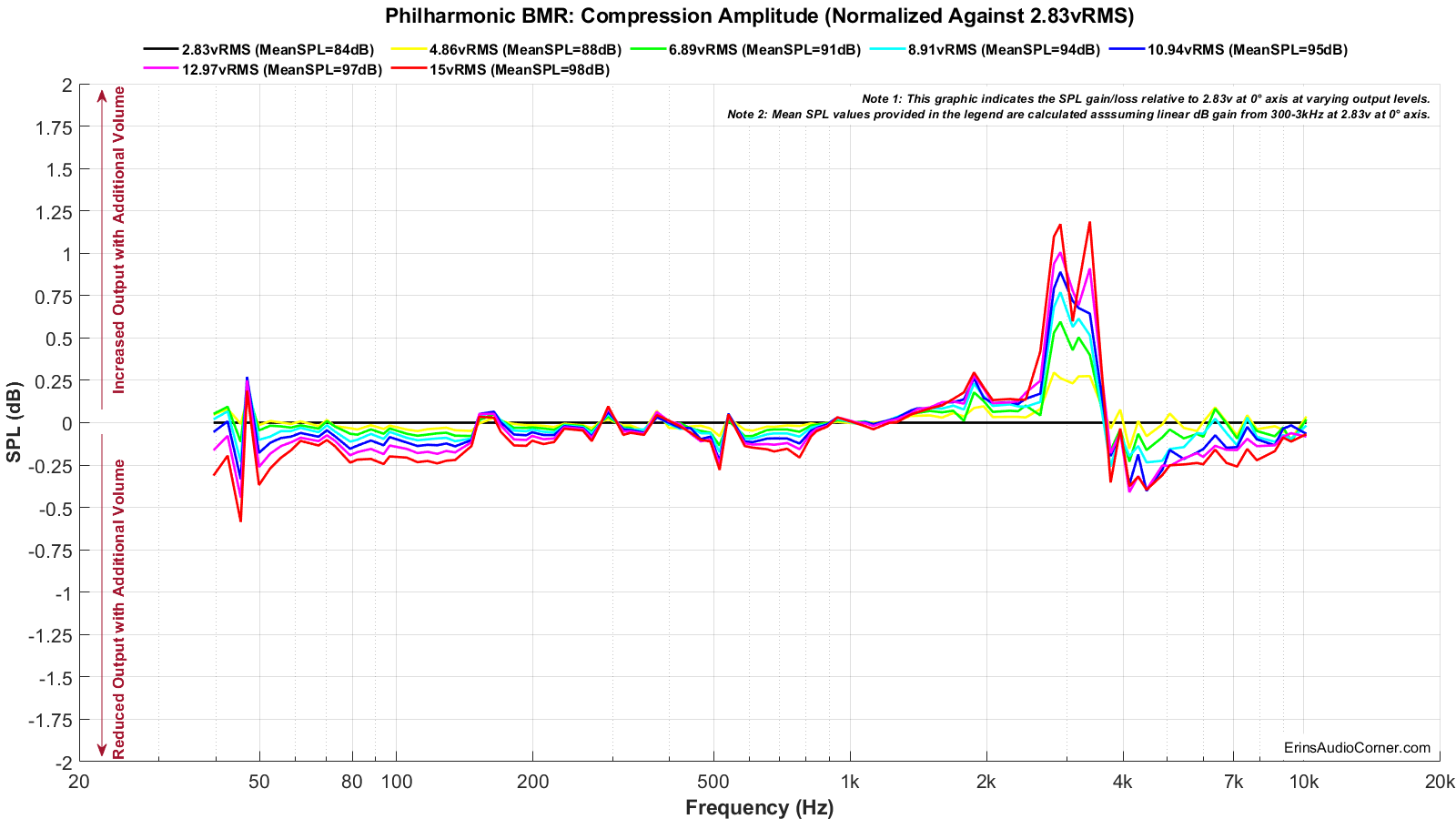
Erin's original reviewed BMR used the same paper woofer as in past years. Only recently did Dennis change that. He didn't see the compression back then:

Note the original reference:
The "old" was at 2.83v. Whatever base sensitivity the speaker was. Which appears to be about 84dB.

My "new" tests are normalized to 76dB. That means the reference output is 8dB from the start. Depending on how non-linear the speaker is at the low-to-mid volumes (76-86dB) that could very well explain these differences. IOW, you aren't comparing apples-to-apples. You can possibly compare 84dB to the higher output values but if I had to guess, I'd say that's where the main difference lies.
 
@hardisj , I did not get all that from your video. As a DM / Philharmonic Fan Boy, of course I want you to fall down to your knees and worship as I do! :p But I did not feel that you had it in for this Speaker.

But seriously...
You reported what you experienced clearly, and you described what your experience was; on several occasions pointing out that it was part of your preference. I think you good. :)

On another note...
One of my test songs is Tori Amos' Northern Lad from Choirgirl Hotel. The chorus of this track has her singing (and SPL climax) at what is a sensitive part in my own hearing. I have not explored what frequency is triggering me, however this happens somewhat regularly with this cut. At one point, I even built into my Audyssey App a more gentle/shallow and slightly wider version of their MRC crater which seemed to attenuate the issue.
I suspect this is a similar experience. (Would appreciate hearing you thought if you have the time to listen on whatever Speaker you may choose!)
 
And, let me say this:

I heard what I heard. If you don't then OK. It doesn't change my impressions and the data jives with the things I discussed.

I also think it's still a great speaker but may be more room dependent than I would have initially thought. This is still part of the learning process. Before, I'd have told you I loved ±90° front radiation. Now, I'm not sure. I don't know if the tradeoff of image precision is "worth" the very wide radiation (for my home theater room) but I also can't say that all speakers with such wide radiation would behave the same way. I can "assume" they would but I don't *know* they would.

This is all part of the learning process. If you like your speakers then keep on liking them. But trying to cast doubt on what I heard or what the measurements show just comes off weird. The data is supposed to enlighten. Not draw ire and discontent.
This is a learning process for both of us. Horizontal dispersion is perhaps the single least science-anchored aspect of speaker design. There doesn't seem to be any "correct" answer at this point. I listen mainly to classical music recorded in natural venues. To me, very a broad dispersion speaker like the BMR best recreates what I've been hearing at concerts and in the violin and viola sections of orchestras for over 60 years. As I've posted many times, that approach might not be to everyone's liking, particularly for studio recordings of vocals and other material of a more popular vein. I'll certainly take your comments about treble glare to heart and listen again to make sure I haven't missed it to date.
 
But I did not feel that you had it in for this Speaker.

Right. I certainly didn't. I was mainly relaying my experience, the data and some things to consider.

Typical reviews are:
"here is the data, figure it out" or "the highs sound like silk and the bass is buttery smooth"

There is so much more in between that I find interesting. As I said, the fact that I previously loved the v1 for its wide radiation but found myself to not care for it this round (in my home theater room) thanks to the seemingly lack of clarity it results in is an interesting finding. I didn't expect that. At all.

Then, throw in that my experience in my larger and open living room wasn't quite the same and I'm genuinely intrigued by that finding and am curious if - over time - I've started to get a better grip on radiation patterns that I prefer. For different rooms. I've had the opportunity to listen to a LOT of nice speakers in the two years since I listened to the BMR v1. And with that, I've tried to make sense of how the data relates to what I hear when I listen. I pass this info along. That's all I can do. :)
 
Last edited:
This is a learning process for both of us.

Bingo.

Speakers are not black and white. I think people tend to forget that or just don't quite grasp it. Tradeoffs and preferences dominate what makes one person happy vs another. To me, this is what makes the hobby so interesting and bucks the notion that a single SPIN graphic is the only thing we need. It's a step in the right direction but the minutia that makeup the SPIN data is important.


Edit: FWIW, I was considering asking if you would be interested in coming on and talking about your speakers sometime. I think having the perspective of the designer would be cool. Same as when Ryan Bouma came on and talked about his DIYSG 1099's. Explain to people your process and the tradeoffs/things you wanted to have out of your speaker. If you'd be interested let me know. But if you are not, I understand.
 
Last edited:
Right. I certainly didn't. I was mainly relaying my experience, the data and some things to consider.

Typical reviews are:
"here is the data, figure it out" or "the highs sound like silk and the bass is buttery smooth"

There is so much more in between that I find interesting. As I said, the fact that I previously loved the v1 for its wide radiation but found myself to not care for it this round (in my home theater room) thanks to the seemingly lack of clarity it results in is an interesting finding. I didn't expect that. At all.

Then, throw in that my experience in my larger and open living room wasn't quite the same and I'm genuinely intrigued by that finding and am curious if - over time - I've started to get a better grip on radiation patterns that I prefer. For different rooms. I've had the opportunity to listen to a LOT of nice speakers in the two years since I listened to the BMR v1. And with that, I've tried to make sense of how the data relates to what I hear when I listen. I pass this info along. That's all I can do. :)
What I find really interesting is that we're able to focus on deviations of 1 dB -1.5dB. Back when I was growing up, speakers were lucky to fit in a +/- 5 dB window. So we're making progress.
 
As I said, the fact that I previously loved the v1 for its wide radiation but found myself to not care for it this round (in my home theater room) thanks to the seemingly lack of clarity it results in is an interesting finding. I didn't expect that. At all.
This is a head scratcher for me. There are differences between V1 and V2 but surely the radiation pattern is very similar. It seems odd that one would be loved for its dispersion and the other would be disappointing for the same characteristics. Don't get me wrong, I can imagine myself doing the same thing because I know I like the sound of my system better some days than other days. It has to be difficult to be consistent in the subjective part of reviewing.
 
This is a head scratcher for me. There are differences between V1 and V2 but surely the radiation pattern is very similar. It seems odd that one would be loved for its dispersion and the other would be disappointing for the same characteristics. Don't get me wrong, I can imagine myself doing the same thing because I know I like the sound of my system better some days than other days. It has to be difficult to be consistent in the subjective part of reviewing.
I don't want to speak for Erin, but I took this to mean that:
  • The advantages (and drawbacks) of wide dispersion speakers can be room-dependent
  • With the benefit of having critically listened to a multitude of speakers of all varieties over a further two years, his tastes have almost certainly developed and changed
To me, very a broad dispersion speaker like the BMR best recreates what I've been hearing at concerts and in the violin and viola sections of orchestras for over 60 years. As I've posted many times, that approach might not be to everyone's liking, particularly for studio recordings of vocals and other material of a more popular vein.
What are some of your reference tracks that are well-suited to this purpose? I always lament that fact that my high-quality orchestral music selection is sorely lacking when going through speaker comparisons.
 
It seems odd that one would be loved for its dispersion and the other would be disappointing for the same characteristics.

Well, that’s my point. I’ve tested a lot of stuff since then. My expectation back then could have been based on lackluster performances wrt radiation and as I’ve listened to other speakers, maybe my preference has changed or my willingness to accept various tradeoffs has.


Edit: this was said better than I said it.

With the benefit of having critically listened to a multitude of speakers of all varieties over a further two years, his tastes have almost certainly developed and changed


Bingo
 
The dispersion pattern of the BMR Monitors in V1 and 2 are pretty much identical. The more likely factor is Erin's taste has changed since his original V1 review. When you go through a ton of speakers it's not uncommon for taste to change in the process. In addition, different rooms can make a difference in any subjective listening test. Trying to compare two speakers that are not in the same room for AB tests is almost impossible.
Yes, a change in taste is what I was assuming too.
 
Back
Top Bottom