• Welcome to ASR. There are many reviews of audio hardware and expert members to help answer your questions. Click here to have your audio equipment measured for free!

Philharmonic BMR Monitor Semi-Objective Review - Road Show Stop 1

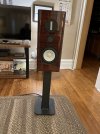
So far I have to say I'm quite pleased with the horizontal dispersion of the BMR Monitors, I can still hear 'music' off to the side quite a ways away.

I'm not thrilled with the black speaker covers though, I would buy grey ones if they were OEM but I think I might have to DIY a pair.
Do you know how much grief I took when I photographed the BMR's with the grills on, and they came out looking grey? So many emails assuring people they were really black. I kind of like the contrast of grey as well, but I think we're a minority opinion.
 
Curiosity got the better of me so I did the comparison of RAAL vs OW1 as described in post #290. So the OW1 was about 6 inches above the RAAL, and WOW1 speaker tilted down slightly so that I was listening to the OW1 axis about 10' away. Playing pink noise high-passed at 4KHz and gain compensated so they both played at the same level.

I was very surprised; they sounded very different. The OW1 sounded like it had much more very high freq content, and also gave me the sensation that two frequency bands were playing, as if there were a dip between (could just be how my brain processed having more high-end energy?). The RAAL sounded like a single continuous band of noise with less high end compared to the OW1.

This is opposite of the previous impression I have had of the speakers. The BMR with the RAAL I have felt has more sparkle. But this plays in a larger room than the OW1, so that probably has something to do with it.

On dispersion, horizontally they both seem to go all the way to about 90 degrees, just moving around and listening with my ears. But vertically the RAAL falls off fast off axis, of course.

Here are moving microphone measurements, about a one foot box at the listening position. This is with the compensation for pink noise slope, so flat horizontal would be the ideal anechoic.

As for RAAL magic, I have no idea. I think I must just be hearing spectral difference more than I would expect to notice.

View attachment 206258

A question for the community:

To my ears, no speakers I've ever heard are able to reproduce the sound of percussion -- drum sticks hitting cymbals, or clapping hands, or snapping fingers -- with enough realism that you could close your eyes and really imagine you were hearing the live musician in your room. For vocals, guitar, strings, or horns, yes, speakers can transport me there. But hit two drum sticks against each other, and the illusion is gone.

I wonder: is it lost in the recording, or in the speakers, or somewhere else?

Does anyone own speakers that reproduce those sounds like a live performance, real enough that it really sounds like it's in your room? What recording, what speakers?

Why I ask: I wonder if the ribbon tweeters I've heard sound more realistic than domes for those percussive sounds, maybe because of the overtones. But I've never ABX tested, and I don't trust my listening memory.
 
Maybe something is lost at the microphone? Maybe speakers don't produce enough instantaneous SPL (need more than you think)?
If he's talking about the 'tha-ck tha-ck' sound of wood,I would hazard it's probably because the sound generation continues in the wood past the initial peak and the gain required to capture all of that would require a very large dynamic range to encompass and a noticeably high noise floor from the intense gain. So unless you're dedicating a mic to that sound and then spending time trying to clean it up out of the rest of the mix by doing signal differential stuff from the other mics, you'd end up with an unusable recording (at least in the raw form).

I don't think the sound difference with snaps or claps is caused by the same acoustic phenomena, but the recording process would be similarly hampered I think since capturing extreme data points tends to always capture more noise and is usually more technically difficult across board.
 
A question for the community:

To my ears, no speakers I've ever heard are able to reproduce the sound of percussion -- drum sticks hitting cymbals, or clapping hands, or snapping fingers -- with enough realism that you could close your eyes and really imagine you were hearing the live musician in your room. For vocals, guitar, strings, or horns, yes, speakers can transport me there. But hit two drum sticks against each other, and the illusion is gone.

I wonder: is it lost in the recording, or in the speakers, or somewhere else?

Does anyone own speakers that reproduce those sounds like a live performance, real enough that it really sounds like it's in your room? What recording, what speakers?

Why I ask: I wonder if the ribbon tweeters I've heard sound more realistic than domes for those percussive sounds, maybe because of the overtones. But I've never ABX tested, and I don't trust my listening memory.

It's a combo of how the sounds are mixed and our expectations of what real is and how we think things are supposed to sound. I think the idea of wanting to achieve "musician in the room" is a little backwards. Most acoustic instruments sound pretty bad in the room and what we often think of being the "real pure sound" is usually processed. For drums, you don't want the sound of being there because it sucks usually, it's really unbalanced, cymbals are loud as hell, kick and snare sounds nothing like what it does through the mics or mixed. Convolution verb is a good way to make a recording have convincing space that sounds "in the room".

My two way floor standers with a soft dome tweeter offer some very convincing realism so I don't know if a different tweeter or material is going to give you that. I think a lot of this is mental, some days my speakers sound just ok, other days I'm shocked at their "realism".
 
If he's talking about the 'tha-ck tha-ck' sound of wood,I would hazard it's probably because the sound generation continues in the wood past the initial peak and the gain required to capture all of that would require a very large dynamic range to encompass and a noticeably high noise floor from the intense gain. So unless you're dedicating a mic to that sound and then spending time trying to clean it up out of the rest of the mix by doing signal differential stuff from the other mics, you'd end up with an unusable recording (at least in the raw form).

I don't think the sound difference with snaps or claps is caused by the same acoustic phenomena, but the recording process would be similarly hampered I think since capturing extreme data points tends to always capture more noise and is usually more technically difficult across board.
Thanks! This is really interesting and makes sense. At least part of it is in the recording and mix.
 
My guess is you're a percussionist. In your head you hear a certain sound when playing and you're not experiencing the same exact sound on speakers. If you were a vocalist or a horn player you would feel the same way about these sounds on a speaker. Musicians are the hardest group to please with a speaker system until they understand that a great sounding speaker is good enough and it's not going to sound exactly like being on the drum set.

Most music is delivered via speaker amplification. The audience (non-musicians) think it sounds great but the musician playing will rarely think it sounds identical to them playing acoustically.

Personally, I think "Track 5 - Drum Solo" from "The Link Alive - Gojira" sounds amazing on the Revel F328Be. :D
It's true, most music is delivered through inexpensive speaker amplification. A good home amp and speakers can easily do better than the typical music venue.

When I go for live shows, it's the percussion that always sounds so different to my ears.

Thanks for the drum solo recommendation! I'll play that track.
 
I'd be interested in recording a few things, processing the takes differently, and asking people here which sounds the best and or the most natural to them. Would be interesting to see the results.
 
It's true, most music is delivered through inexpensive speaker amplification. A good home amp and speakers can easily do better than the typical music venue.

When I go for live shows, it's the percussion that always sounds so different to my ears.

Thanks for the drum solo recommendation! I'll play that track.
That drum solo sounds great! It makes me think domes aren't so bad on drums that are recorded well.
 
An interesting short and sweet review.
I think an important note to make is that Dennis, as I understand, isn't designing for high output. I've seen him mention on occasion, a Decibel Nightmare. ;)
I know that when I turn it up, I am usually not pushing above 80dB peaks: I usually listen at -10dB on my Marantz, depending on how hot the source may be. On occasion, when I am watching a movie instead of listening to Music, I will push the system at near-reference level. I can't say that I've ever identified a point where I felt the Speakers are not handling things well at those levels.
My BMRs are the ca. 2018 version as reviewed by J Larson on AH, not the OG pair originally reviewed by Erin, nor the newer version just reviewed above. I also have the Phil3s in my system as of May 2019. For 6 months, the BMR Monitors were my mains.
FWIW, when endeavoring to make recommendations, I always find it worthwhile to ask about the users SPL preferences. As we all know, Speaker design is a matter of tradeoffs and finding the perfect pair is nigh on impossible. Extreme SPL is not the goal with the BMRs.
That said, I have never felt myself in want of anything more with any of my gear from Dennis.
 
Erin's original reviewed BMR used the same paper woofer as in past years. Only recently did Dennis change that. He didn't see the compression back then:

Philharmonic%20BMR_Compression_Normalized.png


It's also not evident in the tweeter by 98 dB. The BMR was one of the higher output speakers he tested. Wonder what happened?
 
The SB woofer allows for slightly higher sensitivity and 2nd order cross to the mid, iirc.
The old scan speak classic woofer is nice and performs quite well.
The newer design is supposed to also be taking advantage of the modified 64-10X Raal as opposed to the original 64-10. Higher output and lower distortion is supposed to be the benefit of the newer Raal design.
 
I know what the graphs show, but I’ll just say in practical use I’ve never encountered any of these issues with the BMRs I have. Possibly I don’t listen as loud as I thought? And Dennis has stated numerous times these weren’t really design for home theater like output.
 
I know what the graphs show, but I’ll just say in practical use I’ve never encountered any of these issues with the BMRs I have. Possibly I don’t listen as loud as I thought? And Dennis has stated numerous times these weren’t really design for home theater like output.
I'd say 99.99% people do not listen at 85dB or above level. I tested one of the BMR harmonic distortion at 90 dB (OmniMic is accurate in dB reading) and I have to wear ear protection. In my Home theater, I usually listen at 65 dB with some scenes the volume would be higher. Before I actually use a dB measurement tool, I don't really know how loud I'm listening. When Dennis and I did the Capital Audio Show last November, he was demoing the Tower's super bass capability by turning the volume way up to shake the room. When we switch to regular track, we forgot to turn down to the normal volume, that instant, the Tower was driven by full power of the NC400 in the demo room. Every one was shocked because of the super loud volume and also the clean clarity of the sound. We immediately turn down the volume to "normal" to not shock everyone. That is to say for a very short instant (almost like a reflective thing), extremely loud volume can shock us to cause reflective action. The high output higher frequency is.....
 
I'd say 99.99% people do not listen at 85dB or above level.
Don't want to nitpick too much, but I'd bet that 99% of users of this speaker, which is a niche market already, will have material that exceeds 85 dB when their average SPL is around 75 dB. It's not going to be every day but they would encounter those levels.
 
Last edited:
Don't want to nitpick too much, but I'd bet that 99% of users of this speaker, which is a niche market, will have material that exceeds 85 or 90 dB when their average SPL is around 80 dB. It's not going to be every day but they would encounter those levels.
That's probably true. But as I read those graphs, the issue doesn't really show up until 102 dB. Frankly, I was surprised at how well the tweeter help up at super-90 dB levels, and I haven't encountered any audible distortion in the bass at what I consider uncomfortably loud levels. But I'm perfectly OK with a conclusion that the BMR monitors aren't extremely high output devices.
 
The comment regarding the 2-3KHz glare surprised me, esp where he comments in the written review that this would be a showstopper for him without EQ. I think guitar and female vocals sound amazing with these speakers, without EQ.

I also have not noticed anything sounding wrong around 500Hz where he suspects some kind of resonance.

Has anyone who has heard these had similar impression to what Erin describes?
 
Back
Top Bottom