• Welcome to ASR. There are many reviews of audio hardware and expert members to help answer your questions. Click here to have your audio equipment measured for free!

Introducing the Phono Cartridge Measurement Library

Compared to Technics 270C / Nag G28, and to a Goldring 2400. Maybe I was expecting a significant step up over the 270, but it wasn't, didn't seem to punch as hard. Loading was whatever the phone leads are plus the 220pF / 47K of my Yamaha phono stage. The caveat is of course my room/system. Elac DBR6.2 in a very odd shaped room.
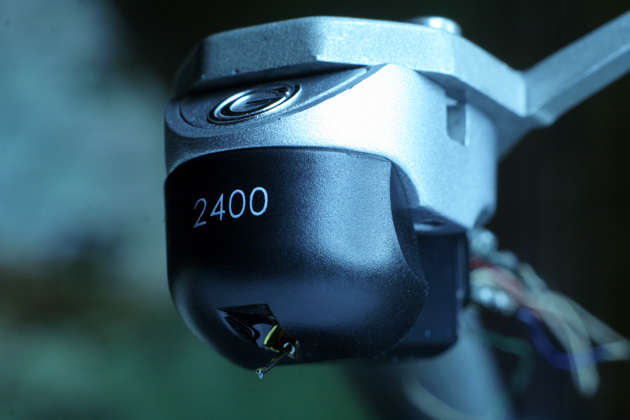
The Goldring might be a bit peaky and bright.

 
What controls were used for the comparisons?
None, I've got no measurement tools. I can only make subjective comparisons. All I could do is rotate the various carts I had using same recordings and either feel excited or underwhelmed!
 
There is no guarantee with the JICO SAS/B. It varies with models and stylii. Some work excellent, others don't.
Yes, that seems to be the case. Hence my reluctance to rush out and get one.
 
None, I've got no measurement tools. I can only make subjective comparisons. All I could do is rotate the various carts I had using same recordings and either feel excited or underwhelmed!

I assumed as much when you described it as punchy, which is a tell-tale for unmatched levels as it’s exceedingly rare to see a cart not have fairly even frequency response below 1k.
 
The Goldring might be a bit peaky and bright.

My hearing rolls off at 13kHz so that HF peak won't be obvious to my ears. Interesting review, I liked the 2400 but it wasn't worth the extra cost over the 270C for me.
Its possible that it's pointless investing in anything better specced as I simply won't benefit from it.
 
I assumed as much when you described it as punchy, which is a tell-tale for unmatched levels as it’s exceedingly rare to see a cart not have fairly even frequency response below 1k.
Yes, it's really difficult to make any comparison subjectively. I tried to vol match using a dB meter handheld but I suspect the uncertainty error was quite large.
 
My hearing rolls off at 13kHz so that HF peak won't be obvious to my ears. Interesting review, I liked the 2400 but it wasn't worth the extra cost over the 270C for me.
Its possible that it's pointless investing in anything better specced as I simply won't benefit from it.
It may well affect. Rolling off means you need higher SPL to hear it. If you have an EQ you could try + 5 vs 0 vs -5 dB at 13-14 kHz.
 
Yes, it's really difficult to make any comparison subjectively. I tried to vol match using a dB meter handheld but I suspect the uncertainty error was quite large.
With a volt meter and competent ADC you can put together a reasonably controlled comparison. Speed stability to the turntable matters a lot or you’ll get pops when you switch tracks, which is enough to cause false differences and tip off as to what is what. Measuring SPL isn’t anywhere near consistent enough.
 
I assumed as much when you described it as punchy, which is a tell-tale for unmatched levels as it’s exceedingly rare to see a cart not have fairly even frequency response below 1k.
Yes, it's really difficult to make any comparison subjectively. I tried to vol match using a dB meter handheld but I suspect the uncertainty error was pretty significant
 
Tbh, the challenge / fun part is trying to correlate the measurement data to what I remember hearing.
 
Skimmed through all 48 pages and couldn't reach a conclusion to the vexing question I have, that is whether the invest in a SAS Boron for the 270C, or stick a 540ML on and be done. I wasn't a fan of the 95ML, sounded dull in comparison in my system and room. I was also thinking about trying the 205 mk3 with an NOS 205ED3 stylus, but it's a risky investment. How did the 205CII-L with original Ti cantilever compare?
A cartridge "sounding dull" is more likely to be an issue that is resolvable via custom loading (or Digital EQ) than via needle change.

A needle change will alter the frequency response, but given we don't know the effective tip mass/cantilever resonance, the result is completely random

Same deal with swapping cartridges - every cartridge/needle combination, will need its own independent loading for optimal results..

If you keep the load static at 47k and whatever capacitive loading you have, you will effectively be randomly adjusting your frequency response by swapping cartridge and/or needle.
If you have the time and patience.... you can experiment with cartridge/needle combos until you find one that suits you, or alternatively pick one that has decent underlying performance parameters (good needle profile, alignment, low mass cantilever, output level of cartridge is a good match for your phono stage, etc...) - and then adjust the R and C to get better results.

Keep in mind, that unless your phono stage is designed for varying the R&C, R can only be lowered (by putting additional R in parallel with the existing R, using double adapters and R plugs), and C can only be raised (longer cables can easily do that!)

I have had cartridges running with R=27k to R=80k, and C values ranging from 60pf to 700pf

 
A cartridge "sounding dull" is more likely to be an issue that is resolvable via custom loading (or Digital EQ) than via needle change.

A needle change will alter the frequency response, but given we don't know the effective tip mass/cantilever resonance, the result is completely random

Same deal with swapping cartridges - every cartridge/needle combination, will need its own independent loading for optimal results..

If you keep the load static at 47k and whatever capacitive loading you have, you will effectively be randomly adjusting your frequency response by swapping cartridge and/or needle.
If you have the time and patience.... you can experiment with cartridge/needle combos until you find one that suits you, or alternatively pick one that has decent underlying performance parameters (good needle profile, alignment, low mass cantilever, output level of cartridge is a good match for your phono stage, etc...) - and then adjust the R and C to get better results.

Keep in mind, that unless your phono stage is designed for varying the R&C, R can only be lowered (by putting additional R in parallel with the existing R, using double adapters and R plugs), and C can only be raised (longer cables can easily do that!)

I have had cartridges running with R=27k to R=80k, and C values ranging from 60pf to 700pf
Agreed, and therein lies the challenge. I can't practically alter the load, and you're right, it's something of a lottery. However, info such as this thread help make it less of a roll of a dice. The plots from the 95ML are consistent with what I was hearing compared to the plots of the Technics. Perhaps dull is not the right adjective, but the outcome was I preferred to listen to the original technics cart.
 
Actually, the question I posed earlier is what can we deduce from this database such that we can make informed choices and less random choices based on subjective reviews. For me, I'm interested in better understanding of whether the AT 540ML performs better than my technics 270C? I can see from the measurements of the unflat HF response of the 95ML explain why I might have described it the way I did.
It also seems that the Shure V15 with a Jico boron works very well too.

The electrical load is 47k and estimated 320pF (220 for the amp, plus 100 for the cables). The VTA might not be correct for the 540ML if the bodies are different heights, and there is no VTA adjustment on my arm so that might be factor, but it can be overcome.
 
if you can ...try a significantly lower capacitance value on the amplifier side like 100pf or less... ;-)
 
if you can ...try a significantly lower capacitance value on the amplifier side like 100pf or less... ;-)
Without investing in a separate phone amp and cutting the leads to a short length, that's not possible. It's not a financial investment I want to make anyway. I have thought about carts that are designed to work into higher capacitance loading, e.g. Shure M95, ortofon black.
 
the modification in your current amplifier (?) may not be difficult, or even really simple...
,-)
 
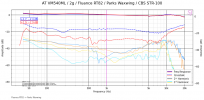
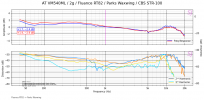
AT VM540ML
VM540ML final 3.png

Notes
  • Cartridge: Audio-Technica AT VM540ML
  • Stylus condition <5 hrs on vinyl
  • Test record: CBS STR100 issue 3
  • Turntable: Fluance RT82 Stock
  • Tracking force: 2g
  • Phono stage and ADC: Parks Waxwing
  • Capacitance- 90pf for stock Fluance cables (credit to USER), Waxwing likely has 47pF
  • Purchased as it was on sale and I was impressed by the measurements others have made
 

Attachments

  • VM540ML final 1.png
    VM540ML final 1.png
    75.5 KB · Views: 224
  • VM540ML final 2.png
    VM540ML final 2.png
    74 KB · Views: 256
Last edited:
AT VM540ML
View attachment 355768

Notes
  • Cartridge: Audio-Technica AT VM540ML
  • Stylus condition <5 hrs on vinyl
  • Test record: CBS STR100 issue 3
  • Turntable: Fluance RT82 Stock
  • Tracking force: 2g
  • Phono stage and ADC: Parks Waxwing
  • Capacitance- 90pf for stock Fluance cables (credit to USER), Waxwing has unknown capacitance
  • Purchased as it was on sale and I was impressed by the measurements others have made
I am wondering how you are getting such a relatively flat response!

It looks more like what I would expect loaded at 36K, or from a VM95ML.
 
I am wondering how you are getting such a relatively flat response!

It looks more like what I would expect loaded at 36K, or from a VM95ML.
I don't think its any better then what others have posted, it looks really good zoomed out but once you zoom in on chart type 3 (I think its 3) it shows the pretty typical AT house curve
 
I don't think its any better then what others have posted, it looks really good zoomed out but once you zoom in on chart type 3 (I think its 3) it shows the pretty typical AT house curve
My 740ML shows a much more pronounced rise at 10k. I wonder if there's just more capacitance that I thought:


Audio-Technica VM740ML_2.0 g_~100 pF _47k Ω_STR-100_norm1_1.png
 
Back
Top Bottom