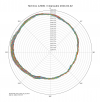
Is it really that common for the nominal f, if stated as 3150, not to be 3150 but some significantly different f??My point is that it doesn't help if the f that's on the test record isn't what it's advertised to be, which is often the case. Within reason this is never an issue unless someone what's to plot a very high number of revolutions which seems a bit pointless.
I've tested the Stroboscope Engineer android app.the good old stroboscope, even a 300hz one, is good for adjusting the speed when it is possible ;-)
The Strobily app seems even better. And indicates my TT runs at a very stable and accurate 33⅓ RPMI've tested the Stroboscope Engineer android app.
Seems to work ok, and seems to indicate my Dual Golden 1 runs true.
It has a "calibrate" facility that checks for "latency".
Is it really that common for the nominal f, if stated as 3150, not to be 3150 but some significantly different f??
How large a deviation should one expect?
P. S. It might not be pointless to plot two revolutions from widely separated times.
Just musing: 4 Hz is about 1.3 ‰ at 3khz, which should be about the same as a drift of 3-4 strobe lines per minute, at 50hz.As the software doesn't support doing elapsed-time groups, you'd be looking at a manual process to try to align those plots regardless.
My best test record is 4Hz off, and the speed accuracy of my 'table is quite high being PLL with a modern clock source. You can't infer both, so you need to assume one is correct. The is just shifting the error from one cause to another.
I use NAK T-100 software to help me center record before making a polar plot. Easy to see immediate effect of different centeringI’ve got to reem it out the center. It’s has 0 play in it.
What is your process for this? Trial & Error? I messed around trying to center a test record last weekend without much success.I use NAK T-100 software to help me center record before making a polar plot. Easy to see immediate effect of different centering