• Welcome to ASR. There are many reviews of audio hardware and expert members to help answer your questions. Click here to have your audio equipment measured for free!

Do power conditioners matter?

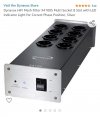
What about something like this?

Would a filtered power socket like this make sense for a living room setup with TV, Router, gaming console next to amplifier, DAC etc?

I'm not talking about improving sound quality etc.
But who knows what noise a gaming console might add.

IMG_20220501_143259.jpg
 
I have a buzzing transformer in my subwoofer (class AB) so I thought I'd see if it was a DC in the AC issue. I bought off Amazon an Audiolabs DC Blocker to try, knowing that if it didn't work, I could send it back. Tried it this morning and it did absolutely nothing for my buzzing transformer in the sub, so it's currently heading it's way back. I quickly tried it on some of my other amps too to see if it would make any difference to them, as it claims to also be a power conditioner. I have a Denon 3700H receiver (class AB) and a Primare i35 Prisma amp (class D) and it did absolutely nothing that I could detect.
All this probably means my electricity is fairly clean, the rest of the audio stuff is working great and there's no issues in my house.
But it also means that tomorrow I'll be taking the amp plate out of the sub to investigate and fix the problem.
 
I have a buzzing transformer in my subwoofer (class AB) so I thought I'd see if it was a DC in the AC issue. I bought off Amazon an Audiolabs DC Blocker to try, knowing that if it didn't work, I could send it back. Tried it this morning and it did absolutely nothing for my buzzing transformer in the sub, so it's currently heading it's way back. I quickly tried it on some of my other amps too to see if it would make any difference to them, as it claims to also be a power conditioner. I have a Denon 3700H receiver (class AB) and a Primare i35 Prisma amp (class D) and it did absolutely nothing that I could detect.
All this probably means my electricity is fairly clean, the rest of the audio stuff is working great and there's no issues in my house.
But it also means that tomorrow I'll be taking the amp plate out of the sub to investigate and fix the problem.
Quess these things can't so anything if a transformer inside a amplifier is the issue.

But I'm still wondering if there might be a benefit for TVs, gaming consoles, led lights when they share one Power-Strip with a hifi setup
 
Quess these things can't so anything if a transformer inside a amplifier is the issue.

But I'm still wondering if there might be a benefit for TVs, gaming consoles, led lights when they share one Power-Strip with a hifi setup
Often the DC in the AC is a thing with transformers humming and is sometimes cured by one of these DC blockers. Unfortunately it's not the problem I have.
My different amps are all connected to different devices. For instance my TV is connected to my receiver and my stereo amp is powering my front left and right in all uses, which is also the device I stream audio through. I've got a Blu Ray player that I also use as a CD transport. I've also got LED lighting in the same room and some from the same mains outlets as the audio equipment. I don't have a games console though. The DC blocker/conditioner did nothing for my audio that I could hear no matter what it was connected to.
Just my house and gear though. I know there's other people who have issues that swear by these things, but just didn't work for me.
You could do what I did and order one from Amazon and try it and if it does nothing, send it back.
 
It may be possible that line conditioners might throttle high powered amplifiers, but they may allow a modestly powered amplifier to work well and provide surge protection.
 
What about something like this?

Would a filtered power socket like this make sense for a living room setup with TV, Router, gaming console next to amplifier, DAC etc?

I'm not talking about improving sound quality etc.
But who knows what noise a gaming console might add.

View attachment 203755

Unfortunately the product website doesn't give a lot of specifications. I would just consider this to be a fancy looking power strip, and would not have confidence in it's surge suppression or filtering capability. Maybe look at one of these APC units?
 
This is exactly the kind of response I was looking for! You made clear points and I believe you set the bar for others who are also wondering about power conditioners. Thank you so much!

When you say:

Would I put a line conditioner between the wall and my Parasound HCA-2200 II amplifier, with its two 1.2KVA transformers and 110,000 µf of power supply capacitors? Absolutely not! A line conditioner would impede the amplifier's power supply from doing it's job. (Pun intended)

Aren't the amplifier's power supply and transformers going to function normally anyway?

Does that mean worse performance? I have read about power line conditioners robbing systems of dynamics and punch. And yes, they are subjective terms....but people claim to have noticed differences before and after.

In theory anyway, wouldn't slightly cleaner power place less strain on the audio components, leading to maximum performance? So in other words, line conditioned power going in to an amplifier wouldn't have to be regulated as much by the power transformer. In audio, I guess they say the shortest path is the best. So in this case, we're trying our best for that...

I hope I made sense. :)

As Waxx has mentioned, anything between the wall outlet and a device needs to accommodate the peak current draw requirements of the device. In the case of my Parasound amplifier, it is designed to draw no more than 1,000 watts of AC, but its power supply features big and heavy transformers to store a reasonable amount of energy in their magnetic field. This energy storage helps provide smooth continuous power during transients related to amplifier operation or minor mains power instability. Electrically, a line conditioner will either a) provide no value at all or b) restrict current to the amplifier during demanding transient events (music); negatively effecting dynamics and punch. Put another way, a line conditioner is most likely to just "get in the way" of the amplifier performing properly - so worse performance.

In theory, mains power is clean. In reality, mains power is always contaminated with noise. Think of it this way, any properly designed piece of equipment sees "dirty" mains power as completely normal and within specifications. If your mains power regularly exhibits issues, such as surges (significant over voltage) or brownouts (significant under voltage), surge suppression (which you should always have for lighting protection, etc.) and line conditioning may be worth having. Otherwise, a line conditioner is a waste, so stick to the "shortest path is the best".

This may be a slightly controversial statement, but generally surges can cause damage, while brownouts do not. Excessive voltage is will likely to strain and/or damage components to the point of failure. Brownouts often result in a device stopping operation, but with a properly designed power supply, will not usually result in damaged. (However, there are exceptions to every rule.) When a brownout is observed and there is subsequent equipment damage, it is usual an associated surge with the brownout event that has caused the damage.

If audiophiles understood how switching power supplies operate and were truly concerned about "clean" AC mains power quality, they would not permit switching power supplies in their homes! But wait! There is audio equipment that use switching power supplies. In fact, a Class D amplifier is just a switching power supply. See how important "clean" AC is (not)?

Apologies if I am being repetitive. It's just power line conditioners are intended to solve specific observed or anticipated electrical problems and this whole topic vis-à-vis audio performance, gets me agitated. With normal AC mains, if a line conditioner improves audio system performance, that strongly indicates that there are defective/poorly designed power supply component(s) in the audio system.
 
It may be possible that line conditioners might throttle high powered amplifiers, but they may allow a modestly powered amplifier to work well and provide surge protection.

As mentioned in a previous post, please do not rely on line conditioners for surge suppression. While this article mentions UPS devices, it is equally applicable to line conditioners.
 
Does anyone here understand this character?


What is he measuring? What decibels are these? :)
 
Does anyone here understand this character?
Not sure, as haven't spent the time to watch it. Could we have a summary of the key aspects please?


JSmith
 
Not sure, as haven't spent the time to watch it. Could we have a summary of the key aspects please?


JSmith
So, the guy lists the measurement results and according to them the "noise" is -38 decibels, then -45, then -50 (or something like that) with different conditioners. He doesn't say if it's SPL, or ratio, nothing. Totally confusing if you ask me. Just watch it, it's fun. :)
 
I've read about the PS Audio P12 being ineffective on this site. I also watched the YouTube video with the PS Audio Noise Harvester not doing anything useful.

Power conditioners can be sold for hundreds of dollars or a lot more! Do these products actually clean your electricity?

And if so, which one actually works?
Every hospital I have ever worked in had/has power conditioners on the high tech equipment. If they don't work why do they have them. I know for a fact that that MRI equipment we have has to have one to maintain the warranty and service contract.
 
Every hospital I have ever worked in had/has power conditioners on the high tech equipment. If they don't work why do they have them. I know for a fact that that MRI equipment we have has to have one to maintain the warranty and service contract.
This is what happens when a power glitch or other defect occurs while operating a superconducting magnet:
Large magnets need to be protected against power loss, power glitches, shifts in the magnetic windings, coolant loss, and have protection to prevent electrocution in the case of failure or defect since the collapsing magnetic field leads to enormous electric fields. I'm not sure I would characterize these protection circuits as power conditioners. I worked in research labs with large magnets and was in the room during several magnet events, they are loud and dramatic due to the amount of energy that is released. I don't know much about hospital MRI but for sure they have a very dangerous magnet that needs some very well thought-out power delivery.
 
Every hospital I have ever worked in had/has power conditioners on the high tech equipment. If they don't work why do they have them. I know for a fact that that MRI equipment we have has to have one to maintain the warranty and service contract.
Are you talking power conditioner or UPS? Hospitals use both. If your house has a brown out nobody dies and your equipment will be fine. If you live somewhere where lightning is a problem than a surge protector might be handy. Otherwise power conditioning is useless. Why would even a few volts of noise make any difference when its riding on top of 120VAC which is what your PS sees as noise when its outputting DC. Yes the 340v pk to pk 60hz is noise. And RF is usually filtered out at the power input.

There are a few exceptions where a UPS/conditioner can help. If your one of these buy one from a real UPS manufacturer not one of the over priced audiophool ones from BSaudio or ZRo research..
 
Back
Top Bottom