I think, I assume Howard416 means this graph:Which transfer function graph do you mean? Please share a screenshot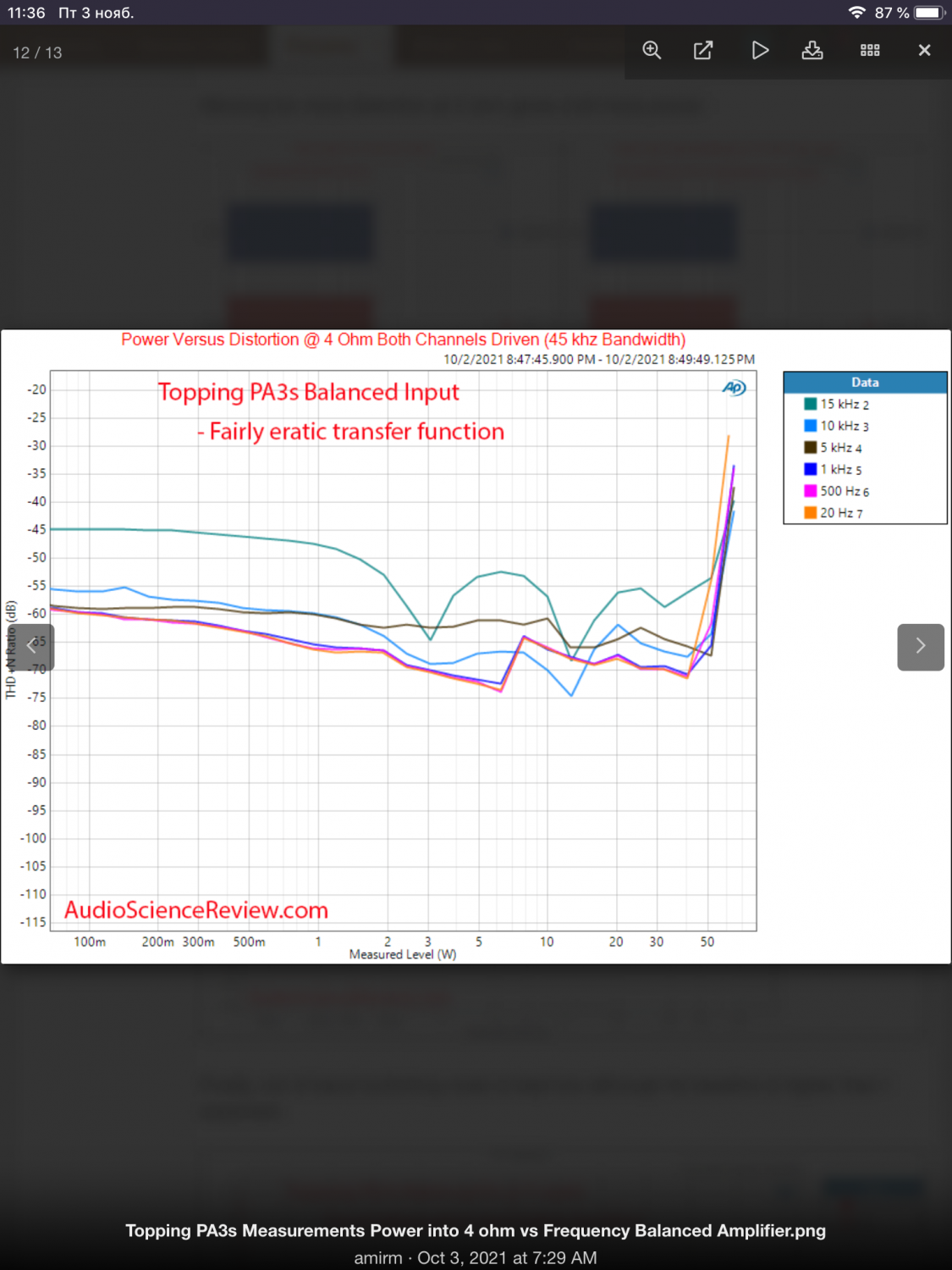

-
WANTED: Happy members who like to discuss audio and other topics related to our interest. Desire to learn and share knowledge of science required. There are many reviews of audio hardware and expert members to help answer your questions. Click here to have your audio equipment measured for free!
- Forums
- Audio, Audio, Audio!
- Amplifiers, Phono preamp, and Analog Audio Review
- Stereo and Multichannel Amplifier Reviews
You are using an out of date browser. It may not display this or other websites correctly.
You should upgrade or use an alternative browser.
You should upgrade or use an alternative browser.
Topping PA3s Review (Desktop Amplifier)
- Thread starter amirm
- Start date
@Music1969 Many music lovers and members of the forum are confused by this graph... Although I just can’t catch these distortions by ear. Compared to other amplifiers. Maybe the ears aren't the same anymore. I'm getting old.I'm just over 60 years old.
I rather compare this with other amps.@Music1969 Many music lovers and members of the forum are confused by this graph... Although I just can’t catch these distortions by ear. Compared to other amplifiers. Maybe the ears aren't the same anymore. I'm getting old.I'm just over 60 years old.
And I'm also 60+

Attachments
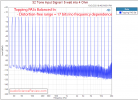
Yes it is not as clean as this one below but you have to pay more $ (this is the reliable model not the Discrete model with problems)@Music1969 Many music lovers and members of the forum are confused by this graph...
The one from the OP in this thread:Which transfer function graph do you mean? Please share a screenshot
Like, I would I have to go out of my way to find one that is worse.

Of course, distortion of signals above 10kHz is inaudible, since the first harmonic is already 20kHz.
You mean *harmonic* distortion of signals... is inaudible.Of course, distortion of signals above 10kHz is inaudible, since the first harmonic is already 20kHz.
correct, but being single frequency (at a time) test, that test pretty much only has harmonic distortion.You mean *harmonic* distortion of signals... is inaudible.
I understand. What doesn’t make sense to me is that in what seems to be every other case, an amp that does not test well in those sweeps does not do well in the multi tone. But this one does.correct, but being single frequency (at a time) test, that test pretty much only has harmonic distortion.
Not sure I've seen that - do you have a specific example?I understand. What doesn’t make sense to me is that in what seems to be every other case, an amp that does not test well in those sweeps does not do well in the multi tone. But this one does.
Hi all, I'm trying to use a PA3s in my car, and I'm wondering if I am okay to feed it DC 24V instead of the original PSU's 26V.
I can think of below 4 options if I do that. Could anyone give me an advice?
a. It will work normally with a slightly less(something like 24/26) peak output. No harm will be done to the amp.
b. It will work but it will damage the hardware.
c. Nothing happens. The amp wouldn't even turn on.
d. The amp will catch fire or explode.
For any other case than 'a', I'll have to buy a 220V AC inverter which I don't really want to..
I would appreciate your opinion very much. Thanks!
I can think of below 4 options if I do that. Could anyone give me an advice?
a. It will work normally with a slightly less(something like 24/26) peak output. No harm will be done to the amp.
b. It will work but it will damage the hardware.
c. Nothing happens. The amp wouldn't even turn on.
d. The amp will catch fire or explode.
For any other case than 'a', I'll have to buy a 220V AC inverter which I don't really want to..
I would appreciate your opinion very much. Thanks!

restorer-john
Grand Contributor
Hi all, I'm trying to use a PA3s in my car, and I'm wondering if I am okay to feed it DC 24V instead of the original PSU's 26V.
I can think of below 4 options if I do that. Could anyone give me an advice?
a. It will work normally with a slightly less(something like 24/26) peak output. No harm will be done to the amp.
b. It will work but it will damage the hardware.
c. Nothing happens. The amp wouldn't even turn on.
d. The amp will catch fire or explode.
For any other case than 'a', I'll have to buy a 220V AC inverter which I don't really want to..
I would appreciate your opinion very much. Thanks!
Your car has a 24V outlet/supply?

Is your car's battery voltage 24V?Hi all, I'm trying to use a PA3s in my car, and I'm wondering if I am okay to feed it DC 24V instead of the original PSU's 26V.
I can think of below 4 options if I do that. Could anyone give me an advice?
a. It will work normally with a slightly less(something like 24/26) peak output. No harm will be done to the amp.
b. It will work but it will damage the hardware.
c. Nothing happens. The amp wouldn't even turn on.
d. The amp will catch fire or explode.
For any other case than 'a', I'll have to buy a 220V AC inverter which I don't really want to..
I would appreciate your opinion very much. Thanks!
The PA3s power supply voltage can be used up to 26V, but as the engine speed increases, the battery terminal voltage may exceed 27V.
Well, I don't think the amplifier will be damaged, but please check the rise in terminal voltage with a voltmeter.
Also, be sure to connect the amplifier's power source directly from the battery terminal. Otherwise you will suffer from generator noise.
My full expectation would be a, with aprox 0.7dB lower output.Hi all, I'm trying to use a PA3s in my car, and I'm wondering if I am okay to feed it DC 24V instead of the original PSU's 26V.
I can think of below 4 options if I do that. Could anyone give me an advice?
a. It will work normally with a slightly less(something like 24/26) peak output. No harm will be done to the amp.
b. It will work but it will damage the hardware.
c. Nothing happens. The amp wouldn't even turn on.
d. The amp will catch fire or explode.
For any other case than 'a', I'll have to buy a 220V AC inverter which I don't really want to..
I would appreciate your opinion very much. Thanks!
If it were mine, I'd be sufficiently confident to just do it - while accepting the very small risk I am wrong.
I can't see any way b or d would happen.
EDIT - and taking note of @Toku s warning - the main chip has an absolute maximum rating of 27.5V beyond which it can be permanently damaged. You need to be sure that voltage is never exceeded - including from surge/transient conditions.
Last edited:
No, it has only 12V. But I can easily find a laptop charger that can be connected to a cigarette lighter jack. The problem is, they only support up to 24V - couldn't find anything higher.Your car has a 24V outlet/supply?
Of course there are inverters that can provide 220V AC, but they are bulky, more expensive and unreliable. By unreliable I mean the safety shut down would trip too often even if I connected a very small load from my past experience. The rating of the inverter was 300'W'(should be specified as VA, already wrong there) but it couldn't even take the transient power-on current of a 30W AB class amplifier.
Thanks for your reply. It's 12V and I explained further in my response to restorer-john just above.Is your car's battery voltage 24V?
The PA3s power supply voltage can be used up to 26V, but as the engine speed increases, the battery terminal voltage may exceed 27V.
Well, I don't think the amplifier will be damaged, but please check the rise in terminal voltage with a voltmeter.
Also, be sure to connect the amplifier's power source directly from the battery terminal. Otherwise you will suffer from generator noise.
"No, it has only 12V. But I can easily find a laptop charger that can be connected to a cigarette lighter jack. The problem is, they only support up to 24V - couldn't find anything higher."
So I'm trying to use the 12V cigarette jack in my car for the power source. Since it's (probably) not directly connected to the generator or battery itself, my guess is I wouldn't have to worry about the voltage fluctuation or generator noise you mentioned. May I ask your opinion about this?
I appreciate your opinion. The risk seems very small, so I'll just do it this weekend and let you guys know how it went.My full expectation would be a, with aprox 0.7dB lower output.
If it were mine, I'd be sufficiently confident to just do it - while accepting the very small risk I am wrong.
I can't see any way b or d would happen.
EDIT - and taking note of @Toku s warning - the main chip has an absolute maximum rating of 27.5V beyond which it can be permanently damaged. You need to be sure that voltage is never exceeded - including from surge/transient conditions.
Basically what I'm trying to do is using home audio speakers in my car. I used to put a pair of Celestion KR8(not exactly 'home' speakers though..) 8 inch woofer speakers on the back seat of my compact SUV, and I connected them to a small SMSL D class amp. The amp required 12V DC, so it was easy to get power from a cigar jack laptop adapter. I liked the result - quite better than the original car stereo(Bose or something).
Ah. the music source was just my Android phone's 3.5mm analog output.
Now KR8's are gone, and I'd like to put Polk R200's on the folded back of the rear seat this time, expecting a better quality. The problem is I need more amp power since the sensitivity of KR8 was much higher(9dB, at least according to the spec) than R200. With the old SMSL amp, even the full volume is far from being enough. That is why I want to use a PA3s instead.
I'll try to be careful about exceeding voltage. Thanks again and have a great day.
Similar threads

- Replies
- 1K
- Views
- 174K
- Replies
- 354
- Views
- 72K

- Replies
- 519
- Views
- 110K
- Replies
- 776
- Views
- 130K
- Poll
- Replies
- 146
- Views
- 24K