• Welcome to ASR. There are many reviews of audio hardware and expert members to help answer your questions. Click here to have your audio equipment measured for free!

Genelec GLM Review (Room EQ & Setup)

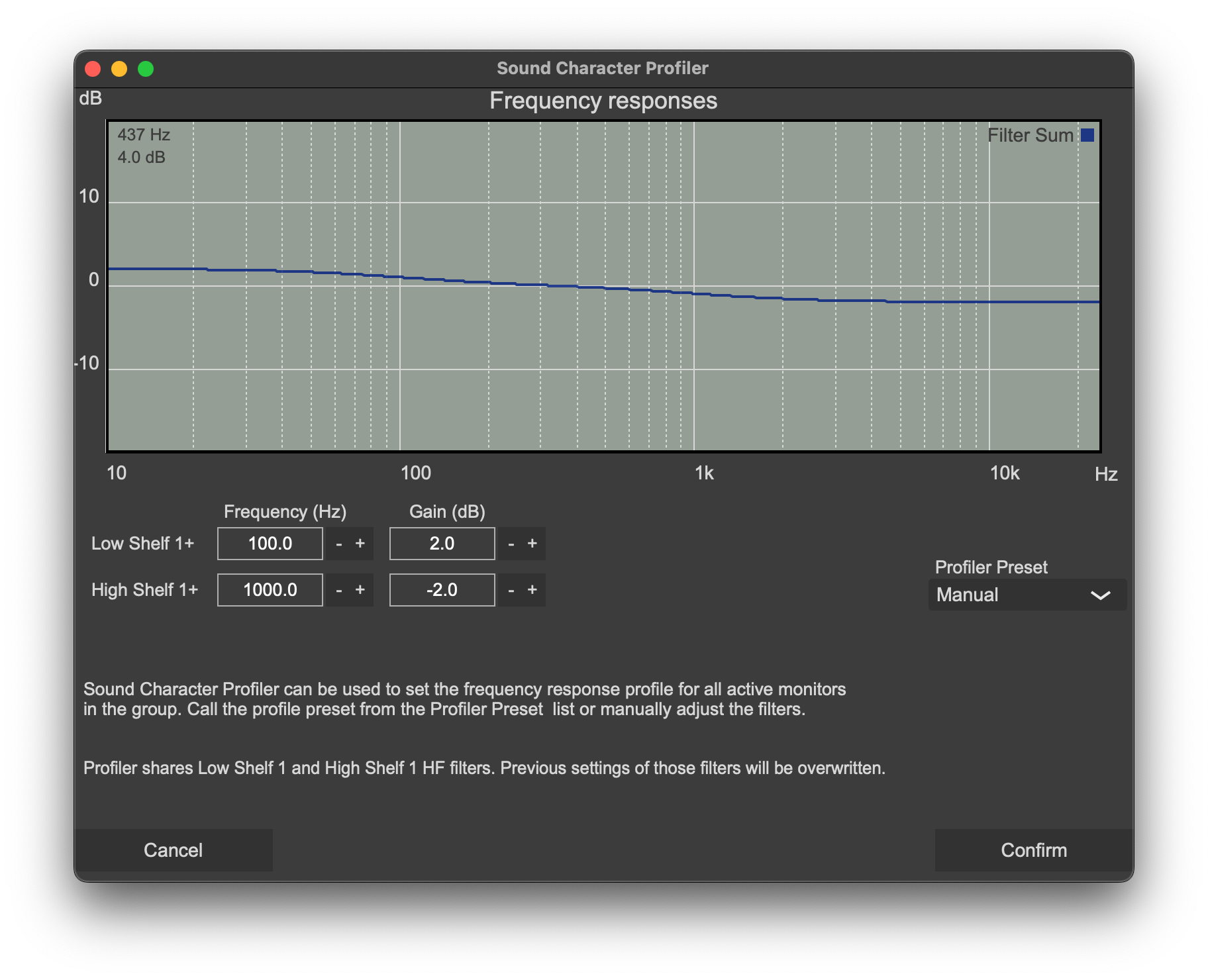
I would like to try a even downward slope too, using GLM. The GLM Sound Character Profiler has one low shelf and one high shelf filter (unknown Q?), and there are 2 low and 2 high shelf filters (plus 16 notch filters) for each speaker separately. I tried this (I don't really know what I am doing :))
1671371401777.png
 
I would like to try a even downward slope too, using GLM. The GLM Sound Character Profiler has one low shelf and one high shelf filter (unknown Q?), and there are 2 low and 2 high shelf filters (plus 16 notch filters) for each speaker separately. I tried this (I don't really know what I am doing :))
View attachment 250813
Try to find out what the Q is for those filters, then if it's close to Q0.5 for the High Shelf Filter in GLM then you could try what I suggested, as long as the two High Shelf Filters for each speaker are also able to input Q0.5, then you can combine the GLM High Shelf with the two High Shelf's for each speaker. (as long as your GLM is feeding all your speakers, I don't know much about GLM)
 
  • Like
Reactions: mkt
Try to find out what the Q is for those filters, then if it's close to Q0.5 for the High Shelf Filter in GLM then you could try what I suggested, as long as the two High Shelf Filters for each speaker are also able to input Q0.5, then you can combine the GLM High Shelf with the two High Shelf's for each speaker. (as long as your GLM is feeding all your speakers, I don't know much about GLM)

There are no Q factor for the shelf filters in GLM, and only filters (shelf or otherwise) with a plus-sign can have a positive gain.
 
There are no Q factor for the shelf filters in GLM, and only filters (shelf or otherwise) with a plus-sign can have a positive gain.
Yes, which is why I said to try to find out what the Q factor is for those filters in GLM. And of course plus-sign = positive gain, I didn't realise we were doing Math class? o_O;)
 
Yes, which is why I said to try to find out what the Q factor is for those filters in GLM. And of course plus-sign = positive gain, I didn't realise we were doing Math class? o_O;)
Yes you’re right. Time to email Genelec about that.

What he meant is some filters do not allow positive gain at all. That only ones which have a + sign in GLM allow to add gain.
 
Yes you’re right. Time to email Genelec about that.

What he meant is some filters do not allow positive gain at all. That only ones which have a + sign in GLM allow to add gain.
Ha, ok, GLM sounds pretty limiting on that customisation basis then! No, but still you can add the 3 High Shelf Filters I talked about into software parametric equalisation at your playback source if all else fails - so EqualiserAPO on PC or in any music player that allows parametric EQ. (Which of course you can apply on top of your GLM or any other EQ that you do using any other device/system).
 
I kind of like some limitations with GLM and the genelec eco system. That way I've found that I listen to more music/films rather than tinkering. I love both though but the latter too much for my own good. :)
 
Ha, ok, GLM sounds pretty limiting on that customisation basis then! No, but still you can add the 3 High Shelf Filters I talked about into software parametric equalisation at your playback source if all else fails - so EqualiserAPO on PC or in any music player that allows parametric EQ. (Which of course you can apply on top of your GLM or any other EQ that you do using any other device/system).
Yes equalizer apo is the way to go for Windows source.

GLM is quite limiting actually even more after you add a w371. It does not allow anything but the sound character profiler shelves and 4 negative only notches. No positive gain allowed anywhere except +3dB maximum in the low or high shelf within sound character profiler.
 
I kind of like some limitations with GLM and the genelec eco system. That way I've found that I listen to more music/films rather than tinkering. I love both though but the latter too much for my own good. :)
Limitations are not what prevent tinkering. It’s your ears and what’s between them that does that.

Not being able to create a proper tone curve is not a good limitation to have.

I’m happy with what SCP allows thanks to my ears and what is between them. However SCP needs to either be less limited or offer better curve presets at least.

You just set it and forget it anyway but it should allow some tuning that has some basis in psychoacoustics or human hearing/preference curves.

The reason is the product is for professionals who produce on flat response. They know audiophiles are buying their product it’s even in the survey to download GLM. So SCP is the bone they threw us. It’s not a very good bone.
 
Last edited:
Yes equalizer apo is the way to go for Windows source.

GLM is quite limiting actually even more after you add a w371. It does not allow anything but the sound character profiler shelves and 4 negative only notches. No positive gain allowed anywhere except +3dB maximum in the low or high shelf within sound character profiler.
Fair do's yes. For folks out there, if you want to model all your EQ filters together to see what effect they're having then you'd want to use some kind of graphical EQ program like REW. It's very flexible, a bit daunting at first, but once you understand how everything fits together then you can model EQ effects from multiple sources so that you're not just wondering how those extra filters will effect your measured frequency response. It's totally flexible ("your imagination is the limit once you know the basics"), but beyond the scope of explaining how it works in this thread - just consider learning how to use it if you want to maximise your EQ & understanding thereof - for all the people reading out there (not specifically you @srrxr71)
 
Yes, which is why I said to try to find out what the Q factor is for those filters in GLM. And of course plus-sign = positive gain, I didn't realise we were doing Math class? o_O;)
The plus-sign is by the filter name and was added in an update by Genelec to indicate that that filter can have a positive gain. Only a few filters, if any, can have positive gain.
 
The plus-sign is by the filter name and was added in an update by Genelec to indicate that that filter can have a positive gain.
(Yes, it was already explained more than adequately by @srrxr71 )
 
Re: As a general rule, superbly built speakers are of no need of correction in higher frequencies other than overlaying a target curve which should to be taste.
Can you use a Schiit Loki to "overlay the target curve"? That is twiddle the knobs to get the best possible tasting music for you? It seems more scientific to, say, overlay a Harman curve, but does that get every individual to the best possible taste? Surely individual tastes are all different, just as there is a vast range for preferences for "curry heat" or "saltiness", etc., in food. So don't you have to end up twiddling knobs anyway, to get to your unique preferred taste? So why not just start and end by twiddling knobs and get a Schiit Loki rather than spending all this time, money, and brain power on advanced digital solutions? (OK, professional recording engineers need to do this, they need to know exactly when the curve is objectively flat or not. But I'm thinking of the average listener... why should they care if the curve's flat? Why would they want to know what the curve looks like, they just want the music to sound good...)

 
I don't own Genelec speakers nor know much about GLM, but they guy said "I wish I could make an even slope from bass down to treble", which sounds like he wants a Linear Tone Control, which you can achieve using 3 High Shelf Filters together, the ones I mentioned. Perhaps there is an option in GLM to enter those 3 High Shelf Filters or in whatever Playback Source he's using.

I might have to recalculate Genelec's filters in GLM, but yes, there are filters like that in the software. Just will depend on how much I can change them. (The old 82xx series speakers I have only have half the number of filters of the newer 83xx series.)
 
I might have to recalculate Genelec's filters in GLM, but yes, there are filters like that in the software. Just will depend on how much I can change them. (The old 82xx series speakers I have only have half the number of filters of the newer 83xx series.)
It might end up making best sense to apply those 3 High Shelf Filters at your source anyway, either in playback software or EqualiserAPO (depending on what your source is) - as it is an overall change to the tonal balance that you'd want to apply to all speakers at once anyway, so it's more "economical" to apply it right at your source rather than having to waste filters in each of your speakers or in GLM or whatever.
 
I might have to recalculate Genelec's filters in GLM, but yes, there are filters like that in the software. Just will depend on how much I can change them. (The old 82xx series speakers I have only have half the number of filters of the newer 83xx series.)
I don’t remember any calibration that used more than a few filters. There should be enough left even on the 8260.

You can mostly do whatever you want with notch filters but the shelves are limited.
 
Noob question- does speaker placement matter if I calibrate with GLM? e.g. if I place the speakers directly on (hard) floor, can I rely on GLM to fix most of the reflection issues?
 
Noob question- does speaker placement matter if I calibrate with GLM? e.g. if I place the speakers directly on (hard) floor, can I rely on GLM to fix most of the reflection issues?

You should place the monitors as best as you can before using GLM as some things cannot be fixed by any room EQ.
 
Noob question- does speaker placement matter if I calibrate with GLM? e.g. if I place the speakers directly on (hard) floor, can I rely on GLM to fix most of the reflection issues?

Placement absolutely matters, and so does treating first reflection points.
Reflections can't be compensated with GLM or any other DSP / room correction SW.
Room correction isn't perfect, but can lessen problems in the bass area as they are standing waves (room resonances).

You would be looking for Beam Width Control - like in the Beolab 90 @ €100k for a pair.
You can check that out here in an interview with Bang & Olufsen's Tonmeister Geoff Martin.

 
Back
Top Bottom