
• Welcome to ASR. There are many reviews of audio hardware and expert members to help answer your questions. Click here to have your audio equipment measured for free!

"PureArtFi" LS-6 loudspeaker - is this on "our" radar?

mhardy6647

Grand Contributor
Forum Donor
Joined
Dec 12, 2019
Messages
17,476
Likes
40,093
Just saw mention and some positive feedback on this new (?) loudspeaker project, and wondering if anyone here knew of 'em and/or were paying any attention to this?
I did a quick keyword search here & didn't see anything, so I figured I'd take a chance and just ask.

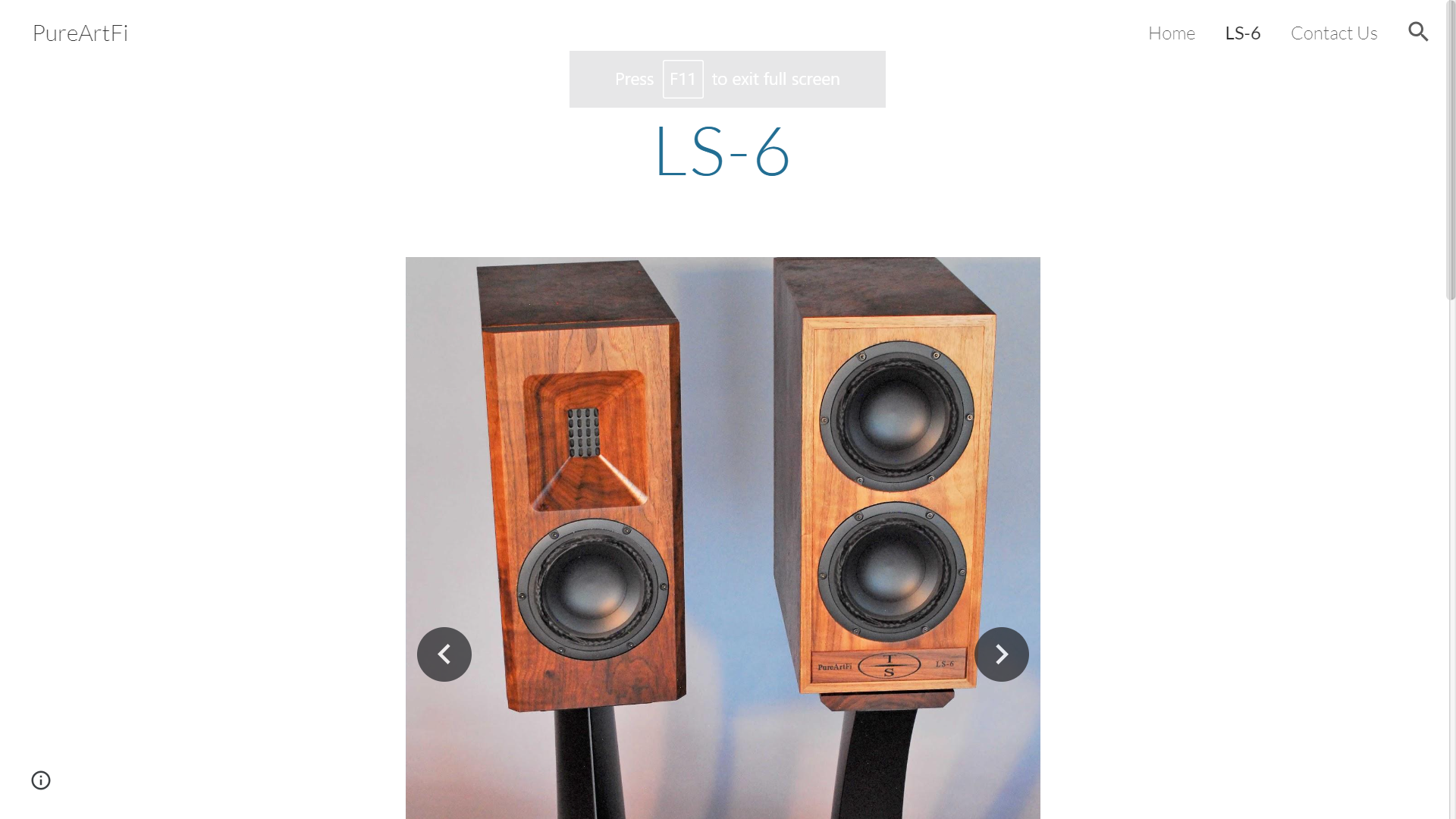
1695768643693.png


I ask mostly because of the names associated (or, at least dropped) with respect to the project:

In 2019 the dream team of Bruno Putzeys, Lars Risbo, and Peter Lyngdorf announced an audio company named Purifi. A team with such beyond reproaches credentials and history of successes in both the commercial and academic sides of the HiFi industry bears watching. They announced breakthroughs in understanding hysteresis distortion resulting from iron and steel components applicable to both Class-D amplifiers and loudspeaker drivers. This led to the introduction in 2020 of the first Purifi woofers touted to “crack the extended-stroke code”. The “code” referenced is the fact known to loudspeaker engineers and advanced audiophiles that despite appearing on paper to have identical air moving capabilities in use traditional 12” and 15” short stroke woofers sounded better than 7” class long stroke woofers. The design and use case dilemma this created is that bass systems using 12 to 15 inch woofers require large refrigerator sized enclosures. Such mammoth boxes are welcomed, even celebrated, in dedicated single purpose listening rooms and home theaters. In more typical multi use spaces such outsized boxes are rejected as out of balance for harmonious living spaces. The “extended-stroke code” Purifi cracked is the complexly interrelated factors that kept long excursion drivers producing higher levels of inter-modulation distortion (IMD) when using their long stroke capability to make deep loud bass. In HiFi such claims of breakthrough are essentially a weekly occurrence. Given the credentials of the team at Purifi and their explanations of the multiple techniques brought to bear in early 2020 a shipment of first production PTT6.5 woofers and passive radiators were brought in for testing. From the first test boxes the results can be described as ‘gob smacked’ and ‘stunning’. The promised bass depth and volume is delivered, beyond that the reductions in distortions across the drivers’ entire operating range brings a clarity unique to the luxury woofer segment. For the next two years all our loudspeaker developments centered on extracting the maximum performance from this true break though driver.
 
Saw the speaker reviewed on New Record Day and clicked on it since the woofer was very recognizable. Then I realized the waveguide and the tweeter looked familiar too.

Did some research, the tweeter is from GR Research and the crossover from Danny himself.

That really makes me question NRD's choice to say "no money exchanged" and "my thoughts are my own" when Danny is at least a business partner in NRD's speaker endeavour, if not his friend. I don't know if NRD mentions it later in the review, I looked at the transcript and couldn't find anything with the search function, but it's possible that I missed it.

I stopped watching when I didn't see the conflict of interest mentioned in the very first minutes.
 
I mean yes no money exchanged sure, but having affiliation with people involved and maybe having listened to one of those drivers before, there could be some bias.

I think it's likely a reasonable speaker, but for the price it seems like you are paying for the making of that cabinet mostly. How much more inert would it be vs your standard Radiant/March/AsciLabs/Purifi etc is it worth that?
 
Watched New Record Day review and measurements, and my first thought was: how can the waveguided ribbon driver be so wide at the 5-6 kHz region? My theory is that the sharp edges of the waveguide behave like a separate small square cabinet around the tweeter, causing a diffraction effect. As a result, 3 kHz has a narrow directivity and 6 kHz has a wide directivity. Funny, that this is almost exactly a directivity pattern of a simple speaker without a waveguide at all, with uneven sound power response.
pure-horizontal.jpg

pure-vertical.jpg
 
Over tenthousand bucks without the stands. Regarding the fiew posted measurements and the available options (Ascilab, Radiant Acoustics, March Audio tec.) at about half the price or less it's a clear pass to me. And the involvement of Dany doesn't help to change my mind.
 
Watched New Record Day review and measurements, and my first thought was: how can the waveguided ribbon driver be so wide at the 5-6 kHz region? My theory is that the sharp edges of the waveguide behave like a separate small square cabinet around the tweeter, causing a diffraction effect. As a result, 3 kHz has a narrow directivity and 6 kHz has a wide directivity. Funny, that this is almost exactly a directivity pattern of a simple speaker without a waveguide at all, with uneven sound power response.
View attachment 522732
View attachment 522733
Most of Danny’s design exhibit this directivity including his upgrades. He gets good on-axis flatness, but seems to always create the ~5Khz peaking off axis.
 
Over tenthousand bucks without the stands. Regarding the fiew posted measurements and the available options (Ascilab, Radiant Acoustics, March Audio tec.) at about half the price or less it's a clear pass to me. And the involvement of Dany doesn't help to change my mind.

Quite the opposite on the latter sentence I’d think.
 
More than twice the price of March Audios, and the Clarity 6.1.

About three grand more expensive than Radiants new floorstander.

And four thousand more than March's new floorstander.

And that’s the cheapest version.

A big no, I’d say.

And £3000 for the stands???
 
Back
Top Bottom