Not sure what you are reffering to. Both 1.17VRMS and 1.56VRMS are in the linear behaviour rangeIf a dac is specified to work within it's linear range at a maximum level of somewhere under 2V you would be well aware of the restrictions put on it under normal operating conditions. Testing this device at close to clipping and insisting that the measurements are valid is the epitomy of arrogance. This has nothing to do with the fact that a preamp putting out a less than reasonable output level is an engineering decision that no one in his right mind would agree with.
Let's say Amir decides that not only does a dac need to be able to produce a randomly chosen voltage level no matter the effect on the measurements, he decides that all of the amplifiers he tests need to put out 100 watts/ch because almost all speakers need to have at least that much power according to him. Every amp he tests with less than 100W out seems to have measurements that are less than stellar, for some reason he can't exactly put his finger on. Should that be taken seriously?
Is this a good analogy or not?

-
WANTED: Happy members who like to discuss audio and other topics related to our interest. Desire to learn and share knowledge of science required. There are many reviews of audio hardware and expert members to help answer your questions. Click here to have your audio equipment measured for free!
- Forums
- Audio, Audio, Audio!
- Amplifiers, Phono preamp, and Analog Audio Review
- Stereo and Multichannel Amplifier Reviews
You are using an out of date browser. It may not display this or other websites correctly.
You should upgrade or use an alternative browser.
You should upgrade or use an alternative browser.
Cambridge Audio CXA81 Review (Sample 2)
- Thread starter amirm
- Start date

- Joined
- Jan 1, 2020
- Messages
- 1,363
- Likes
- 2,045
To err is to be human, we are a very fallible species. I can accept your reasoning that Amir may or has not been able to put his finger on inconsistencies in his measurements. Yes, as his target audience we should hold him accountable, but there is decorum that we must adhere to. He is allowed to resolve the inconsistency in his measurements and allowed a chance to rectify his mistakes. End of the day, we are getting a lot of information for free by an individual that is dedicating a lot of his personal resources and time to this hobby.If a dac is specified to work within it's linear range at a maximum level of somewhere under 2V you would be well aware of the restrictions put on it under normal operating conditions. Testing this device at close to clipping and insisting that the measurements are valid is the epitomy of arrogance. This has nothing to do with the fact that a preamp putting out a less than reasonable output level is an engineering decision that no one in his right mind would agree with.
Let's say Amir decides that not only does a dac need to be able to produce a randomly chosen voltage level no matter the effect on the measurements, he decides that all of the amplifiers he tests need to put out 100 watts/ch because almost all speakers need to have at least that much power according to him. Every amp he tests with less than 100W out seems to have measurements that are less than stellar, for some reason he can't exactly put his finger on. Should that be taken seriously?
Is this a good analogy or not?
formula 977
Active Member
- Joined
- Apr 8, 2022
- Messages
- 105
- Likes
- 88
You need to refer to the measurements in the original review.Not sure what you are reffering to. Both 1.17VRMS and 1.56VRMS are in the linear behaviour range
Ok, well he corrected this. How is this arrogance?You need to refer to the measurements in the original review.
formula 977
Active Member
- Joined
- Apr 8, 2022
- Messages
- 105
- Likes
- 88
As soon as it's agreed to not test equipment when it is driven into clipping and taking measurements proved to be invalid only then can we return to issues of decorum and making friends or talking about scheduled oil changes.To err is to be human, we are a very fallible species. I can accept your reasoning that Amir may or has not been able to put his finger on inconsistencies in his measurements. Yes, as his target audience we should hold him accountable, but there is decorum that we must adhere to. He is allowed to resolve the inconsistency in his measurements and allowed a chance to rectify his mistakes. End of the day, we are getting a lot of information for free by an individual that is dedicating a lot of his personal resources and time to this hobby.

I am not kidding you when I tell you that I just (2 minutes ago) wrote those two words at "Oil Change Intervals Objectively"....we return to issues of decorum and making friends or talking about scheduled oil changes.

OP

- Thread Starter
- #87
Sony and Philips set the standard for unbalanced output of CD players at 2 volts. More than 40 years later, are you seriously advocating that it should be wild west and anything goes as far as output of a digital device?If a dac is specified to work within it's linear range at a maximum level of somewhere under 2V you would be well aware of the restrictions put on it under normal operating conditions. Testing this device at close to clipping and insisting that the measurements are valid is the epitomy of arrogance.
Here are the specs from the manual:
Where are you seeing its limit as far as output voltage? What would you assume as a consumer it is? Some random value not subject to scrutiny?
Your point is out of order anyway as both in the original review and this one I showed the performance at wide range of outputs.
I will continue to test products at 2 volts. If you don't like it, tough. But keep your insults to yourself.
OP
- Thread Starter
- #88
Oh, so you really don't know this topic. Here is the service manual for first Sony CD player, CDP-101:Let's say Amir decides that not only does a dac need to be able to produce a randomly chosen voltage level no matter the effect on the measurements, he decides that all of the amplifiers he tests need to put out 100 watts/ch because almost all speakers need to have at least that much power according to him. Every amp he tests with less than 100W out seems to have measurements that are less than stellar, for some reason he can't exactly put his finger on. Should that be taken seriously?
You see how it clearly says it outputs 2 volts? That is from 1981. Still think I made this up?
Learn the topic first before shooting from the hip this way.
formula 977
Active Member
- Joined
- Apr 8, 2022
- Messages
- 105
- Likes
- 88
What insults? I'm not taking sides. If a manufacturer decides to cut corners by not buffering the output of their dac and simply sticking a resistor on the output to swing at CMOS levels either that is fine or measuring that same device at 2v is fine. It can't be both. You did not make measurements at 2V for the revised dac tests. I can't imagine what you could be talking about.I will continue to test products at 2 volts. If you don't like it, tough. But keep your insults to yourself.
formula 977
Active Member
- Joined
- Apr 8, 2022
- Messages
- 105
- Likes
- 88
I was thinking dip stick was 2 wordsI am not kidding you when I tell you that I just (2 minutes ago) wrote those two words at "Oil Change Intervals Objectively".
You have learned more than you bargained for today.I was thinking dip stick was 2 words
Congrats.

I think it’s very fair to point out as a negative that these targets are not met and criticise a product for it, But I don’t feel measuring the performance of a product past clipping is what most of us want to see measured.I also don’t think that such values are fully standardized as we may feel. In the end this is an integrated products and I’ve seen pre out at many levels, and nominal unbalanced line level is indeed lower. I am not saying it’s right but I don’t think 2 Volts is a strict requirement The spec sheet of a CD player don’t count as a standard, even if it’s a commonly used and useful value, unless there is an actual standard if so I stand corrected. Again, my point is not if it’s justified or not to go lower, but it’s that Sinad above clipping is not a very interesting metric.Oh, so you really don't know this topic. Here is the service manual for first Sony CD player, CDP-101:
View attachment 211572
You see how it clearly says it outputs 2 volts? That is from 1981. Still think I made this up?
Learn the topic first before shooting from the hip this way.
formula 977
Active Member
- Joined
- Apr 8, 2022
- Messages
- 105
- Likes
- 88
I don't know why you're telling this to me. If it's a big deal tell Cambridge to make a product that puts out a decent signal level so you can test it at the voltage you like instead of compromising in this particular case for their benefit.Oh, so you really don't know this topic
This amp is a bit screwy anyway. Stereophile said 13db excess gain on the dac and less output on balanced vs unbalanced.
Last edited:
OP
- Thread Starter
- #94
Huh? So you want to see the performance of some products at 2 volts and others at some random voltage?I think it’s very fair to point out as a negative that these targets are not met and criticise a product for it, But I don’t feel measuring the performance of a product past clipping is what most of us want to see measured.
OP
- Thread Starter
- #95
I have told them as I have told the AVR manufacturers. Currently they set this output based on the needs of their internal amplifier. This is dead wrong as people are going to use an external amplifier which in many cases is not even made by the same company. The industry needs to move toward 2 volts. They have not because no one before me complained about it. Well, I am complaining about it.If it's a big deal tell Cambridge to make a product that puts out a decent signal level so you can test it at the voltage you like instead of compromising in this particular case for their benefit.
The higher output voltage level was set by Sony/Philips in order to have better dynamic range. This is 100% pro consumer and pro performance. To take any other position makes no sense whatsoever.
Remember again, this is not "what I like." I have tested literally hundreds of DACs that output 2 volts on RCA. Have you been sleep during all that and think I just made this up for this review???
OP
- Thread Starter
- #96
And I am being modest here. If it were up to me I would ask for even higher output voltages. Look at the difference it makes in dynamic range from recently reviewed pro DAC:
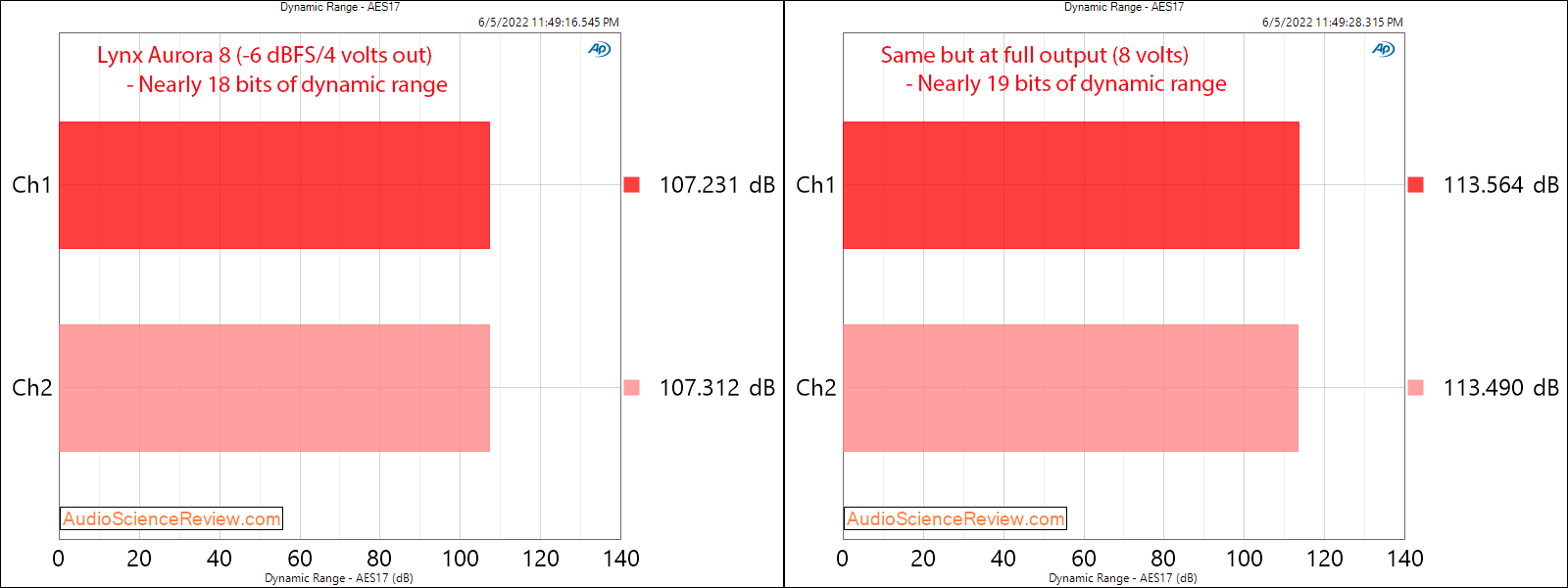
Double the output and you get 6 dB of improvement in dynamic range. Why on earth would you advocate for lower output voltages? It makes no sense whatsoever.
Double the output and you get 6 dB of improvement in dynamic range. Why on earth would you advocate for lower output voltages? It makes no sense whatsoever.
formula 977
Active Member
- Joined
- Apr 8, 2022
- Messages
- 105
- Likes
- 88
That's the point. There are so many better dacs around that if you come across one like the Cambridge or the many AVRs with the same fault why even consider them for evaluation.I have tested literally hundreds of DACs that output 2 volts on RCA
I asked this question previously, you probably missed it. Which of the Cambridge measurements is valid, the ones in the first review or the ones in the second review. It doesn't get any simpler than that.
Since you are speaking on our behalf, would you please ask these manufacturers to also NOT cause higher heat and increased distortion products, at the same time?I have told them as I have told the AVR manufacturers.

JSmith
Master Contributor
The first was purchased retail via Amazon... the second was sent by Cambridge Audio. Both measurements are valid for what was tested at the time of testing... simples.Which of the measurements is valid, the ones in the first review or the ones in the second review.
JSmith
OP
- Thread Starter
- #100
And I would have known that in advance, how? And how would people know about it if I had not tested and published?That's the point. There are so many better dacs around that if you come across one like the Cambridge or the many AVRs with the same fault why even consider them for evaluation.
You are making no sense in your comments. I suggest taking them to a different thread than this.
Similar threads

- Replies
- 6
- Views
- 516


- Replies
- 775
- Views
- 129K
- Replies
- 276
- Views
- 46K

- Replies
- 519
- Views
- 110K
- Replies
- 354
- Views
- 72K
