
• Welcome to ASR. There are many reviews of audio hardware and expert members to help answer your questions. Click here to have your audio equipment measured for free!

Crosstalk measurement - Which record is best?

stereoplay

Active Member
Joined
Oct 2, 2021
Messages
117
Likes
125
Location
Deutschland
I want to start a new thread to discuss my findings and share some thoughts about crosstalk with you. There are some threads here dealing with crosstalk from time to time, but then the topic drifts away.

For my measurements I used a linear tracker from Uher, the PS936. So I had not to deal with tracking errors or antiskating. Cueing is fast and precise and measurements respectively.

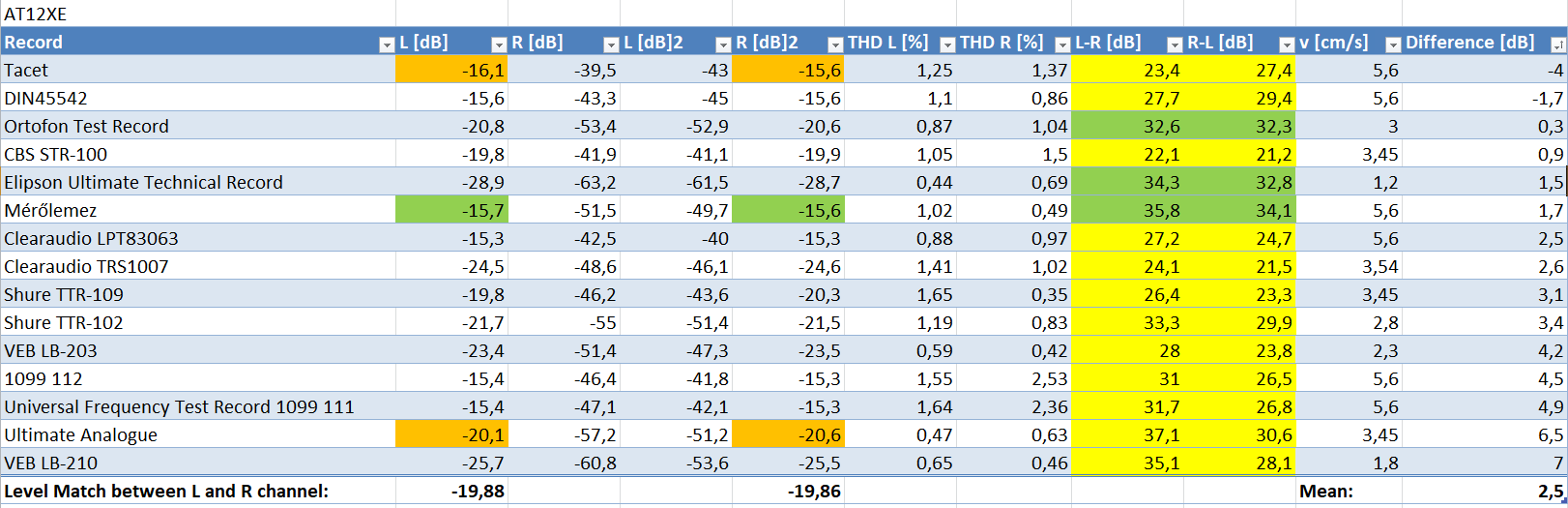
I used a AT-12XE and took some records with dedicated cross talk signals (1KHz). Azimuth was not adjusted and was done by bare eye.
1680858625375.png

The first four columns are relative levels, but as I only want to see the difference it doesn`t matter. Tacet and Ultimate Analogue have an imbalance of levels and they deliver most differences in crosstalk (I sorted the table accordingly).
Overall crosstalk difference over all records is 2.5dB. Some records are outliers (Tacet, Ultimate, VEB).

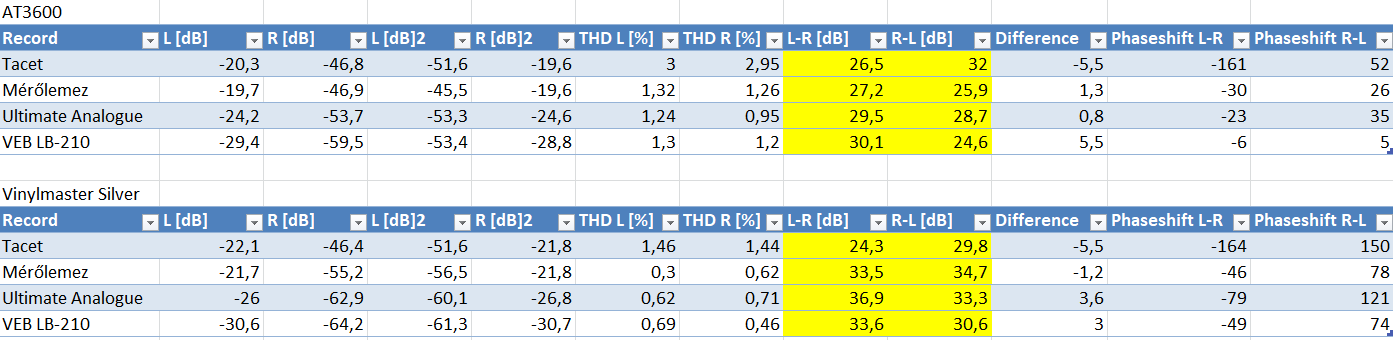
So I decided to go deeper in the Tacet, Mérőlemez, Ultimate Analogue and the VEB. Reference was the Mérőlemez as this has best level matching and crosstalk. I first optimized the azimuth with the Mérőlemez and noted the phase shift also:

1680859634477.png

and with other pickups I had ready to hand:
1680859750163.png


So my first conclusions are:
  • Whatever phaseshift is telling me, the Tacet steps out of line a little bit
  • Tacet an Ultimate are a little bit off with their levels
  • Crosstalk level difference is high on the Tacet compared to the other records
In my view the Mérőlemez is best for measuring and adjusting crosstalk.
 
you just miss the denon which on these 1k ref will be well placed .. (or see its reissue rti, but rare )
(as I had said better than 41db lr or rl on the specific test crosstalk hungaroton and 155lc)
ps
look traduction of "Mérőlemez" from hungarian ;-) not a name...

(where I don't really agree is that it seems to me that often the 1k ref of many discs are not presented for use in crosstalk...
just like sweeps of fr...
divert, does not always work
;-) )
 
Last edited:
Have posted this information in other forums you may be involved in....these are figures using different LP's
The Analog Magic software [I and II] was tested against an oscilloscope with very similar readings...The software is great...Albums are questionable.....

Book2.jpg
 
Does it really matter a whole lot?
The head, and the ears only give us a finite level of crosstalk isolation. It is not like the right ear cannot hear the left speaker.

(But I do agree that more cross talk isolation is better.)
 
Does it really matter a whole lot?
The head, and the ears only give us a finite level of crosstalk isolation. It is not like the right ear cannot hear the left speaker.

(But I do agree that more cross talk isolation is better.)
One would like to have the signal where it belongs, and not bleed to the other channel. Crosstalk is in essence distortion/noise, even if signals often are correlated.
 
Great trove of data, thank you very much.

I have an exotic test record with the 3 first outer tracks designated 1Khz, 0dB. I use it to "level" my vinyl rip @ -16dbFS in order to prevent most pops to digitally clip.

Here's what an Audio-Technica VM95C gives me with the ADC actually leveled at -12dBFS with another cartridge, hence the flawed balance there. I am glad to see that my levels and measurements are in good proximity with your spreadsheet. Validation is important with experimentation.

2 channelsSignal only
Right channel
Signal only
Left channel
Left-19,1323-42,7681-19,2885
Right-17,5759-17,6755-45,1251
Diff / crosstalk 1,5564 25,0926 25,8366

A question directly to @stereoplay, this is the first time I see a mention of the TACET record. How does it fare overall ?
By the way, would you care sharing with us how you level up the output from your phono source to the ADC ?
 
One would like to have the signal where it belongs, and not bleed to the other channel. Crosstalk is in essence distortion/noise, even if signals often are correlated.
^100% true^
But the point is that unless you have headphones on, you cannot get lower than ~25dB as the ears bottom out there.

So that distortion is not really something that would be easily noted.
Other distortions are likely more important.

^That said^, it is a good sign when the crosstalk is low.
(Whether it is in a cartridge, or bible thumper or preacher types coming around to the front door.)
 
^100% true^
But the point is that unless you have headphones on, you cannot get lower than ~25dB as the ears bottom out there.

So that distortion is not really something that would be easily noted.
Other distortions are likely more important.

^That said^, it is a good sign when the crosstalk is low.
(Whether it is in a cartridge, or bible thumper or preacher types coming around to the front door.)
Probably so; my take is that low and even crosstalk is one QC parameter that characterise a good cartridge/stylus.
 

Attachments

  • 1729628827229.png
    1729628827229.png
    54.9 KB · Views: 91
Last edited:
Question......we all seem to agree that the software [app or device] we use for crosstalk readings works well......our [My] problem is ......which LP [should] are we using for our settings..........if we adjust for one test Lp we can be miles out on another as is being shown in our figures....
We can eyeball or microscope the stylus to be correct [we hope] but we can't vouch for any LP as we do not know the errors...

So.....what is the solution....
Which LP [mass produced] do we trust....
 
My take is to 1) set it visually, 2) fine-adjust with the Ortofon test record at 1 kHz. The Ortofon contains 4 tracks that are located in the middle of the record. Generally use the record that gives the lowest values.

Do not exceed +/- 2 degree when fine adjust, rather within 1 degree from visual view.
 
Ortofon is quite close to my best crosstalk reference disk Azimuth , using Ortofon is just fine yes.
Reference 37,5/37,5
Ortofon 30,6/28,8
 
Thank you Balle...[politely asked] ....what makes you think ...based upon your opinion.....that the Ortofon is correct and not another one that is showing worse figures [which may be correct]
I tentatively use the Analogue Productions based upon the fact they press so many other titles which I have many of...instead of A Magik, Adjust+ [album], Cardas etc.....no actual factual bases behind my choice...[your opinion...??]

Thanks
 
(you have to pay a little attention to the velocity level of the test files used to sort things out... and often not observe on test files, ex sweep for fr etc., which are not dedicated to this use...)
 
Thank you Balle...[politely asked] ....what makes you think ...based upon your opinion.....that the Ortofon is correct and not another one that is showing worse figures [which may be correct]
I tentatively use the Analogue Productions based upon the fact they press so many other titles which I have many of...instead of A Magik, Adjust+ [album], Cardas etc.....no actual factual bases behind my choice...[your opinion...??]

Thanks
I can also comment on this. The real answer is that it is difficult to know which one that is the best one. There are however a few things that indicate that the record is a good one.

1. The record should provide the lowest crosstalk in both channels when cartridge is adjusted for that record. That means that the cutting and pressing is good for the individual channels.
2. The results should also be confirmed by the phase test of the crosstalk channel.
3. The record should be absolutely flat.
4. A plus if the record provide several tracks that give consistent results.
 
Thomas....As per previous charts....many records show different results based upon how accurately they were cut....the overall figures are very wide spread...thus you are adjusting only for that record...and then hope it is correct...
 
Thomas....As per previous charts....many records show different results based upon how accurately they were cut....the overall figures are very wide spread...thus you are adjusting only for that record...and then hope it is correct...
Yes. But again, the ones with the lowest crosstalk are the best candidates. Hopefully the test records were made with the ambition to be as correct as possible. If you get very low crosstalk values you know that this record has the lowest signal in the crosstalk channel. Many records have residual signal that should not be there.
 
Unfortunately not correct ..re LP
It depends on how it is mastered and then pressed. Assume it is mastered with equal LP groove side data but pressed etc with a strong offset of data R greater db than L ...your azimuth with your correction to this LP when you equalise will be completely of........thus such discrepancy between what we consider TEST LP's
 
Unfortunately not correct ..re LP
It depends on how it is mastered and then pressed. Assume it is mastered with equal LP groove side data but pressed etc with a strong offset of data R greater db than L ...your azimuth with your correction to this LP when you equalise will be completely of........thus such discrepancy between what we consider TEST LP's
As I said, there is no way to know for certain. But you can focus on those with lowest crosstalk and work from there. Measuring a lot of records will also give you outliers. I can measure mine as well and publish. The more the better.
 
Scott was working on a Python script to do real-time AZ measurement - it was the last topic we'd discussed before he disappeared. He never shared it, but I'm thinking it's worth taking up. Having to do laybacks for post-processing gets a bit tedious, and the FR tracks aren't necessarily the best for AZ adjustment.
 
Back
Top Bottom