• Welcome to ASR. There are many reviews of audio hardware and expert members to help answer your questions. Click here to have your audio equipment measured for free!

Belden ICONOCLAST XLR Cable Review

Rate this cable

  • 1. Poor (headless panther)

    Votes: 156 54.4%
  • 2. Not terrible (postman panther)

    Votes: 87 30.3%
  • 3. Fine (happy panther)

    Votes: 21 7.3%
  • 4. Great (golfing panther)

    Votes: 23 8.0%

  • Total voters
    287
Because someone likes to add to the confusion by discussing audible differences of other cables (speaker cables of different gauge).
Aha a classic move , move the goalpost to something else and russels teapot in one combo :)

"Somewhere there will be a particular cable that in some particular contrived situation makes difference"
 
I did prove it. I listened. I can prove it to you to. Listen.


That proves nothing, even to you, since you don't understand what 'proof' means here.

'Don't trust authority'? Not ever? That reads like an authoritative statement.

This forum is completely wasted on you.
 
Is this cable and/or its design patented?
A good question.

If high-end audio cable designs like this one actually do have patents, it's kind of disturbing. If none do, then either the patent examiners are good; or they also read ASR; or the cable manufacturers haven't tried to get patents yet.

I hope it's the case that the patents don't exist.
 
Is this cable and/or its design patented?

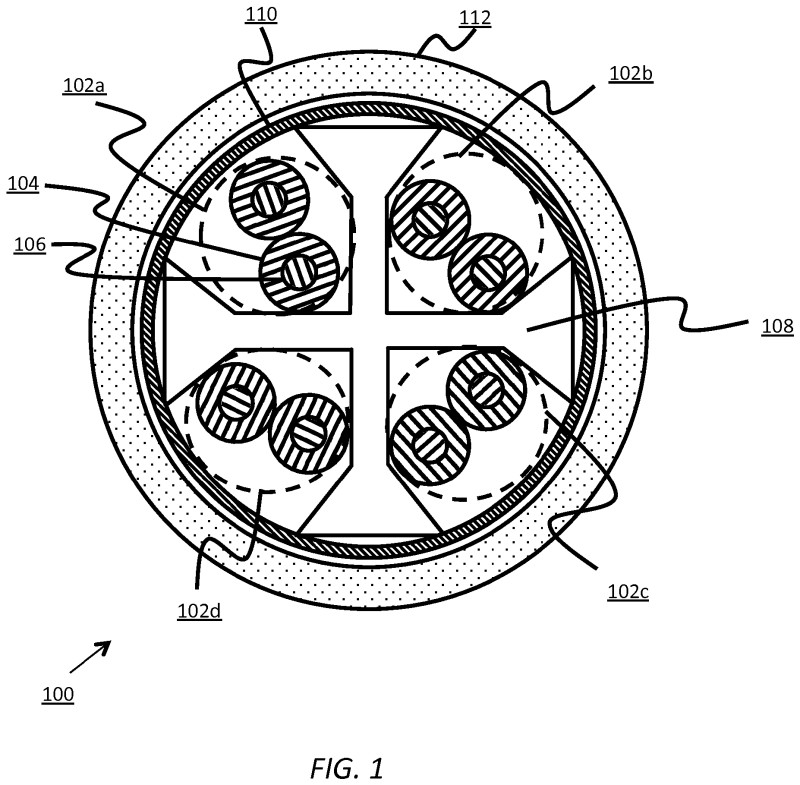
I think it is https://patents.justia.com/patent/20150179306

And a second patent for the same design, but this time sold as a data cable https://www.patentguru.com/EP3309799B1 This patent clearly shows the cable geometry shown earlier in this thread:

imgf0001.tif_800x800.png


The spline in the center has already been patented more than a decade before https://patents.justia.com/patent/20030132021
 
Last edited:
Any test for fancy Tellurium? I think they got one of the most mysterious stories in this business.
 
A good question.

If high-end audio cable designs like this one actually do have patents, it's kind of disturbing. If none do, then either the patent examiners are good; or they also read ASR; or the cable manufacturers haven't tried to get patents yet.

I hope it's the case that the patents don't exist.
As far as I understand, in the US patents don’t have to achieve anything useful. You can patent any mechanism or process as long as it doesn’t already exist or is a non-obvious addition. It can improve, make things worse, or make no performance difference.

The problem is people think something being patented means it does something beneficial.
 
Yes cables have had patents since the early days of Monster and MIT cables. Most MIT cables at one time listed the patents on the cable.
 
As far as I understand, in the US patents don’t have to achieve anything useful. You can patent any mechanism or process as long as it doesn’t already exist or is a non-obvious addition. It can improve, make things worse, or make no performance difference.

The problem is people think something being patented means it does something beneficial.
You can get a patent on anything no matter how obvious or how much prior art exists. All you have to do is muddle up the description enough that nobody can work out what the invention is or, crucially, isn't. Be sure to use the word "plurality" a lot. Then you rent a closet somewhere in the Eastern District of Texas and start filing lawsuits. Profit!
 
Galen's theory on why cables make a difference is that different frequencies in audio have different propagation delay/speed in the cable and he aims to reduces this differential as to have all the frequencies arrive closer in time.
So theoretically speaking, you could rate cables on this "quality" by what length of cable you can have before you get the minimum audible frequency and maximum audible frequency offset from each other by a time greater than is human-perceivable. Do other cables meet the same spec, or have this theoretical concern at a lower length?

I suppose the practical test would be, is the null at all audible?
 
So theoretically speaking, you could rate cables on this "quality" by what length of cable you can have before you get the minimum audible frequency and maximum audible frequency offset from each other by a time greater than is human-perceivable. Do other cables meet the same spec, or have this theoretical concern at a lower length?

I suppose the practical test would be, is the null at all audible?
You can listen to Amir's null yourself. He posted a link to it. BTW, what research has been done indicates we aren't very much bothered by lots of phase differences at higher frequencies. Yet such phase differences will ruin a null.
 
You can get a patent on anything no matter how obvious or how much prior art exists. All you have to do is muddle up the description enough that nobody can work out what the invention is or, crucially, isn't. Be sure to use the word "plurality" a lot. Then you rent a closet somewhere in the Eastern District of Texas and start filing lawsuits. Profit!
Didn't Dyson do just that with their Vacuums?

It was pretty much the exact same thing as some grain silo thing back in the 1920's and oddly enough almost identical to the Hoover WindTunnel vacuum "Technology", but somehow they convinced everyone, that Dyson "Invented" something, that was already in use......:facepalm:
 
I found a philosophical definition to describe the phenomenon I’ve long-assumed existed that falls under the cognitive bias construct—namely the tendency for people who have invested a significant amount in a particular product to view that product as effective or superior, even when presented with evidence to the contrary. And funnily enough it’s called “post-purchase rationalization” (or more formally “choice-supportive bias”).

For those not already aware, the details are here:

 
Last edited:
I found a philosophical definition to describe the phenomenon I’ve long-assumed existed that falls under the cognitive bias construct—namely the tendency for people who have invested a significant amount in a particular product to view that product as effective or superior, even when presented with evidence to the contrary. And funnily enough it’s called “post-purchase bias” (or more formally “choice-supportive bias”).

For those not already aware, the details are here:


I have found that the DIY speakers I have made over the years. I tend to over-estimate how good they are.

Not saying they "Suck" or anything, but often in my mind, at least initially, I often think they are just "More" than they are....it happens.

I am man enough to at least acknowledge out shortcomings as humans.
 
I'd be curious to know why the cost is so high? I've owned BJ cables at one point or another and always well made and did what I expected, but never knew they sold $785 cables. Your test is exactly what I expected. Surprised to hear Galen try to defend. Your last reply was succinct.
 
I found a philosophical definition to describe the phenomenon I’ve long-assumed existed that falls under the cognitive bias construct—namely the tendency for people who have invested a significant amount in a particular product to view that product as effective or superior, even when presented with evidence to the contrary. And funnily enough it’s called “post-purchase rationalization” (or more formally “choice-supportive bias”).

For those not already aware, the details are here:

In accounting and finance it’s known as “sunk cost”.
 
Well , maybe I'm the odd duck here... But I disagree to the simple measurement result.

I haven't look at the detail measurement and data of that Belden website.

But based on my evaluation, this former Belden engineer do have a point. Your test had great flaws.

As with any measurement device, they had their limitation. Although many of older science claimed that their device limitation are well above the limitation of our biology mesurement system, it often proved wrong afterward.

For some examples we takes mp3 and 44khz sampling frequency. We used to believe mp3 makes no different at all, cause all it compressed are the loudness different that should be unable to capture by human ears. Same with the sampling frequency, 96khz and 192 khz shouldn't make such huge different by the measurement standard in where 44khz introduces. They used to think they capture "real life" sound at that moment based on science, and laugh of those vinyl recorder musician.

There are actually lots of similar so called "voodoo" in audio industry history, because they don't understand how hard to replica and represent a continuous analog wave that can range from near dc to 35khz. But as the technology advance in both DAC, ADC, amplifier, studio monitor, it make sense there is more and more revealing in the weakest part of the whole audio chain.

That being said, if you're not owning the most expensive ADC, DAC, amplifier and studio monitor, your weakest chain probably won't be the cable.

But all in all, I think maybe it's the source or the measurement device at fault. Possibly had very high capacitance, low crystal clock rate, processing system or slow transcient response that introduce some delay in the cable's signal. the source, cable and measurement device called a WHOLE chain of system for a reason.

IMO, the best way to test a cable is using a capable enough professional studio equipment to listen some Opera house/stage real orchestra performance (not those song recorded in studio and optimize for mp3/handphone device). If the source doesn't had enough transcient responses (like an all playing moment in orchestra) and the measurement device only measure static sound without proper spec... It hardly can justify the Transcient response of a cable is what it capable of.

 
Well , maybe I'm the odd duck here... But I disagree to the simple measurement result.

But based on my evaluation, this former Belden engineer do have a point. Your test had great flaws.

For some examples we takes mp3 and 44khz sampling frequency. We used to believe mp3 makes no different at all, cause all it compressed are the loudness different that should be unable to capture by human ears. Same with the sampling frequency, 96khz and 192 khz shouldn't make such huge different by the measurement standard in where 44khz introduces. They used to think they capture "real life" sound at that moment based on science, and laugh of those vinyl recorder musician. Still do. But backed up with scientific testing.

That being said, if you're not owning the most expensive ADC, DAC, amplifier and studio monitor, your weakest chain probably won't be the cable.


IMO, the best way to test a cable is using a capable enough professional studio equipment to listen some Opera house/stage real orchestra performance
Are you serious? Everything you state is right out of the 1990's thinking by audiophiles. It has all been proven wrong in numerous tests. I suggest you continue your journey on ASR and you will get up to date on what is happening in current audio testing etc.
Price has nothing to with anything in audio after you are in the mid fi level. DACs, amps and all wiring especially.
You ended with listening as your "test" protocol. That has been debunked since the 1980's. The human ear/brain function is the WORST test device there is.
 
Last edited:
Well , maybe I'm the odd duck here... But I disagree to the simple measurement result.

You are free to disagree, however I prefer to rely on scientific method rather than placing my faith in crystals and homeopathy.
 
Back
Top Bottom