
• Welcome to ASR. There are many reviews of audio hardware and expert members to help answer your questions. Click here to have your audio equipment measured for free!

Accurate speaker in-room response. Which UMIK1 orientation is better, horizontal 0º or vertical 90º? (Question)

tecnogadget

Addicted to Fun and Learning
Joined
May 21, 2018
Messages
561
Likes
1,024
Location
Madrid, Spain
Although I've been using Umik1 for years, at first I always seem to have it right, but then the results end up driving me crazy with the same doubt:

What combination of microphone positioning and calibration file gives us the real response our ears perceive at the listening point above the transition frequency? Especially if one wants to take measurements to perform room and Eq correction, tailoring the speaker response with a target curve.

THEORY

1649746631396.png


DIRAC LIVE Manual:
1649746844050.png

The same is true for almost any mainstream room eq software like Audyssey. They all recommend using the 90º cal file and point the mic to the ceiling.

More specialized software like Acourate, Audiolense, Focus Fidelity, recommends using the microphone horizontally pointing at the center between the main channels and 0º calibration file.


IN PRACTICE
main-qimg-8fcf5f575b6276dfcfd75820831ea34f

The issue arises when a person has a multi-channel system for enjoying movies but at the same time uses it as a stereo system for listening to music. Ideally, you choose a preferred target curve and EQ all channels to follow the same curve (in my case, Harman or Olive/Toole).

A UMIK1 and most measurements microphones are omnidirectional, but this does not mean they are 100% omnidirectional in all frequencies. So when your surround and back surround speakers are positioned behind your listening position, if pointing the microphone horizontally toward the center between the front channels, the microphone would be oriented backwards with respect to the surrounds, which would be causing a kind of "acoustic shadow".

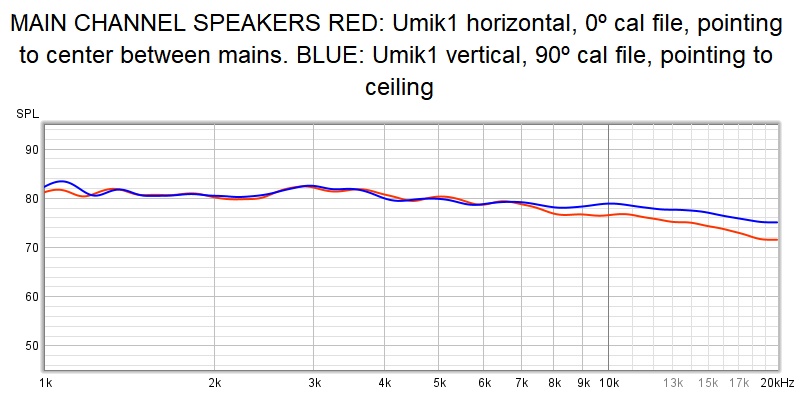
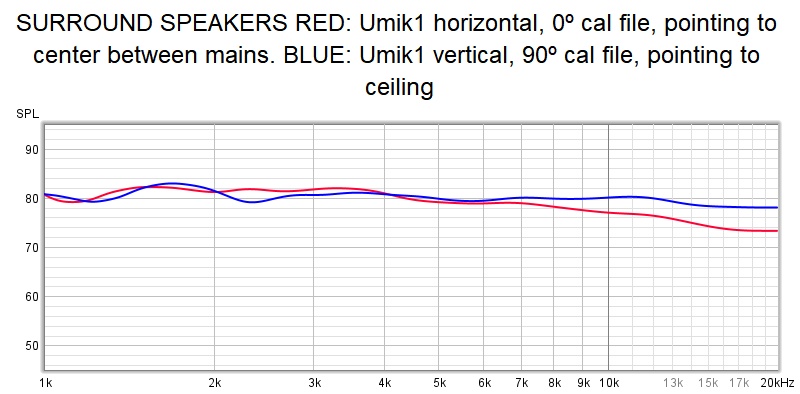
Here are some in-room measurements I have taken, plotted only from 1kHz onwards to focus on the difference in microphone orientation and not on room modal interactions or loudspeaker response:
Example 1 mic vertical vs horizontal.jpg


Example 2 mic vertical vs horizontal.jpg


As you can see, in both cases there ends up being a difference of about 5dB in the treble region between one way of orienting the microphone and the other, with their respective calibration files ( all measurements have been made without eq, hence no target curve applied yet)
Which makes me absolutely doubt which is the real response I should take for the target curve, since a difference of +-5dB would absolutely change the tonal balance and puts us on the fine line between dull and bright.

If it were a question of loudspeaker response measurement, vs. room response measurement, it is easier to agree that the former would be done horizontally at 0º and the latter vertically at 90º.

The conclusion I draw from my measurements is that for room/speaker eq, if we measure horizontally at 0º the direct sound of the speaker takes precedence, and if we measure vertically at 90º reflections and diffuse field are added into the measurement...and unless I am wrong, this is the way our ears end up hearing the music.

Should we limit to one method or the other, or does it make sense to consider a hybrid model? One that considers the room as two halves from the listening position

-Alternative option 1: Measure the main and center speakers with microphone pointing horizontally to the front and cal file 0º, and measure the surround speakers with microphone pointing to the ceiling and cal file 90º.

-Alternative option 2: Measure the main channels and center speaker with microphone pointing horizontally to the front and cal file 0º, measure the surround channels with microphone horizontal and cal file 0º but pointing backward from the listening position, this way we achieve a better line of sight between the surrounds and the microphone.
 
0deg.

And you should tune the the treble / tonal balance to your liking, rather than the curves - so from that perspective the accuracy of the curve doesn't really matter that much? Above the Schroeder frequency you increasingly hear the direct sound rather than the room.

Not sure where you see the 5dB difference either? They're basically identical up to 7khz, and at 10khz you have a ~2dB difference?

Even at 20khz it's around ~3dB(?), and only your resident bats will be bothered by the difference.
 
Both methods are aiming at consistency - the microphone has the same angle relative to all speakers.

(Although note that the angle of incidence with the speakers for the 2-channel "0º" method is actually 30º, not 0º)

Your method will end up with different incidence for every speaker, and hence open you up to inconsistent tonality. You won't be consistent between C and LR.

It increases the number of variables. If there's an issue with the 90º or 0º calibration, it would at least hit every speaker similarly, so be handle-able with a single target EQ curve adjustment.

A less problematic alternative would be to rotate the mic to point at each speaker in turn and use 0º calibration, but that's fiddly. So the upwards with 90º is the easier version of that.
 
Even at 20khz it's around ~3dB(?), and only your resident bats will be bothered by the difference.
Misreading the scale? It's 2dB per grid line, so nearly 5dB difference at 20kHz on the surround graph. Looks like enough of a difference to be worth thinking about. (Edit: oh, he said 5dB for both. Nope).

Does suggest something off with the calibration though. I can't immediately see a reason to a correctly calibrated mic should show such a difference at that end of the scale. Isn't 20kHz going to be almost entirely direct, in which case an anechoic calibration should match in-room better, if anything, than lower-frequencies. Less reflections to worry about.
 
The answer is actually easy, above the transition region you don't want to EQ a loudspeaker to predefined target, but the target there is flat direct sound (usually on-axis or listening window average) so that mic calibration issue is actually none.
 
Misreading the scale? It's 2dB per grid line, so nearly 5dB difference at 20kHz on the surround graph. Looks like enough of a difference to be worth thinking about. (Edit: oh, he said 5dB for both. Nope).

Does suggest something off with the calibration though. I can't immediately see a reason to a correctly calibrated mic should show such a difference at that end of the scale. Isn't 20kHz going to be almost entirely direct, in which case an anechoic calibration should match in-room better, if anything, than lower-frequencies. Less reflections to worry about.

They're typically not perfectly calibrated. I have a factory UMIK-1 and a UMIK-2 that's calibrated by Cross-Spectrum Labs, they're around 1-2dB off from each other in the upper range. I also suspect that the calibration files may have been done at a 1 meter distance. High frequencies are highly directional, so in the listening position several meters away, it would make some sense that a 90 degree position shows drop-off at the top end.

Here's my Umik-1 (blue) vs Umik-2 Cross spectrum labs (red) measuring a speaker @1m:
Note that even though they're not perfectly equal, I'd say the Umik-1 with the factory calibration is close enough to be perfectly fine for most purposes.

1649761783029.png
 
High frequencies are highly directional, so in the listening position several meters away, it would make some sense that a 90 degree position shows drop-off at the top end.
Absolutely, but why wouldn't this be reflected in the respective calibration files, and hence not be visible in the final calibration-corrected measurement? The OP's graphs were allegedly with the correct calibration files in use.

Maybe user error, and the correct calibration files were not in fact in use?

Just looked at my own UMIK-1 calibration files, and they have a 5dB difference at 20kHz between the normal and "_90deg" one.

Edit: Looked even more closely - my calibration difference is 2dB at 7kHz and 6dB at 20kHz, which is very close to the difference shown in the OP's surround graph. That makes me pretty confident the two curves are in fact using the same calibration file, not the different ones, so you're seeing the raw difference that should be hidden by calibration.

If that's the case, the front curves show less of a difference because the "0º" is actually 30º, as previously mentioned.


Edit 2: Okay, realised the front curve is actually showing the 30º with *less* treble than 90º, which indicates that the calibration is in use, but it's over-compensated. And I think that is explicable because it's 30º - the calibration is correcting for 90º versus 0º, not 90º versus 30º. You're seeing a 2-3dB drop for the 30º angle.

And for the surround curve the measurement with the "0º" calibration is actually at something like 110º cos it's pointing forward. There won't be a huge real measurement difference between 90º and 110º, but you just see the whole calibration difference, intended for 0º versus 90º. Total misuse of the 0º calibration there.
 
Last edited:
Should we limit to one method or the other, or does it make sense to consider a hybrid model? One that considers the room as two halves from the listening position

-Alternative option 1: Measure the main and center speakers with microphone pointing horizontally to the front and cal file 0º, and measure the surround speakers with microphone pointing to the ceiling and cal file 90º.

-Alternative option 2: Measure the main channels and center speaker with microphone pointing horizontally to the front and cal file 0º, measure the surround channels with microphone horizontal and cal file 0º but pointing backward from the listening position, this way we achieve a better line of sight between the surrounds and the microphone.
In response to my own questions about mic accuracy and angles, I've been experimenting with considering the system as two halves, one from the listening position (20-400Hz) and one from the near field speaker output (>400Hz). After completing a standard Dirac calibration, I load a flat target and measure the speakers at about 30cm with horizontal mic position and 0 degree calibration file. The inverse of this measurement creates perfectly flat output at the speaker.

For the target curve, I use the listening position flat target (or Harman +2dB or +4dB) from 20-400 and the inverted near-field measurement above 400. I do this for all speaker groups, so the target is different for each group above 400Hz, but I don't perceive any issues with it. I've been using this method for a few weeks, and it sounds more right to me than any other target I've used.

Here's the target I get for LR:
LR full.png
 
Well... this is an old conversation, but I realized something similar today. With my findings I must say its NOT the angle of the mic that's causing this but the calibration file.
1773027083909.png


I posted this image in an fb group because I was getting a different result using the MMM and normal traditional measurement.
"The image shows the difference between MMM and normal "steady" measurement. With the normal measurement, the mic is positioned straight up. using the 90-degree calibration file. (Purple) With MMM the mic is aimed at the speaker and moved around in a circular motion. (Green) Using the normal calibration file. As you can see, the results are different above 3K.
For testing I checked if it's the mic's orientation that's causing it, but actually, no. It is the calibration file.
Light blue is mic pointing up, but a 90-degree calibration file is loaded for MMM (pink periodic noise was used).
The orange is the same. Mic pointed up. pink periodic noise was used, but a normal calibration file was loaded. So it's not the mic position. Not the type of noise, but the calibration file itself is doing that."
 
Your calibration file is either for 90deg or 0deg. If it doesn't say, then assume it's 0deg. The 90deg calibration file typically lifts the treble because omni mics are not perfectly omni, there is usually some volume loss at very high frequencies.
 
Your calibration file is either for 90deg or 0deg. If it doesn't say, then assume it's 0deg. The 90deg calibration file typically lifts the treble because omni mics are not perfectly omni, there is usually some volume loss at very high frequencies.
Calibration files are correctly named. That is not my issue.
I think op's issue was not the mic orientation but when you use a different calibration file for that orientation. This is confirmed by not changing the orientation but only the calibration file. Circling back to the age old question... so which orientation should be used?
I know people like to use MMM with mic pointing at speakers..
 
so which orientation should be used?

If you are taking a "speaker" measurement, e.g. a nearfield driver measurement, or a free-field measurement, or a quasi-anechoic measurement: mic pointing at speaker.

If you are taking a "room" measurement, or trying to measure speakers in a surround system, mic pointing at ceiling. If you point the mic at the front speakers, it will underestimate sound coming from behind the mic and not give you a proper reading.
 
If you are taking a "speaker" measurement, e.g. a nearfield driver measurement, or a free-field measurement, or a quasi-anechoic measurement: mic pointing at speaker.

If you are taking a "room" measurement, or trying to measure speakers in a surround system, mic pointing at ceiling. If you point the mic at the front speakers, it will underestimate sound coming from behind the mic and not give you a proper reading.
So in room the MMM shouldnt be used?
 
So in room the MMM shouldnt be used?
I don't discourage using MMM but maybe you should double check with normal sweeps, this is my personal anecdote. I tried MMM (mic point up, swinging around LP) and single point sweep for room correction in a single sweet spot. In the low end under 200Hz, MMM actually hides several large dips that'd be present in the sweep.
 
Well... this is an old conversation, but I realized something similar today. With my findings I must say its NOT the angle of the mic that's causing this but the calibration file.
...
It is possible that the calibration curves you used were not a good match for your particular mic, or there may be other factors in play. The differences in frequency response for "omni-directional" measurement mics for different angles at high frequency are well understood and documented (see figure from B&K's microphone data book for their 1/8 inch to 1 inch mic cartridges https://www.bksv.com/media/doc/be0089.pdf).
B and K Microphone Handbook - be0089.png


When you look at your curves, the blue and orange curves (mic pointing up) match each other very well until ~3 kHz and then they start to deviate from each other as the result of the use of different calibration curves. The purple and green curves (mic pointing at the speaker) show significant differences throughout the whole range, not just above 3 kHz.

That means you were getting a much better measurement-to-measurement consistency with mic pointing up.
 
Back
Top Bottom
