
-
Welcome to ASR. There are many reviews of audio hardware and expert members to help answer your questions. Click here to have your audio equipment measured for free!
- Forums
- Audio, Audio, Audio!
- DACs, Streamers, Servers, Players, Audio Interface
- Digital To Analog (DAC) Reviews and Discussion
You are using an out of date browser. It may not display this or other websites correctly.
You should upgrade or use an alternative browser.
You should upgrade or use an alternative browser.
SMSL M400 Balanced USB MQA DAC Review
- Thread starter amirm
- Start date


I'll definitely get one of the BEST dacs in the world right?Topping has bought our M400? For compared? So soon.
Oh. Come on. Trying to confuse us about DAC chip output characteristics and the output impedance of the DAC as a complete unit?The output impedance has nothing to do with the DAC, the main decision is the output impedance of the low-pass filter circuit, here 4 balance and 2 single both are 470.
As a signal source, this impedance is normal and has no impact on performance.
You guys definitely don't make it easy to choose @SMSL-Mandy @JohnYang1997 , both are awesome dacs, not to mention the price.
I am wondering about the out of band ultrasonics, is that characteristic of the ak4499 or something?
I am wondering about the out of band ultrasonics, is that characteristic of the ak4499 or something?
I didn't design D90 or involved in the design. I just don't like disingenuous words from manufacturers.You guys definitely don't make it easy to choose @SMSL-Mandy @JohnYang1997 , both are awesome dacs not to mention the price.

777
Addicted to Fun and Learning
- Joined
- Jan 1, 2019
- Messages
- 516
- Likes
- 391
Earth terminal and that high voltage connector pushing one each other and there is a risk of it coming out. All that high voltage wires are pressed by the chassis and there is a risk to touch the chassis. The resistance between earth connection and the chassis is 0.1ohm and there isn't any direct clamping screw. If there is short circuit between earth and phase we can have 16A x 16A x 0.1ohm= over 25w on the 10cm of PCB earthe route.Are you pointing out crowded wires that are slightly lose and touching the sealed torodial?
Anyway, I don't care anymore. I notice that no one is interested in details like these. Do as you wish.
Earth terminal and that high voltage connector pushing one each other and there is a risk of it coming out. All that high voltage wires are pressed by the chassis and there is a risk to touch the chassis. The resistance between earth connection and the chassis is 0.1ohm and there isn't any direct clamping screw. If there is short circuit between earth and phase we can have 16A x 16A x 0.1ohm= over 25w on the 10cm of PCB earthe route.
Anyway, I don't care anymore. I notice that no one is interested in details like these. Do as you wish.
I literally asked you for the details. I would continue to speak up.

capitanharlock
Active Member
- Joined
- May 17, 2019
- Messages
- 118
- Likes
- 102
Actually you cared about 2d sound, without transients and audiophile babble like that.The sound is faint, without contrasts, 2D, without transients.
So, Topping or SMSL are the same...... They care only about the measurements, not about the sound. It is just a marketing strategy to kill the western audio companies.
If you want a good sound, you have too look elsewhere.
Just the wrong forum I guess.
Project’s defects are worth a discussion.

Tks
Major Contributor
- Joined
- Apr 1, 2019
- Messages
- 3,231
- Likes
- 5,596
The output impedance has nothing to do with the DAC, the main decision is the output impedance of the low-pass filter circuit, here 4 balance and 2 single both are 470.
As a signal source, this impedance is normal and has no impact on performance.
Hey mandy. I was waiting for a second 4499 DAC, and you guys got it to market and on Amir's test bench. One thing I am weirded out about.
What's up with AKM's filter choices? Where's the "Sharp" brickwall filter that they had on prior chips that cuts down at 22.05 kHz? Were they sleeping when they made this chip >_>
I've been wondering the same thing... Not that it's audible but the ultrasonics on my hpa4 are perfect, i wish my dac could be used for boat sonar like my amp (quoting amir
 ).

I don't understand how the connector affects jitter if the rest of the DAC after the connector is good? Isn't it's job to reject jitter on the interface, as long as the data is recovered correctly.Company says that Toshiba used to make the best Toslink/Optical connector but they no longer do. So they had to use a different one that causes that problem. Seems plausible. I doubt that there is much of a market for premium Toslink connectors in this day and age.

Veri
Master Contributor
- Joined
- Feb 6, 2018
- Messages
- 9,662
- Likes
- 12,306
What's up with AKM's filter choices? Where's the "Sharp" brickwall filter that they had on prior chips that cuts down at 22.05 kHz? Were they sleeping when they made this chip >_>
The Sharp filter is there, I'll tell you what's up with AKM's filter choices, they use the same cut-offs for both 44kHz and 48kHz. That's why it attenuates too slow! I think you are confusing with ESS9038 DACs which have faster filters available. I believe all AKM DACs have these slower filters. Maybe it's part of their Velvet Sound.


Speaking of, I´ve found this beauty on Amazons listing for the Philips X2HR:Maybe it's part of their Velvet Sound.
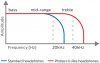
I guess you´d need an anti-filter for that kind of performance, wouldn´t want to cut off all that beautifuly 40kHz treble.
wtfSpeaking of, I´ve found this beauty on Amazons listing for the Philips X2HR:
View attachment 66748
I guess you´d need an anti-filter for that kind of performance, wouldn´t want to cut off all that beautifuly 40kHz treble.
themystical
Member
Since I am on furlough, I have taken the opportunity to study this DAC in a bit more detail and I share my observations.
The SMSL design, as commented by a couple of people only seems to utilise two of the four channels available on this DAC chip. I am simply amazed at how much performance has been extracted from half of the DAC chip as evident from the measurements. In full output DAC mode, I have not seen better SINAD or Dynamic Range figures from any implementation of any manufacturer's DAC chip. I believe the name of the game in DAC designs is to retain as much of the performance of the DAC chip as possible in the external components required to make it functional; this performance is very fragile and easily compromised in the design of the PCB and the external components. SMSL have done an absolutely brilliant job in retaining simplicity and preserving the performance of the DAC chip.
I also observed that there appeared to be electrolyic capacitors in the signal path. These are DC blockers and are possibly provided to protect the subsequent amp under normal and fault conditions. Many "audiophiles" would shrink in horror from this preferring DC coupled or at the very least more stable and linear film/polyprop etc. capacitors. The measurements appear to show no negative implications on linearity of the DAC so this is one for the "believers".
With regard to the output impedance issue, I agree with a number of people who have stated that this is a non-issue. This issue only applies to the balanced connections, the single ended outputs are buffered through additional opamps which also act as summation/LPF filters. For balanced outputs, because the maximum output voltage is around 50% higher than the "standard" 4V there is a tremendous amount of scope to compensate for any additional volt drop across this 1240 Ohm output impedance. As I have stated before, the output circuit is a verbatim implementation of the datasheet recommended circuit. To put this into perspective, the ESS Sabre information recommends resistors in their balanced passive LPF circuit equivalent to a 4000 Ohm output impedance.
Finally, stating the obvious here but whilst the testing at 4V with the resulting lower performance is a fair way of comparing different DAC's with different output voltages, however in use, in pure DAC mode or indeed at full output, it will be possible to benefit from the higher SINAD and dynamic range available and please correct me if I am wrong, there is simply no other commercial DAC available with this level of measured performance?
Veri
Master Contributor
- Joined
- Feb 6, 2018
- Messages
- 9,662
- Likes
- 12,306
It does seem one of the very best. Okto DAC8 Stereo should be similar but it hasn't been reviewed yet so far. I think it will also come close to distortionless performance. @Okto Research hope one will reach Amirm soonFinally, stating the obvious here but whilst the testing at 4V with the resulting lower performance is a fair way of comparing different DAC's with different output voltages, however in use, in pure DAC mode or indeed at full output, it will be possible to benefit from the higher SINAD and dynamic range available and please correct me if I am wrong, there is simply no other commercial DAC available with this level of measured performance?


misterdog
Addicted to Fun and Learning
- Joined
- Dec 7, 2018
- Messages
- 761
- Likes
- 700
The SMSL design, as commented by a couple of people only seems to utilise two of the four channels available on this DAC chip. I am simply amazed at how much performance has been extracted from half of the DAC chip as evident from the measurements.
I nearly did not buy the M400 when I saw how few components there were on the PCB, though I have only seen the top side.
But then maybe less is more.
When you plug it in any fears are certainly put to bed.
Does anyone have an image of the underside of the PCB ?
No components on the underside. It is amazing that the performance is achieved using half a dac using minimal peripherals. I wish the toslink and coax inputs are better tho.I nearly did not buy the M400 when I saw how few components there were on the PCB, though I have only seen the top side.
But then maybe less is more.
When you plug it in any fears are certainly put to bed.
Does anyone have an image of the underside of the PCB ?
Similar threads

- Replies
- 50
- Views
- 10K

- Poll
- Replies
- 62
- Views
- 16K
- Replies
- 0
- Views
- 402
- Replies
- 387
- Views
- 89K
- Replies
- 95
- Views
- 22K
