• Welcome to ASR. There are many reviews of audio hardware and expert members to help answer your questions. Click here to have your audio equipment measured for free!

Revel W228Be In-Wall Speaker Review

Rate this speaker:

  • 1. Poor (headless panther)

    Votes: 5 4.6%
  • 2. Not terrible (postman panther)

    Votes: 10 9.2%
  • 3. Fine (happy panther)

    Votes: 52 47.7%
  • 4. Great (golfing panther)

    Votes: 42 38.5%

  • Total voters
    109
Hi all - I wanted to share my experience with the W228Be's in the context of a 2 channel room that is a "wanna-be" non-environment room, and lessons learned. The room is very small 11 feet "front to back", 18.9 wide, and 7.25 feet high. The reason that it is orientated along the long wall is that the other side (or back) of the room is effectively a hallway with many doors to several different rooms, so the setup is basically on one half of the room.

I put 14.5 inches of treatment across the entire ceiling; 2 feet on entire rear wall; and also about 2 feet on the side walls, with a small door shaped opening on the right side for ingress/egress. Tile floor.

Measurements from DIRAC attached (I would love to use REW but my NAD has been terrible with HDMI connectivity to my laptop, can't get it to work).

Coming from M126Be bookshelves, the W228Be's are very similar. However, because with a straight wall, there no ability to toe-in the speakers. In this kind of dry environment, that can certainly be a con. In fact, when I move from center closer to one speaker vs the other, there is an element of the sound that seems to improve. This could be the radiation of the speakers, or possibly me noticing stereo comb filtering effect being in a dry room. Because there are no side wall or rear wall reflections, I never quite get the illusion of someone signing in my room as I did previously with the M126Be and more reflections.

I will also say that I now 100% understand why many control rooms take this approach - the sound coming out of the speakers just sound right in many aspects. Because reflections are so greatly attenuated, its almost like "yeah, that's what the mic picked up". Songs that may have been grating to listen to in my prior setup, or that were really exciting to listen to but that I could not tolerate for long (due to reflections), you can effectively listen to indefinitely because of the lack of coloration.

Its really excellent for movies with all the details being so clear and quite impressive - but I will say that I miss having a projector and a center channel, even if many of the films I watch from the 80s/70s are stereo or mono, for those that are mastered in 5.1, I definitely prefer the center channel. From a music listening perspective, while it is very good, the lack of the illusion of someone being there and even the reflections (possibly making parts of the music louder or more enveloping) is a def downside.

THAT said, my implementation of NE is obviously flawed. First, the way W228Bes mount into the wall like almost all other in wall speakers, is they literally clamp onto the drywall. If I had to do it again, I would do it the right way, which is where the wall is "around" the speaker, but not attached to the speaker. The wall vibrates (not audibly to my ears) pretty significantly. In addition, I would absolutley toe in with the standard 60 degree recommendation for monitors when doing music listening.

The measurements are far from perfect - but that's effectively a + or - 6 db range (12 db span), which for a room that is front to back 11 feet and 7.25 feet tall..practically a miracle. The sound is exceptional, but 2.0 just fall short for movies for me; and for music the lack of reflections to create that "the singer is there" illusion is a bummer. It was an interesting experiment so I thought I'd share my experience. Please note again, that a lot of my conclusions are based on a flawed implementation of NE, being that my speakers are pointed straight and that they are coupled to the wall (not to mention the front wall is only 2 layers of dry wall, 1 inch total - a far cry from several layers of materials used in a NE room.

 

Attachments

  • 1000003199.jpg
    1000003199.jpg
    106 KB · Views: 145
  • Leftjpeg.jpg
    Leftjpeg.jpg
    230.2 KB · Views: 141
  • rightjpeg.jpg
    rightjpeg.jpg
    216.6 KB · Views: 139
Hi all - I wanted to share my experience with the W228Be's in the context of a 2 channel room that is a "wanna-be" non-environment room, and lessons learned. The room is very small 11 feet "front to back", 18.9 wide, and 7.25 feet high. The reason that it is orientated along the long wall is that the other side (or back) of the room is effectively a hallway with many doors to several different rooms, so the setup is basically on one half of the room.

I put 14.5 inches of treatment across the entire ceiling; 2 feet on entire rear wall; and also about 2 feet on the side walls, with a small door shaped opening on the right side for ingress/egress. Tile floor.

Measurements from DIRAC attached (I would love to use REW but my NAD has been terrible with HDMI connectivity to my laptop, can't get it to work).

Coming from M126Be bookshelves, the W228Be's are very similar. However, because with a straight wall, there no ability to toe-in the speakers. In this kind of dry environment, that can certainly be a con. In fact, when I move from center closer to one speaker vs the other, there is an element of the sound that seems to improve. This could be the radiation of the speakers, or possibly me noticing stereo comb filtering effect being in a dry room. Because there are no side wall or rear wall reflections, I never quite get the illusion of someone signing in my room as I did previously with the M126Be and more reflections.

I will also say that I now 100% understand why many control rooms take this approach - the sound coming out of the speakers just sound right in many aspects. Because reflections are so greatly attenuated, its almost like "yeah, that's what the mic picked up". Songs that may have been grating to listen to in my prior setup, or that were really exciting to listen to but that I could not tolerate for long (due to reflections), you can effectively listen to indefinitely because of the lack of coloration.

Its really excellent for movies with all the details being so clear and quite impressive - but I will say that I miss having a projector and a center channel, even if many of the films I watch from the 80s/70s are stereo or mono, for those that are mastered in 5.1, I definitely prefer the center channel. From a music listening perspective, while it is very good, the lack of the illusion of someone being there and even the reflections (possibly making parts of the music louder or more enveloping) is a def downside.

THAT said, my implementation of NE is obviously flawed. First, the way W228Bes mount into the wall like almost all other in wall speakers, is they literally clamp onto the drywall. If I had to do it again, I would do it the right way, which is where the wall is "around" the speaker, but not attached to the speaker. The wall vibrates (not audibly to my ears) pretty significantly. In addition, I would absolutley toe in with the standard 60 degree recommendation for monitors when doing music listening.

The measurements are far from perfect - but that's effectively a + or - 6 db range (12 db span), which for a room that is front to back 11 feet and 7.25 feet tall..practically a miracle. The sound is exceptional, but 2.0 just fall short for movies for me; and for music the lack of reflections to create that "the singer is there" illusion is a bummer. It was an interesting experiment so I thought I'd share my experience. Please note again, that a lot of my conclusions are based on a flawed implementation of NE, being that my speakers are pointed straight and that they are coupled to the wall (not to mention the front wall is only 2 layers of dry wall, 1 inch total - a far cry from several layers of materials used in a NE room.
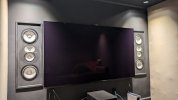
This is interesting to me. For one, a 60 degree toe in? That sounds like a tremendous amount. I moved from Martin Logan XT F100s to the Revel W228Be speakers. I quite liked the Martin Logan speakers, even though they don't measure as well as many others. Maybe it's my older ears that enjoyed the boosted high frequences? I don't know. I had just a few degrees of toe-in, maybe 10 degrees or 15 on the high end? Anyway... I moved to the Revel and did all the room calibration steps. It was good, but not perfect. I am behind a screen, so I knew there would be small compromises. I also faced some issues with a GREAT image. It wasn't that I didn't have a stereo image at all, but it wasn't as anchored as it had been with the Martin Logan speakers - with a toe-in.

I made some changes to my subs and wanted to do a recalibration on them. I use MSO, so it was a process. All that to say, as I completed the calibration process, I was shocked to find the improvement I had in the audio quality. I don't know what I screwed up in the initial calibration, but It's dramatically better. The stereo image is probably 99% as good as the martin logan with toe in? Heck, maybe it's as good now - it's been a few months since I had them here and whether recency bias or something else, but regardless, I'm went from very happy to absolutely delighted after rerunning ARC.

Might be worth a test to see if you encounter a similar improvement. I built my own cavity / sealed box as I had access to space behind the drywall, and I'm just mounted on 5/8" drywall. I just used some MDF with dynamat, and while not absolutely dead, it's pretty rigid with VERY minor coloration behind the wall. I cannot hear any on the speaker side of the wall - the drywall seems to completely neutralize any coloration. I get more wall movement from the subs, so next incremental improvement is some additional bracing behind the wall itself...

Anyway, Just passing this along as I was VERY surprised and happy with the improvements I did not expect.

I
 
This is interesting to me. For one, a 60 degree toe in? That sounds like a tremendous amount. I moved from Martin Logan XT F100s to the Revel W228Be speakers. I quite liked the Martin Logan speakers, even though they don't measure as well as many others. Maybe it's my older ears that enjoyed the boosted high frequences? I don't know. I had just a few degrees of toe-in, maybe 10 degrees or 15 on the high end? Anyway... I moved to the Revel and did all the room calibration steps. It was good, but not perfect. I am behind a screen, so I knew there would be small compromises. I also faced some issues with a GREAT image. It wasn't that I didn't have a stereo image at all, but it wasn't as anchored as it had been with the Martin Logan speakers - with a toe-in.

I made some changes to my subs and wanted to do a recalibration on them. I use MSO, so it was a process. All that to say, as I completed the calibration process, I was shocked to find the improvement I had in the audio quality. I don't know what I screwed up in the initial calibration, but It's dramatically better. The stereo image is probably 99% as good as the martin logan with toe in? Heck, maybe it's as good now - it's been a few months since I had them here and whether recency bias or something else, but regardless, I'm went from very happy to absolutely delighted after rerunning ARC.

Might be worth a test to see if you encounter a similar improvement. I built my own cavity / sealed box as I had access to space behind the drywall, and I'm just mounted on 5/8" drywall. I just used some MDF with dynamat, and while not absolutely dead, it's pretty rigid with VERY minor coloration behind the wall. I cannot hear any on the speaker side of the wall - the drywall seems to completely neutralize any coloration. I get more wall movement from the subs, so next incremental improvement is some additional bracing behind the wall itself...

Anyway, Just passing this along as I was VERY surprised and happy with the improvements I did not expect.

I
By 60 degrees, I meant total (30 degrees for each speaker, i.e. if we were drawing an equitaleteral trianlge each "corner" of the triangle would be 60 degrees, but it is 30 degrees if you drew an imaginary straight line through the speakers in front of you, i.e. 30 degrees off of that line as a reference point.)

Glad you are happy with your setup! I think my point was that even though I could not "hear" the drywall shaking; it clearly vibrated during normal playback, meaning to me that if though it wasn't an "audible" issue, it would be hard to tell if there was a difference without the drywall shaking along with the speaker. Maybe ARC also makes a difference, but I can't believe it has any magic beyond what DIRAC has (which is what I have used); also simply a matter of "luck" when ARC/DIRAC auto calibrates with a million variables. I think the primary issue I experienced was identical dip in both speaker's responses when sitting smack dab in the center, such that the off axis angle of both speakers was identical, and non environment room made the dip all the more apparent/audible.

I think the lack of the ability to freely toe in speakers to adjust for room acoustics, one's ears, and treatment, is too big of a downside (or source of OCD) to me personally, but there's no denying that the 228Bes sound excellent. I think if one could angle one's walls and test toe-in in advance, that would be the ideal scenario. I still would prefer to do it without mounting speakers to the drywall, however, just like the real pros do it with normal studio monitors in their own enclosure / stand which is not connected to the physical wall
 
Back
Top Bottom