
-
Welcome to ASR. There are many reviews of audio hardware and expert members to help answer your questions. Click here to have your audio equipment measured for free!
- Forums
- Audio, Audio, Audio!
- DACs, Streamers, Servers, Players, Audio Interface
- Combination Audio DAC and Headphone Amplifiers
You are using an out of date browser. It may not display this or other websites correctly.
You should upgrade or use an alternative browser.
You should upgrade or use an alternative browser.
Qudelix-5K Bluetooth DAC & Headphone Amp
- Thread starter amirm
- Start date
I would also be very interested to know that!What's the default target for AutoEQ preset in Qudelix? Can we change the default target chosen for headphone's measurements from the AutoEQ DB to something else?

Besides the target, the question is also about what AutoEQ optimization parameters they use. I suspect sniffing the web traffic between the App/Cr Extension and AutoEQ would show how Qudelix “queries” the AutoEQ website, but haven’t had the energy to explore that further…
I would love to see Qudelix integrating an AutoEQ tab—really the AutoEQ web interface—into their App/Cr Ext. So we could choose what target, what optimization parameter we want, exactly how AutoEQ works…


- Joined
- Oct 25, 2019
- Messages
- 12,473
- Likes
- 18,131
Believe it's Harman target with a couple of dB reduction to that in the bass shelf. Don't believe you can change that in devices /apps that use those eq profiles.What's the default target for AutoEQ preset in Qudelix? Can we change the default target chosen for headphone's measurements from the AutoEQ DB to something else?
SPK EQ breaks Sound pressure Volume reported in the Input section
My "default receiver profile" Impedance/Sensitivity value in Volume > Option matches my current IEM. However, when i turn on and set the exact same value for the custom profile with 0 EQ adjustments, the reported Sound Pressure volume gets lowered quite a bit, while the actual volume stays the same. Can someone with a 711 coupler do some measurements to confirm my finding?
Misleading volume level is a huge downside to me personally.
Interestingly enough, 20 Band PEQ option with 0 EQ adjustments now also reports a heavily misleading number, 20+ dB lower. I can totally see someone accidentally blowing their ears off. Yikes.
Last edited:
Are you sure?Believe it's Harman target with a couple of dB reduction to that in the bass shelf. Don't believe you can change that in devices /apps that use those eq profiles.
Here is an example with "1Custom02", the first one in the AutoEQ list:
Q5K SPK PEQ:
In AutoEQ, selecting Qudelix 5K as the target equalizer App and everything else as "default",I got:
AutoEQ Harman In-Ear 2019:
AutoEQ Harman over-ear 2018:
They are not exactly the same...
And you're correct, there is no way to control & adjust what the QUdelix App does with AutoEQ.
Last edited:
Are you sure?
Here is an example with "1Custom02", the first one in the AutoEQ list:
Q5K SPK PEQ:
View attachment 355096
In AutoEQ, selecting Qudelix 5K as the target equalizer App, I got:
AutoEQ Harman In-Ear 2019:
View attachment 355104
AutoEQ Harman over-ear 2018:
View attachment 355103
They are not exactly the same...
An you're correct, ther eis no way to control & adjust what the QUdelix App does with AutoEQ.
It defaults to 5128 inspired target, which is called AutoEQ in-ear.
/tree/master/targets/It does not appear to be exactly the same either… Some slightly different default parameters?It defaults to 5128 inspired target, which is called AutoEQ in-ear.
/tree/master/targets/
- Joined
- Oct 25, 2019
- Messages
- 12,473
- Likes
- 18,131
I believe the black table you quote is the same as from the preferred profiles on the github autoeq pages https://github.com/jaakkopasanen/AutoEq/tree/master/resultsAre you sure?
Here is an example with "1Custom02", the first one in the AutoEQ list:
Q5K SPK PEQ:
View attachment 355096
In AutoEQ, selecting Qudelix 5K as the target equalizer App and everything else as "default",I got:
AutoEQ Harman In-Ear 2019:
View attachment 355104
AutoEQ Harman over-ear 2018:
View attachment 355103
They are not exactly the same...
And you're correct, there is no way to control & adjust what the QUdelix App does with AutoEQ.
albeit with the filters differently ordered. Not the autoeq app.
For over ears I believe jaako has set the magic to match a Harman target with reduced bass. At least it used to. May have changed.
Last edited:
Thanks for clarifying! I didn't know that...I believe the black table you quote is the same as from the preferred profiles on the github autoeq pages https://github.com/jaakkopasanen/AutoEq/tree/master/results
albeit with the filters differently ordered. Not the autoeq app.
For over ears I believe jaako has set the magic to match a Harman target with reduced bass. At least it used to. May have changed.
The black table I included above is what the Qudelix App/Cr Ext. loads from AutoEQ. It is indeed the preferred profiles from the result folder in @jaakkopasanen Github page.
Follow-up on the Active Ground feature with headphones...Oh yeah, you’re correct! My bad! I checked the Qudelix forum, and yes, it only works with the 2.5mm bal. output. I also checked with a 2.5 TRRS cable and yes, the Active Ground option is enabled.
So you need a 2.5mm male to 3.5mm (or anything else that is single end L/R) adapter.
I have a 2.5/3.5 adapter for my E1DA PowerDAC. It should work with the 5K Active Ground mode…
The E1DA PowerDAC 2.5/3.5mm adapter does not work: the 2.5mm TRRS is wired L+ / R+ / [L- R-] / [L- R-].
But I found an adapter that did work
 :
The 2.5mm TRRS is wired [L- R-] / R+ / L+ / [L- R-], so it ties the L- and R- together as needed for Active Ground.
I tested the feature with a Moondrop Para, a low-impedance headphones (8 Ohms, 101 dB/Vrms per manufacturer spec.), where Active Ground could make a difference due to the additional current capabilities. The Para cable is a regular 3.5mm TRS to dual L & R 3.5mm. That's what I used with the 5K through the above adapter.
Subjectively, the 5K/Para combo handled better a large bass shelf on top of my current PEQ (which already includes a bass shelf). But in normal use, with my PEQ for that HP and at my typical listening levels, I'm not sure I could reliably tell the difference... I would need to do (a lot!) more testing or do actual measurements...
I have not tested Para with a balanced cable, but I anticipate it would be identical: it should have the same current capabilities as Active Ground, with the additional benefit of a higher voltage swing--not needed in the case of a low-impedance HP.
So, Active Ground could be a good option for "current-hungry" headphones when a balanced (differential) connection is not possible (due to, for example, the headphones wiring).
I have not tested Active Ground when using the 5K as a preamp: the feature could help avoid/alleviate ground loops. I would also love to see if Active Ground has any (positive) effect on SINAD results--something I could attempt to measure if I ever find the time and motivation...

Last edited:

- Joined
- Jun 5, 2016
- Messages
- 3,509
- Likes
- 6,017
FWIW, I played with "active ground" too. I used this adapter.
I guess it "works" in that the amp doesn't cut off (turn off active ground and it does). However, it did not seem to affect the max SPL, at least on my DCA Aeon 2 Noires. I guess if I end up using them as portable (admittedly unlikely; the fold is a neat parlor trick but headphones really need to fold flat to be suitable for travel) I will source a 2.5mm TRRS cable.
I guess it "works" in that the amp doesn't cut off (turn off active ground and it does). However, it did not seem to affect the max SPL, at least on my DCA Aeon 2 Noires. I guess if I end up using them as portable (admittedly unlikely; the fold is a neat parlor trick but headphones really need to fold flat to be suitable for travel) I will source a 2.5mm TRRS cable.

Brianc
Active Member
- Joined
- May 22, 2019
- Messages
- 151
- Likes
- 141
Late to this, but have you considered using a Roku device for streaming? At least with the TVs that use Roku and I assume it's true of their standalone devices, you can mirror the remote on your phone and then output sound via Bluetooth to the Qudelix. This is a great feature that I'm not sure if other streaming OS have.To follow up: I am able to get my other devices working with my Q5K by setting my AVR to "passthrough" the appropriate HDMI channel (yes it does mean I have to go in and switch this). Then when the AVR stays turned off, my BDP or PS4 essentially have a direct connection to the TV. I could pair the Q5K directly with the source devices but that was more connections than I wanted to manage. And, I wasn't sure if I would run into any audio sync issues if the audio and video were being handled by two different devices. Everything going through the TV is simpler in my view and I let it handle the A/V sync.
So my uses for the Q5K now include:
Android Phone w/LDAC
Windows PC w/USB
And when I need to be quiet and keep the HT system off, but want to play a game or movie:
Sony A80K w/A2DP, AVR set to HDMI passthrough
...my IEMs sounding the same from every source because the Qudelix is handling the EQ profile. Perfect!
The only thing I have left to test is sending PCM vs "compressed audio" from the Sony OLED. Basically, I am unsure if the Q5K will do a stereo downmix or if I need to have the TV do it.

- Joined
- Jun 5, 2020
- Messages
- 5,376
- Likes
- 4,372
Noted, but I'm not sure I need to invest in one. The Sony TV works great with the Qudelix.Late to this, but have you considered using a Roku device for streaming? At least with the TVs that use Roku and I assume it's true of their standalone devices, you can mirror the remote on your phone and then output sound via Bluetooth to the Qudelix. This is a great feature that I'm not sure if other streaming OS have.
Hi there , I may be repeating a lot of other comments but for me the Qudelix 5K remains a top choice
1. complete 20 band DSP _ brought my AKG 371 with Brainwave Pads to life
2. Bluetooth is LDAC
3 Battery life is good =6h
4. on USB Connection you really get a High-sound up to 96 KHZ at 24bit from Qubuz or Tidal
5. when listening in an environment with a lot of people around I recommend the original AGG 371 headphones with the Brainwaves velour replacement
6. but if you're alone and nobody cares about the noise level go for the HD6XX with the corresponding Auto EQ curve that you van download from the Quedix App
To sum this up:
you need a 4 G compatible phone.
you need an external Digital to Analog Audio Converter =here the
Qudelix DAC serves has an amplifier
the best connection from you phone is US, but of course that is not always comfortable, so *Bluetooth' . The sad thing about basic Bluetooth is that is wasn't design for music but general data:
the result is general Bluetooth sounds .... PRETTY BAD!! As a consequence a couple of companies such as Apple and Sony have developed optimized Bluetooth protocols: they are called AptX or LDAC
This Qudlix K5 handles both of and when you combine it with an Sennheiser HD6XX you can invite you wife to week of wonderful holidays because of the all snake oil that you did not spend
Depends a lot on volume and headphones, with easy to drive ones (e.g. IEMs) can be significantly more than this.Battery life is good =6h

olds1959special
Major Contributor
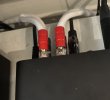
I fried my Qudelix 5K. Fortunately they are sending me a new one, it was within the warranty period. The shipping to Korea was almost the cost of a new one. Here's how it happened: I’m using a Fosi ZA3 amp. The speaker wires had exposed grounds where they connect to the amp. I had the Qudelix plugged into usb, then had a mini - rca cable plugged into the Qudelix. One of the loose rca plugs touched the exposed ground of the speaker wire connection. I put electrical tape over the exposed parts so it won’t happen again. Attached is a picture showing the red electrical tape over the exposed metal parts that the dangling RCA connector touched which caused the Qudelix to fry. I'm hoping the tape will keep anything like this from happening again.
Attachments

Not to mention you can do useful things like configure battery charging behaviour, and set the priority of the input. The last one is actually extremely useful if you listening to music whilst working. I plug mine into my laptop, listen to music and when a teams call comes in it switches right over and back again when I'm done.Hi there , I may be repeating a lot of other comments but for me the Qudelix 5K remains a top choice
1. complete 20 band DSP _ brought my AKG 371 with Brainwave Pads to life
2. Bluetooth is LDAC
3 Battery life is good =6h
4. on USB Connection you really get a High-sound up to 96 KHZ at 24bit from Qubuz or Tidal
5. when listening in an environment with a lot of people around I recommend the original AGG 371 headphones with the Brainwaves velour replacement
6. but if you're alone and nobody cares about the noise level go for the HD6XX with the corresponding Auto EQ curve that you van download from the Quedix App
To sum this up:
you need a 4 G compatible phone.
you need an external Digital to Analog Audio Converter =here the
Qudelix DAC serves has an amplifier
the best connection from you phone is US, but of course that is not always comfortable, so *Bluetooth' . The sad thing about basic Bluetooth is that is wasn't design for music but general data:
the result is general Bluetooth sounds .... PRETTY BAD!! As a consequence a couple of companies such as Apple and Sony have developed optimized Bluetooth protocols: they are called AptX or LDAC
This Qudlix K5 handles both of and when you combine it with an Sennheiser HD6XX you can invite you wife to week of wonderful holidays because of the all snake oil that you did not spend
Just to clarify two things in your post for others:Hi there , I may be repeating a lot of other comments but for me the Qudelix 5K remains a top choice
1. complete 20 band DSP _ brought my AKG 371 with Brainwave Pads to life
2. Bluetooth is LDAC
3 Battery life is good =6h
4. on USB Connection you really get a High-sound up to 96 KHZ at 24bit from Qubuz or Tidal
5. when listening in an environment with a lot of people around I recommend the original AGG 371 headphones with the Brainwaves velour replacement
6. but if you're alone and nobody cares about the noise level go for the HD6XX with the corresponding Auto EQ curve that you van download from the Quedix App
To sum this up:
you need a 4 G compatible phone.
you need an external Digital to Analog Audio Converter =here the
Qudelix DAC serves has an amplifier
the best connection from you phone is US, but of course that is not always comfortable, so *Bluetooth' . The sad thing about basic Bluetooth is that is wasn't design for music but general data:
the result is general Bluetooth sounds .... PRETTY BAD!! As a consequence a couple of companies such as Apple and Sony have developed optimized Bluetooth protocols: they are called AptX or LDAC
This Qudlix K5 handles both of and when you combine it with an Sennheiser HD6XX you can invite you wife to week of wonderful holidays because of the all snake oil that you did not spend
1. The Qudelix 5K does not have an analog input so you do not need an external DAC other than the 5K since the 5K acts as the USB DAC and amp (assume this is what you were trying to say).
2. You are coresct in that the LDAC codec is Sony's. However, aptX, aptX HD, aptX adaptive, etc. is Qualcomm, not Apple. I believe Apple generally uses AAC (their own codec). If you have an Apple device, you will not be able to use LDAC or aptX (or any of its higher bitrate variants) with the Qudelix 5K.
Have had my 5K since 2020 and it is still going strong. Very happy with the device for portable everyday use.

somebodyelse
Master Contributor
- Joined
- Dec 5, 2018
- Messages
- 7,153
- Likes
- 7,160
And Google has started using Opus, probably to avoid having to pay licensing to any of the above.You are coresct in that the LDAC codec is Sony's. However, aptX, aptX HD, aptX adaptive, etc. is Qualcomm, not Apple. I believe Apple generally uses AAC (their own codec). If you have an Apple device, you will not be able to use LDAC or aptX (or any of its higher bitrate variants) with the Qudelix 5K.
Similar threads
- Replies
- 3
- Views
- 399
- Replies
- 6
- Views
- 1K


- Replies
- 8
- Views
- 1K

- Replies
- 7
- Views
- 4K
- Replies
- 0
- Views
- 549