• Welcome to ASR. There are many reviews of audio hardware and expert members to help answer your questions. Click here to have your audio equipment measured for free!

How to eliminate 120hz ground noise

blestin

Active Member
Joined
Jan 17, 2021
Messages
107
Likes
89
Maybe someone can help me out here with a technical problem. I am having a buzzing noise (maybe 120hz) coming out of my BMR tweeter and I figured out it is caused by a ground loop. I finally pinpointed it to my TV, by connecting a ground lift the the power cord which eliminated the the buzzing. (Warren Coleman’s advise)

Obviously a ground lift is a not a safe long term solution, what device do I need to purchase to eliminated this ground noise?

Warren from VTV recommended I try “adding a 100 ohm resistor from outlet ground to the ground tab and see if that breaks it.” Not sure how to go about doing that.

Options: Ebtech Hum X or Furman AC-215A power conditioner
 
120Hz usually comes from an inadequately filtered full wave rectifier type DC supply. Either filters caps are worn out, or excessive current draw is causing the 120Hz ripple.
 
120Hz usually comes from an inadequately filtered full wave rectifier type DC supply. Either filters caps are worn out, or excessive current draw is causing the 120Hz ripple.

What solution do you recommend, I think I would prefer to try a ISO-Max input isolator as a last resort.
 
If you have the isolator, give it a whirl. if it works, you're home free. If not, then you may need to get the unit serviced. If you are not sure that the frequency of the buzzing is 120Hz, and not just 60Hz with some fuzz on it (which would indicate possible grounding issues), then trying isolators or different interconnects might just work. If it is truly 120Hz, then that indicates an internal problem with a power supply in the equipment. Keep in mind that some interconnects connect the cable's shield to just one of the two connectors on them. Reversing the direction of such interconnects may have a beneficial effect.
 
Two ideas.
1) Move to Australia. No pesky 60 H/120 Hz here.
2) Never remove a protective ground unless your are trained and competent in earthing and MEN systems. It's more complicated than you think, and people die when they get it wrong. Sorry, that's not strictly correct - lots of times nothing happens and sometimes they just kill their loved ones. Yes, it takes more than one thing going wrong to get hurt, but since you have a hum issue you already need to start thinking that at least one thing isn't exactly right
 
Another thing to keep in mind is that if your system has, say, 3 power cords, they should all plug into the same AC circuit. I use one of those 15 amp power strips and plug all my components into that, and the single cord of the strip plugs into a wall outlet. My components do not draw enough current to overload the outlet. Components in the setup plugged into different outlets on different house circuits may invite a ground loop. For safety's sake do not use ground lifters on your equipment!
 
I tried plugging the TV into the same power strip but the issue persists, everything else is plugged into the same strip already as you suggested.
 
Last edited:
Get one of those outlet strips that also has surge suppressor for TV coax.
But I can't guarantee that it will have bandwidth for all the channels.
 
What are all the components that participate in the signal ground loop? If you decide to use a cheater plug to lift the ground on the Tv you could always run a low resistance wire from the chassis to the chassis of the other component if they are not too far apart so they have a single ground.

https://www.audiosciencereview.com/forum/index.php?threads/ground-loops-101.7162/


Are you kidding or are you...?

Depending on the equipment setup, the configuration you suggest will allow all of the equipment connected with the low resistance wire to potentially injure or kill someone.

Using a cheater plug is dangerous, the chassis on the piece of equipment with the cheater plug could have line voltage on it in a fault condition. Tying that chassis to other chasses could allow all of the chassis to have a dangerous voltage.
 
Are you kidding or are you...?

Depending on the equipment setup, the configuration you suggest will allow all of the equipment connected with the low resistance wire to potentially injure or kill someone.

Using a cheater plug is dangerous, the chassis on the piece of equipment with the cheater plug could have line voltage on it in a fault condition. Tying that chassis to other chasses could allow all of the chassis to have a dangerous voltage.

No, not kidding, just trying to understand the whole concept of grounding without becoming an electrical engineer. I withdraw the comment to tie the chassis together. But using the cheater plug broke the signal ground loop. What else could be done to break a signal ground loop? Obviously creating a star ground with the power cables to an outlet doesn’t work.

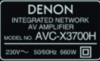
i had hum from a signal ground loop between a Denon 3700X and amp. Either lifting the ground on the DC trigger cable or wiring the shield to the signal ground terminal eliminates the hum. Now when the hum is originating in a TV, would lifting the ground from one end of the HDMI cable, or using a toslink instead of ARC work? I find it interesting that this thread also involves a Denon 3700x. In my case it was the only component in my whole setup with a 2 wire A/C cord.
 
Last edited:
I don’t have the time today to work on this or answer everybody, but thank you all for the helpful advice.
I will try to make time for this tomorrow. I can say that I did buy and try the Furman power conditioner, it did absolutely nothing for the problem. I even tried connecting everything to it to the conditioner and the same outlet. Will try the Hum X next as its quite simple to test.
 
OP, we'd need a complete breakdown of the system. Crystal balls are in kind of short supply these days, you know. It sounds like a fairly typical ground loop issue with unbalanced connections in a nontrivial system with multiple grounds but it will be hard to pinpoint the root cause without knowing the components and connections involved.
 
Currently I have the TV connected by HDMI ARC to my system. There is nothing else connected to the TV except that 1 HDMI cable going to the AVR.

My system is a LG TV —> HDMI to Denon 3700x —> Benchmark RCA to XLR cable —> VTV Eval1 amplifier —> Bluejeans speaker cable —> Philharmonic BMR
 
What are all the components that participate in the signal ground loop? If you decide to use a cheater plug to lift the ground on the Tv you could always run a low resistance wire from the chassis to the chassis of the other component if they are not too far apart so they have a single ground. Ok, don’t do that.

https://www.audiosciencereview.com/forum/index.php?threads/ground-loops-101.7162/


No, not kidding, just trying to understand the whole concept of grounding without becoming an electrical engineer..

" use a cheater plug "
All is said in the word you used and it should warn yourself and your assessment ..

AC is as dangerous as putting your fingers in the outlet.
Grounding (in the meaning of earth ground) saves your life if you have the correct equipment in your electrical board.

1617433912985.png
 
Last edited:
Ok. Bad idea. Don’t use a cheater plug then, and don't connect the two chassis together. Don't do that. Got it.

But there must be a slight difference in the ground between the TV and the Denon receiver to create the hum in this case, right? Is there some way to use the signal ground terminal on the Denon 3700 to eliminate the hum? Maybe somehow connecting the signal ground terminal to the signal ground of the HDMI cable?

Alternatively, if the TV has an optical out, would switching audio over to an optical cord while continuing to use the HDMI for video, might that eliminate the hum in the audio chain, or would the hum still make its way in through the video chain? Just trying to think of ways to break the ground loop.
 
Last edited:
Currently I have the TV connected by HDMI ARC to my system. There is nothing else connected to the TV except that 1 HDMI cable going to the AVR.

My system is a LG TV —> HDMI to Denon 3700x —> Benchmark RCA to XLR cable —> VTV Eval1 amplifier —> Bluejeans speaker cable —> Philharmonic BMR
As @Jbrunwa mentioned, the Denon AVR has a 2-prong power connector, so no ground connection. I would try grounding the chassis, via the grounding screw near the phono input, to the power strip. Generally, I like to ground everything properly first, then only if the problem persists look at breaking loops.
 
As @Jbrunwa mentioned, the Denon AVR has a 2-prong power connector, so no ground connection. I would try grounding the chassis, via the grounding screw near the phono input, to the power strip.
Agreed. The rest all seems to check out.

It's probably the TV's power supply mains filter leakage currents that are giving problem here - they are making their way via HDMI shield and RCA > XLR cable to mains PE at the amplifier. Since HDMI should not be caring much one way or another [1], you may divert them to ground either at the TV itself (e.g. via a satellite / cable / antenna connection or a shielded network cable to an earthed switch or other apparatus) or at the receiver (shielded network cable, phono grounding screw to mains PE).

[1] Well, in the olden days of the AVR-X2000 and such, Denon receivers used to be infamous for HDMI hiccups relating to ground loops (essentially a Pin 1 Problem equivalent), I hope they've improved since then.
 
Ground loop intro: https://www.audiosciencereview.com/forum/index.php?threads/ground-loops-101.7162/

Potential solutions involve breaking the "loop" at the AC line or component (most) responsible for the loop. Some examples:

AC line: https://smile.amazon.com/Ebtech-Hum...dchild=1&keywords=hum-x&qid=1617480089&sr=8-2
Interconnect (line-level) isolators: https://smile.amazon.com/s?k=ground+isolator&ref=nb_sb_noss_1
Cable isolator (cable/satellite boxes are somewhat notorious): https://smile.amazon.com/s?k=cable+ground+isolator&ref=nb_sb_noss_2

There are many, natch, so you should be able to find one meeting your needs.

HTH - Don
 
Usually a metal housing has only 2 prongs because it's isolated, and this AV amp shows it's isolated. So I don't think that grounding the chassis will help.
1617481896367.png


The hum can be caused for many reasons.
Transformer buzz, or vibrations that are amplified.
It could be also current potential leakage. Maybe the amp is not well isolated after all. This can be measured with simple multi-tester . Also reversing the power cord (turning it by 180°) could help.
 

Attachments

  • 1617481142028.png
    1617481142028.png
    98.9 KB · Views: 219
Last edited:
Back
Top Bottom