Isn’t the volume on SACD 6db lower to begin with ? Maybe they wanted to match the volume of CDs and SACDs.
The Denon resamples everything to pcm in the end .
About the level of DSD signals on SA-CD, the situation is more complicated than that.
The
Scarlet Book (SA-CD specifications) specifies that 0 dB SA-CD is equal to 50% DSD modulation index. That means that DSD signals can theoretically go up to +6 dB at the onset of clipping, but the specifications also mandates two limitations, short term and medium term peaks, the former being equivalent to a maximum +3.1 dB. These rules are stated in Annex D of part II of the Scarlet Book.
The Scarlet Book also
recommends (in Annex E) that fully modulated CD Audio signals (ie 0 dBFS) should output the same analogue level than fully modulated DSD signals as per the above specifications (ie 0 dB SA-CD). So theoretically, with CD/SA-CD players following both this rules and recommendation, DSD signals may be able put slightly higher analogue level (+3.1 dB) out than CD Audio PCM signals.
The usually quoted phrase "DSD signals have 6 dB lower level than PCM" originates from the fact than when DSD is decimated in PCM, as it is sometimes done for whatever reasons, the maximum theoretical 100% DSD modulation index (ie +6 dB SA-CD) should be aligned with 0 dBFS in order to avoid clipping the digital signal in the PCM domain at all cost. This graph out of the NPC SM5819 DSD to PCM decimation filter chip
datasheet illustrates that point (comments in red are mine):
On this above graph, it is shown that, on this particular chip, when DSDGAIN is set to "low" (L), the actual 0 dBFS peak signal produced by the decimation filter is set to correspond to 100% DSD modulation index, which has the effect of applying a -6dB attenuation on any DSD signal. But, as is implied on this graph, there is another setting on this chip (DSDGAIN "high" [H]) with which 0 dBFS is aligned on 50% DSD modulation index (the 0 dB SA-CD). That means that, when this particular chip is used, it can not be taken for granted that the DSD level is 6 dB lower than the PCM signal. When DSDGAIN is set "high" on this chip, DSD signals that comply with the Scarlet Book specifications can saturate in the PCM domain.
The relationship between DSD and PCM maximum levels can be made even more complex by many other factors, not the least of which being that some early SA-CDs pressed at the end of the 1990s and the beginning of the 2000s decades do not comply with the Scarlet Book specifications because, at that time, reliable DSD level metering systems did not exist yet. The most famous example of this is the original Sony SA-CD release of
Michael Jackson album's Thriller, that is overmodulated in the DSD domain. I can myself speak about the SA-CD release of Puccini's
Turandot opera in the RCA Living Stereo serie: I have discovered the hard way that this SA-CD release is also overmodulated in some passages. Some of my SA-CD players play back this latter SA-CD flawlessly; others don't and put out gross distorsion or mute the output depending on some settings of the players.
And, most importantly, many dual domain (PCM and DSD) digital to analogue converter chips do not have the same output level at 0 dB when converting one form of signal or the other depending on the conversion method they employ. So, some gain adjustement, either in the digital or analogue domain (or both) have to be made in order to align the analogue output level in each mode of operation.
So, the situation is all but simple.
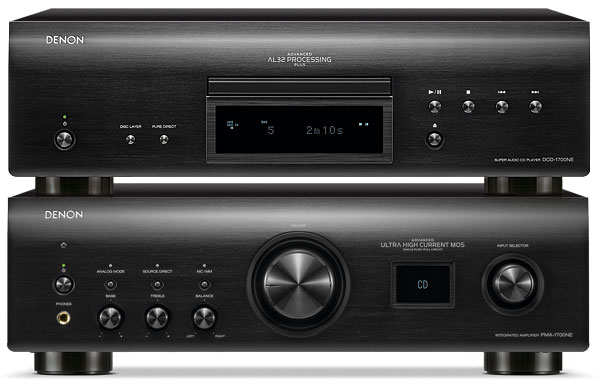
As far as the Denon SA-CD player is concerned, I do not know which one you speak of, the DCD-SA1 or the DCD-1700NE, but neither perform decimation of DSD signals into PCM (except when the optional decimation stage of the DCD-SA1 is enable). They both use Burr Brown digital to analogue converter chips: PCM1792 in the DCD-SA1, PCM1795 in the DCD-1700NE. The designers of this family of chips have described their mode of operation when conversion of DSD signal occurs: digital filtering is applied on the DSD signal, but no decimation (lowering of sample rate down to PCM level) takes place. See
post #176 of another thread about that issue.