@Veganfloyd, one Audyssey tip I can offer: your fronts are showing that characteristic 1.8kHz dip. Since you have the app, turn off Midrange Compensation (MRC).

-
Welcome to ASR. There are many reviews of audio hardware and expert members to help answer your questions. Click here to have your audio equipment measured for free!
You are using an out of date browser. It may not display this or other websites correctly.
You should upgrade or use an alternative browser.
You should upgrade or use an alternative browser.
Denon AVR-X3800H sounds bass-heavy to my ears and markedly different (worse) than the subjectively flat AVR-X3600H - why?
- Thread starter Veganfloyd
- Start date
-
- Tags
- denon avr-x3800h
Yes, it's SINAD related but I rather have 2.0V (Pre-out only) going to an external amplifier vs 1.4V (Spkr + Pre-out)!
That's the misleading part though if you don't mind, because someone could interpret that as limited to 1.4 V when choosing speaker+preout, that is clearly false. Either way you will still get the same, or almost the same output voltage limit, right up to at least 3.5 V, if not the maximum limited by the volume control IC and opamps in the pre out signal path. At closer to the limit, such as 4 V, yes SINAD will likely drop to lower than 70 dB, but clipping is generally considered as SINAD reaching about 40 dB, that is 1%.
I used the following as an example a few time, but that's long time ago so I thought I should post it for new comers to see:
The X3300W, is 3 to 4 generations older than the current X3800H, it absolutely has no preamp mode, that is only speaker+preouts, volume control, opamp, dac ICs and circuitry were all very similar to the X3400H through X3800H.
Denon AVR-X3300W 7.2 Atmos/DTS:X A/V Receiver Review
The Denon AVR-X3300W 7.2CH Atmos/DTS:X networking AV receiver features the latest in HD audio and video processing, music streaming and offers future expandability with solid preamp outputs.
 www.audioholics.com
One can just read Gene's comments, if not the whole review:
Denon AVR-X3300W Preamplifier Measurements
One thing I really love about Denon receivers is they NEVER skimp on their preamp out circuits. Like past models, the AVR-X3300W had an ample amount of drive. I measured a whopping 4.5Vrms unclipped output, which is more than double the voltage needed to make virtually any amplifier reach full rated power. Yamaha please pay attention and step your game up particularly with your AV receivers in this price range that clip above 1.6Vrms. A preamp output of less than 2Vrms is unacceptable in my book.
Agreed on all points. A simple toggle gets you “free additional performance” so why not?That's the misleading part though if you don't mind, because someone could interpret that as limited to 1.4 V when choosing speaker+preout, that is clearly false. Either way you will still get the same, or almost the same output voltage limit, right up to at least 3.5 V, if not the maximum limited by the volume control IC and opamps in the pre out signal path. At closer to the limit, such as 4 V, yes SINAD will likely drop to lower than 70 dB, but clipping is generally considered as SINAD reaching about 40 dB, that is 1%.
I used the following as an example a few time, but that's long time ago so I thought I should post it for new comers to see:
The X3300W, is 3 to 4 generations older than the current X3800H, it absolutely has no preamp mode, that is only speaker+preouts, volume control, opamp, dac ICs and circuitry were all very similar to the X3400H through X3800H.
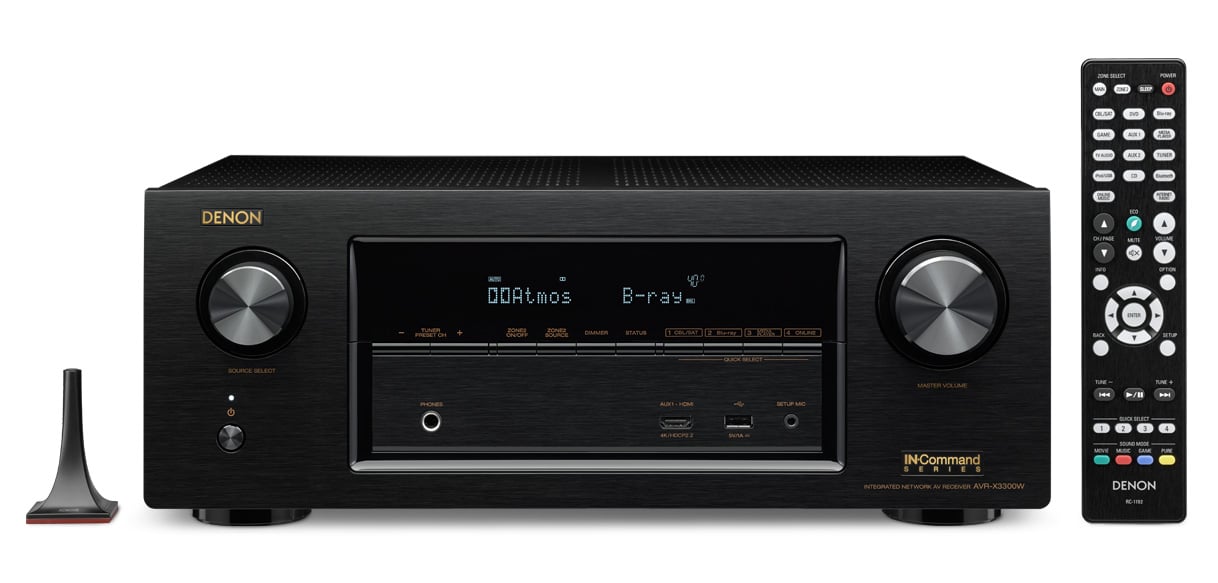
Denon AVR-X3300W 7.2 Atmos/DTS:X A/V Receiver Review
The Denon AVR-X3300W 7.2CH Atmos/DTS:X networking AV receiver features the latest in HD audio and video processing, music streaming and offers future expandability with solid preamp outputs.
One can just read Gene's comments, if not the whole review:
Absolutely, for example, I have taken enough measurements to know that in any of my rooms, even 1 V will be more than enough for my power amps based on my listening habit, amp gain and speaker sensitivities, but given the choice I would definitely target devices that can do up to 4 V/8 V RCA/XLR at SINAD no less than 70 dB.Agreed on all points. A simple toggle gets you “free additional performance” so why not?
For those who don't have the luxury to ensure 4 V at high SINAD, could ease their mind by reminding themselves of the table pre out Vrms vs amp gain vs power amp output table I posted in the X6700H thread a few days ago:

Denon AVR-X6700H with Buckeye NCx500
I know this has been beat to death...but i still have not found a definitive answer: I want to use pre-amp out on my Denon AVR-X6700H (L/C/R) and also use the Avr's remaining internal amps for the remaining Atmos/Auro speaker array (11.1). When used in this fashion, the Denon's pre-amp output...
www.audiosciencereview.com
For the 25.5 dB gain buckeyeamps, just 1.4 V will drive it to 174 W, 4 ohm load. Most people listen to spl with a few watts average with peaks to 100-300 W, so 1.4 V will be able to achieve such use. For me, the average power I need is less than 0.5 W 8 ohms, or 1 W 4 ohms, so even for the very high peaks in movies, it would not exceed 100 W.
Again, let me repeat, if possible I fully agree with EWL, go with preamps that can output 4 Vrms if unbalanced RCA, that way you will have tons of headroom that you hopefully never need but things will sound better psychologically because you know you have lots of reserve.

| Gain: | 25.5 dB | |
| Pre out Vrms | Power amp Vout | Power amp output W |
| 1.4 | 26.37 | 173.86 |
| 1.6 | 30.14 | 227.08 |
| 1.8 | 33.91 | 287.40 |
| 2 | 37.67 | 354.81 |
| 2.2 | 41.44 | 429.32 |
| 2.4 | 45.21 | 510.93 |
| 2.6 | 48.97 | 599.63 |
| 2.8 | 52.74 | 695.43 |
| 3 | 56.51 | 798.33 |
| 3.2 | 60.28 | 908.32 |
OP
Veganfloyd
Member
- Joined
- Dec 17, 2020
- Messages
- 38
- Likes
- 9
- Thread Starter
- #25
Don't get offended warning (as I may be stating the obvious things you already know...): In order to understand why, you should first make sure you are comparing apples to apples and it is easier to do if you just use 2 channel in direct mode to eliminate the effects of DSP, and go from there. Then you need to compare without knowing which one you are listening to, this part is difficult to do for the obvious reasons, but if you know which one you are listening to then it doesn't matter what you think you are hearing, as very few people, if anyone, are not influenced by "knowing which one.....".
Did you compare in direct/pure direct mode with no DSP/Audyssey? As above if done sighted, it wouldn't count but if the differences were really "large", and was done in pure direct mode under the exact conditions (speakers, contents listened to, placements etc.), then I would say it is worth measure the actual frequency response with REW, the Umik-1 mic costs $79 plus shipping, you will need that if you don't have one yet.
That's generally true when no dsp functions are involved, with dsp in use, there will be audible differences, from subtle to the so called night and day kinds, it depends..
As soon as you started comparing with DSP in use, and even with Audyssey then it gets complicated and personal preference will start to dominate. For example, what you consider as bass heavy could be just fantastic for others. So on that, I would just wait and see what others have to say, as for me, once it gets into the subjective territory, there is nothing for me to say that could be helpful at all.
Thank you. The perceived differences described in my original post are apparent both pre-calibration, with Audyssey and in Direct mode. The description of the impact of different correction software choices was meant to illustrate the extent of the bass issue. Apologies for not stating the former clearly.
To clarify further with regards to advice from @palm , I do not use any dynamic EQ options.
I do have the UMIK mic, but I would need to learn how to take the measurements. I would be keen to do so, but I have never done it and might not have the time to learn in the immediate future if there is a high learning curve.
Last edited:
OP
Veganfloyd
Member
- Joined
- Dec 17, 2020
- Messages
- 38
- Likes
- 9
- Thread Starter
- #26
I believe that I found the cause and a potential solution.
Adding a subwoofer in the speaker layout settings (without actually adding a physical subwoofer to the setup) appears to fix the issue. This is without applying any crossover, i.e. all speakers set to 'full range' before and after this change in the settings. My guess is that by default Denon AVR-X3800H forces the LFE channel or the low-pass filter content derived for the subwoofer outs into the front speakers, thus effectively doubling the low-frequencies. Ironically, there are settings available to chose whether the LFE content should be added to non-subwoofer speakers and which ones, but they are inaccessible without a subwoofer(s) present in the Speakers Layout section.
The downside of this 'fix' is that both my Audyssey and Dirac calibrations were removed. Understandably so, but in the case of Audyssey this means the necessity to have a subwoofer at hand to complete the calibration as Audyssey stops if no sound is detected, and a major waste of time to re-run everything (11 speakers + now subwoofer, 8 positions, multiple retakes needed for unexpected sounds over the several minutes needed per position). I need to investigate if I can get a make-believe subwoofer added in Dirac more easily.
Adding a subwoofer in the speaker layout settings (without actually adding a physical subwoofer to the setup) appears to fix the issue. This is without applying any crossover, i.e. all speakers set to 'full range' before and after this change in the settings. My guess is that by default Denon AVR-X3800H forces the LFE channel or the low-pass filter content derived for the subwoofer outs into the front speakers, thus effectively doubling the low-frequencies. Ironically, there are settings available to chose whether the LFE content should be added to non-subwoofer speakers and which ones, but they are inaccessible without a subwoofer(s) present in the Speakers Layout section.
The downside of this 'fix' is that both my Audyssey and Dirac calibrations were removed. Understandably so, but in the case of Audyssey this means the necessity to have a subwoofer at hand to complete the calibration as Audyssey stops if no sound is detected, and a major waste of time to re-run everything (11 speakers + now subwoofer, 8 positions, multiple retakes needed for unexpected sounds over the several minutes needed per position). I need to investigate if I can get a make-believe subwoofer added in Dirac more easily.
OP
Veganfloyd
Member
- Joined
- Dec 17, 2020
- Messages
- 38
- Likes
- 9
- Thread Starter
- #27
I checked the analogous impact of adding a subwoofer in the settings Denon AVR-X3600H on my subjective listening experience. This is again without adding a physical subwoofer and with all speakers set to full range. There was also a bass reduction, consistent with the behaviour of the X3800H. However, the low frequencies became too quiet, buried in the mix and lacking impact, as though a crossover was applied contrary to the settings.
In summary:
1. Denon AVR-X3800H without a subwoofer - way too much bass. Sounds defective.
2. Denon AVR-X3800H without a subwoofer + subwoofer on in the settings or Denon AVR-X3600H without a subwoofer - balanced sound in the same ballpark.
3. Denon AVR-X3600H without a subwoofer + subwoofer on in the settings - way too little bass.
I will hope to learn to take REW measurements with my UMIK and follow-up with objective measurements, though it might be weeks from now.
In summary:
1. Denon AVR-X3800H without a subwoofer - way too much bass. Sounds defective.
2. Denon AVR-X3800H without a subwoofer + subwoofer on in the settings or Denon AVR-X3600H without a subwoofer - balanced sound in the same ballpark.
3. Denon AVR-X3600H without a subwoofer + subwoofer on in the settings - way too little bass.
I will hope to learn to take REW measurements with my UMIK and follow-up with objective measurements, though it might be weeks from now.

gfx_1
Active Member
- Joined
- Nov 9, 2019
- Messages
- 142
- Likes
- 105
Just replaced my Marantz SR6007 because the input board didn't work anymore with a Denon X3800h Because it seemed an affordable option at 790 euro (777 german euros) and I never liked the small Maranz circular display. Both were used with the onboard amplifiers and no room correction yet. Cats don't like the setup noises and not enough time in a day. I tried Audyssey with the Marantz but didn't like the end result, so left it off.
I listened to some music and a film maybe a bit more low but not that I noticed it. Setup screens have hugely improved and the HEOS app works alright. No problems playing flac from the raspberry pi (via minidlnad) Speaker setup is still the same two large fronts, no sub because they go low enough and two bookshelf surrounds. No idea what to do with all the leftover channels. It didn't come with Dirac that seems an expensive option.
Did read the original review from Amir but forgotten about it until after ordering
Earc works but that really old hdmi cable needed replacing. Standards have changed not all hdmi cables are the same.
I listened to some music and a film maybe a bit more low but not that I noticed it. Setup screens have hugely improved and the HEOS app works alright. No problems playing flac from the raspberry pi (via minidlnad) Speaker setup is still the same two large fronts, no sub because they go low enough and two bookshelf surrounds. No idea what to do with all the leftover channels. It didn't come with Dirac that seems an expensive option.
Did read the original review from Amir but forgotten about it until after ordering
Earc works but that really old hdmi cable needed replacing. Standards have changed not all hdmi cables are the same.
Just replaced my Marantz SR6007 because the input board didn't work anymore with a Denon X3800h Because it seemed an affordable option at 790 euro (777 german euros) and I never liked the small Maranz circular display. Both were used with the onboard amplifiers and no room correction yet. Cats don't like the setup noises and not enough time in a day. I tried Audyssey with the Marantz but didn't like the end result, so left it off.
I listened to some music and a film maybe a bit more low but not that I noticed it. Setup screens have hugely improved and the HEOS app works alright. No problems playing flac from the raspberry pi (via minidlnad) Speaker setup is still the same two large fronts, no sub because they go low enough and two bookshelf surrounds. No idea what to do with all the leftover channels. It didn't come with Dirac that seems an expensive option.
Did read the original review from Amir but forgotten about it until after ordering
Earc works but that really old hdmi cable needed replacing. Standards have changed not all hdmi cables are the same.
Dirac Live has been offering something like a 30% discount once in a while so if you are not that interested in it you can wait for the next big sale. In my opinion/experience it s worth it. You may not prefer the resulted bass but on paper it is clear that it should improve the bass range for sure while in the above 500-1000 Hz range it would likely depend on your specific set up that is affected by a few other factors.
Similar threads
- Replies
- 12
- Views
- 2K

- Replies
- 4
- Views
- 941

- Replies
- 5
- Views
- 657


- Replies
- 7
- Views
- 987