• Welcome to ASR. There are many reviews of audio hardware and expert members to help answer your questions. Click here to have your audio equipment measured for free!

Yamaha A-1 Vintage Amplifier Review

In 1983, I had a Yamaha that looked identical to this R700, but mine was 70wts a channel and this one is 50wts, so I have no idea what it actually was.
Sounds like the R-900.


1686362806422.png

source: https://www.hifiengine.com/hfe_downloads/index.php?yamaha/yamaha_r-900_brochure_en.pdf

I had a dump-find R-700 that had issues... although I still have a dump-find R-1000 that works properly (so far). The R-700/900/1000 models had some issues with inadequate heat-sinking on some components that rendered them quite failure prone, if memory serves. EDIT: I'll bet @restorer-john rememembers all of the gory details right off the top of his head! ;)


(R-1000 on the bottom)
 
By the late 70's Yamaha was using Sanyo STK monolithic amplifier modules in their receivers instead of discrete transistors. So they were cutting cost. IMO, none of them were anything special. And now, they're nearly impossible to repair when they fail. Can't get parts.
 
Sounds like the R-900.


View attachment 291213
source: https://www.hifiengine.com/hfe_downloads/index.php?yamaha/yamaha_r-900_brochure_en.pdf

I had a dump-find R-700 that had issues... although I still have a dump-find R-1000 that works properly (so far). The R-700/900/1000 models had some issues with inadequate heat-sinking on some components that rendered them quite failure prone, if memory serves. EDIT: I'll bet @restorer-john rememembers all of the gory details right off the top of his head! ;)


(R-1000 on the bottom)
It was the 900! I remember it didn't have the frame the 700 has and was dark like the one you posted. And they 'boast' a -76dB THD. Crazy. The Aiyima 08 Pro is better than that, plus it's rated at THD+N. Amazing.
 
By the late 70's Yamaha was using Sanyo STK monolithic amplifier modules in their receivers instead of discrete transistors. So they were cutting cost. IMO, none of them were anything special. And now, they're nearly impossible to repair when they fail. Can't get parts.
No way man. They said on the box they had "MOSFET" amplifiers! LOL Oh the marketing back then. :facepalm:
 
I was thinking of getting one of these as an amp for my turntable and maybe later pairing it with a dedicated power amp down the road (and just using it for the phono/pre), but then saw this 1 page back

Also, there is no real pre-out with this amp. That "pre-out" comes directly from the main amp. That's why there is no separate input for the power amp I guess.

Is this bad? Not a real pre-out? Does this mean I should only use it as an integrated?
 
The specs Yamaha listed for A-1 pale in comparison to their M- and MX- lineup of power amplifiers.
So I am bit confused why people are getting excited by the A-1? Some M- and MX- models can be had for around the same price or slightly more.
On top of the performance they are some of the best looking vintage amps ever made.


I have MX-50. Which is entry level in this lineup.

css06o.jpg


Specs for M-80
52jrc7.jpg


Specs for MX-1000
4s4nh7.jpg


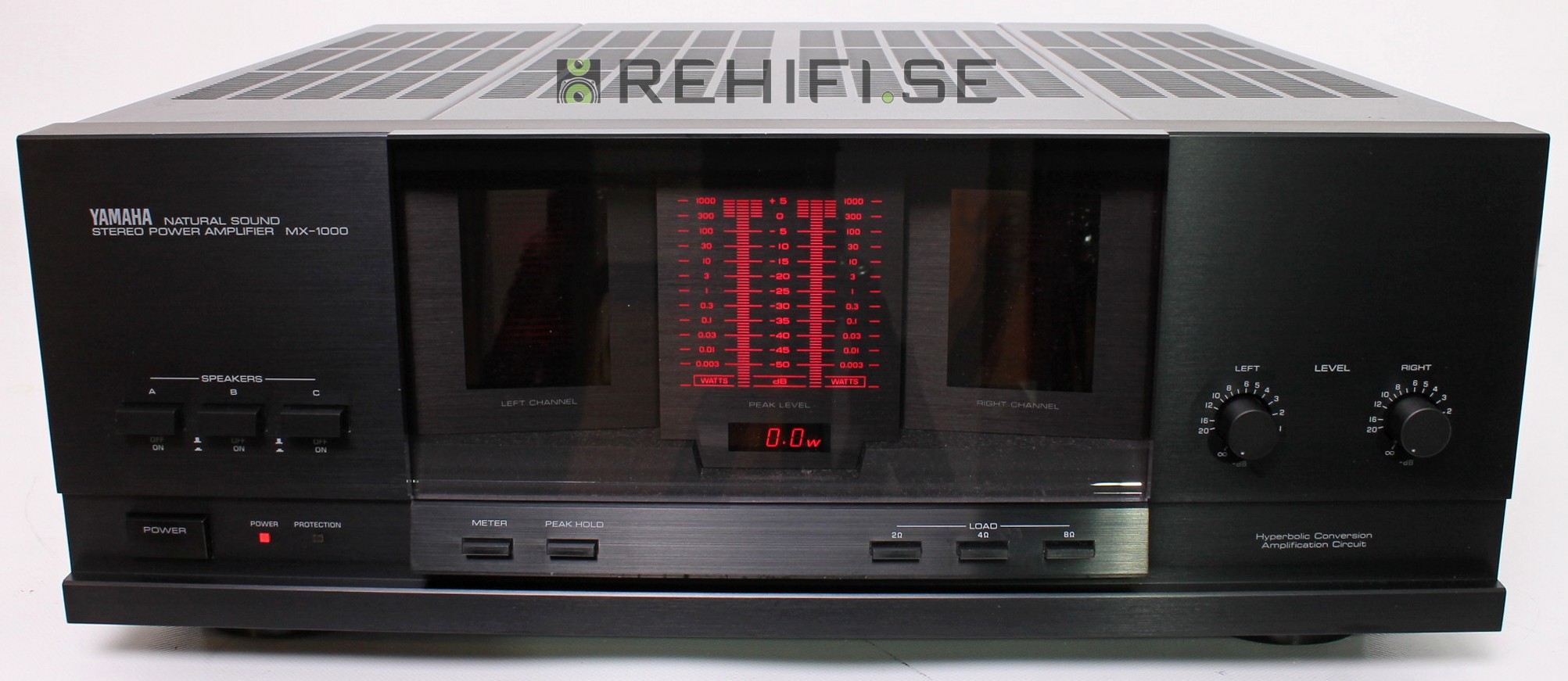
Yamaha-MX-1000-60250.JPG
 
Can't comment on why it's better than the 80s stuff outside of build quality, but I did buy one and recently recapped it while cleaning some other stuff up so far (havent done the big caps yet). That said, it absolutely sings now vs. when I first picked it up.

Some thoughts...
I'm not sure the benefit to the DISC mode just yet, comparing it to Phono w/ Tone disabled is very hard to pick out what's shifting, if anything. Has anyone else had experience with it being beneficial? I tested with my headphones and while there was a difference, it was like switching DAC filters, and there was no wrong or consistent answer. DISC had slightly more crispness on the vocals but through the pre-amp I think it sounded more enjoyable. Blind testing and picking moments where I preferred the sound was pretty split and probably depends on the song. Eh...

I don't currently have a subwoofer to attach so using the tone controls and boosting the bass is very useful with my Klipsch RP-600Ms. While I love EQing and tone controls, the drawback is usually them being noisy and also boosting underlying noise. This thing is dead silent, it's almost unbelievable. To compare I also have a Yamaha C-4 pre-amp from the era (much more expensive) and their top of the line EQ from the 80s, and both have faults and add levels of (tolerable) noise. This flaw is easier to pick up with headphones, and I can say that when cranking the bass with tone enabled, I'm just not hearing any noise enter the signal. This vintage engineering really puts something like the Schiit Loki / Lokius to shame, especially since they market those units as being better than vintage despite being noisy as hell.
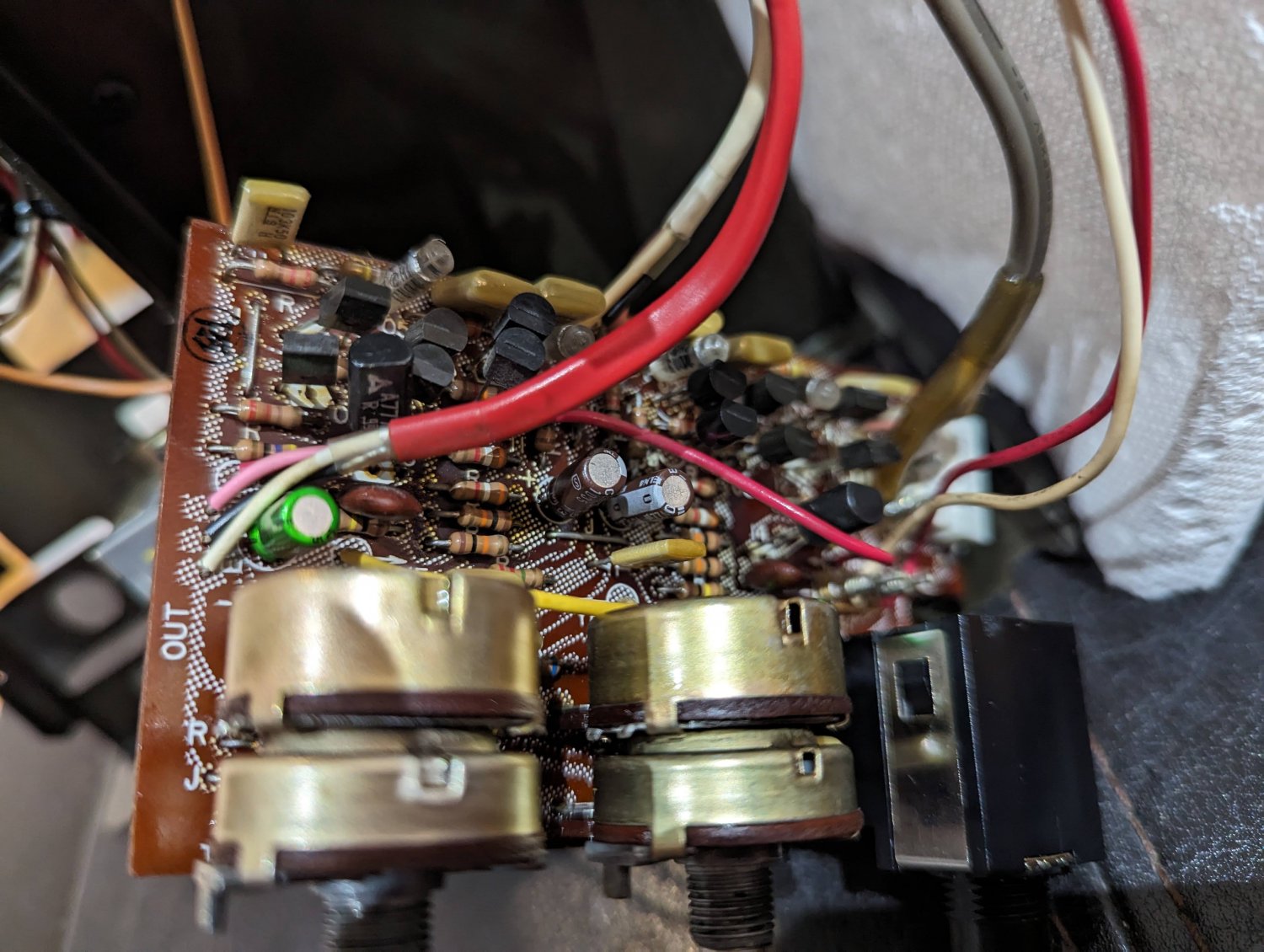
PXL_20230929_041706568.MP.jpg


Speaking of headphones...oh boy. While I have the C4 as a dedicated headphone amp, since it has a dedicated headphone amp built in, the A1 has the headphones built into the tone board and like most integrateds it's an afterthought. Interestingly, though, is just how quiet this thing is even with headphones. Usually its easy to pick up on junk noise with 300ohm headphones once things get moderately loud - even on my modern headphone amps I notice it with high enough gain, and especially with an EQ in the loop. What the A1 is doing here is nothing short of magical to me. I can crank the bass, and crank the volume to head-exploding levels and it's just eerily silent. The 1978 C4 has a dedicated HP board and has noise, the A1 doesn't - go figure. That being said, the A1 is too big, heavy, and hot to use as a headphone amp, but it's interesting to me nonetheless.

As far as normal music listening goes I'm very impressed so far. My current/previous amp for vinyl is a restored Marantz 2225 and its a night and day difference both in quality and headroom. Even using my Bifrost 2 into the AUX I was able to tell it was my Bifrost 2's sound signature, whereas on the Marantz there was nothing special going on (basically bottlenecking the DAC).

Contemplating what to do about the 18,000uf filter caps right now, and still want to clean & re-thermal the transistors in this. New LEDs should be here this week as well. :D
 
I'm not sure the benefit to the DISC mode just yet, comparing it to Phono w/ Tone disabled is very hard to pick out what's shifting, if anything. Has anyone else had experience with it being beneficial?
I mean, it's just an input selector + tone amp bypass, so if all the contacts involved are in good shape the differences should in fact be negligible.
Speaking of headphones...oh boy. While I have the C4 as a dedicated headphone amp, since it has a dedicated headphone amp built in, the A1 has the headphones built into the tone board and like most integrateds it's an afterthought. Interestingly, though, is just how quiet this thing is even with headphones. Usually its easy to pick up on junk noise with 300ohm headphones once things get moderately loud - even on my modern headphone amps I notice it with high enough gain, and especially with an EQ in the loop. What the A1 is doing here is nothing short of magical to me. I can crank the bass, and crank the volume to head-exploding levels and it's just eerily silent. The 1978 C4 has a dedicated HP board and has noise, the A1 doesn't - go figure.
The C4 headphone amp stage is a bit... odd. It has a crapton of gain for some reason.
c4-hpa.png

1 + 10k/150, that's almost 37 dB! And that's following the entire preamp! One thing's for certain, you want to keep the HP LEVEL waaay down at all times. And then a whopping 330 ohm output impedance. That thing could use some reengineering efforts. I can give it a shot if there is any interest. It's a bit tricky since you have to modify the compensation, get the DC balance right and not get into any trouble with the input bootstrapping, plus reducing bias circuit distortion.

With some guesstimates regarding input transistor noise, I'm getting 66 µV of output noise (-83.6 dBV) over a 20 kHz bandwidth. Given that a 300 ohm only sees less than half that, the end result should be about 30 µV (-90ish dBV). While not great, that should not normally be audible in ~103 dB/V Sennheisers.

Try setting HP level on the C-4 such that normal volume is reached at about 11 o'clock on the main volume dial. Still noisy? It should not be.

BTW, the A-1 does not have "the headphones built into the tone board", it is in fact the customary dropper resistor (330 ohm 2 W, apparently) following the power amplifier. And specified residual noise (DISC mode) is in fact just slightly lower than the C-4 at 50 µV. A 112 dB SNR (TONE off) is very respectable in any case, the C-4 scores only 106 dB.
 
  • Like
Reactions: Mat
I mean, it's just an input selector + tone amp bypass, so if all the contacts involved are in good shape the differences should in fact be negligible.

The C4 headphone amp stage is a bit... odd. It has a crapton of gain for some reason.
View attachment 316463
1 + 10k/150, that's almost 37 dB! And that's following the entire preamp! One thing's for certain, you want to keep the HP LEVEL waaay down at all times. And then a whopping 330 ohm output impedance. That thing could use some reengineering efforts. I can give it a shot if there is any interest. It's a bit tricky since you have to modify the compensation, get the DC balance right and not get into any trouble with the input bootstrapping, plus reducing bias circuit distortion.

With some guesstimates regarding input transistor noise, I'm getting 66 µV of output noise (-83.6 dBV) over a 20 kHz bandwidth. Given that a 300 ohm only sees less than half that, the end result should be about 30 µV (-90ish dBV). While not great, that should not normally be audible in ~103 dB/V Sennheisers.

Try setting HP level on the C-4 such that normal volume is reached at about 11 o'clock on the main volume dial. Still noisy? It should not be.

Maybe the high gain design is because it relies on the volume/trim to make it compatible with other impedances? Personally I like to have the the HP volume high, around 7-8, and knock down the overall volume with the main volume. Just the result of trial and error until I was happy. It's incredibly noisy over 9/10 on the hp volume, like it ramps up in the final two notches.

Noise isnt an issue when the 2 volumes are staged adequately, I'm just making a comparison to the A1 going full throttle being silent while the C4 (or any of my other vintage amps for that matter) can't go past 3/10 main volume without noise creeping in and up usually.

BTW, the A-1 does not have "the headphones built into the tone board", it is in fact the customary dropper resistor (330 ohm 2 W, apparently) following the power amplifier. And specified residual noise (DISC mode) is in fact just slightly lower than the C-4 at 50 µV. A 112 dB SNR (TONE off) is very respectable in any case, the C-4 scores only 106 dB.
I guess I just meant the jack itself is on the tone board, nothing special - as you said, customary dropper style
 
There are tone controls (but no balance). I set it to off of course for my testing.
I have had one for years and really enjoy it. There is a balance control. It's the volume dial, there's an inside and outside part of the large dial and they can be turned independently. The only drawback to the unit is as you mentioned, the pesky speaker wire terminals. I have toyed with the idea of replacing them with more modern terminals but can't bring myself to modify a nice original unit (from I believe 1979). I hardly ever see any of these for sale. Were they not a popular unit? My 17 year old self would have drooled over this back then.
 
Aside from a few companies like Benchmark.. and aside from having removed measurement data in their manuals, what exactly have Power Amp makers been doing for the last half decade just wondering?
True enough, but to be fair, may be we can give some credit to some power amp makers who did manage to provide decently comparable quality at very low cost, such as the tiny Yamaha streamer/amp (<$500):

If you look at the distortions of the better channel (red), it is no worse than that of the A1, and is much quieter.

1720615819245.png
 
I hardly ever see any of these for sale. Were they not a popular unit? My 17 year old self would have drooled over this back then.
The A-1 was an relative expensive unit those days, especially for an integrated amp with "only" 70 W/ch. In the seventies I was already interested in "hi fi". It was all about power output and super low distortion those days (a bit like ASR nowadays :)) and you could buy amps with the same specs or better for much less (even from Yamaha!). It was marketed as an audiophile "high end" product, designed with good sound quality in mind. Look at the pictures in this thread and see that biggest part of the amp is the power supply with those big 18.000 uF caps and large (dual) transformers! That was not that common those days, especially not for an integrated amp. So I don't think there are that much copies sold. The were sold only for a few years too. Occasionally they show up though.
 
  • Like
Reactions: Mat
I have toyed with the idea of replacing them with more modern terminals but can't bring myself to modify a nice original unit (from I believe 1979).

Just make up a short pair of leads with a banana socket to pin, or track down some of these banana sockets to ribbed pin adaptors. Perhaps put some heatshrink around them so they dont touch each other (short).


IMG_3379.jpg

IMG_3378.jpg


IMG_3380.jpg


Similar: https://www.aliexpress.com/item/1005006395387097.html

 
Last edited:
Yes. Or... a 42 year old unit stored in a damp shed and sporting its original filter capacitors has a measured SINAD performance comparable to that of a new Crown XLS 1502.

Makes one laugh...
I bought the A-1 in 1979 & T-1 as well. Both are well cared for. I did have the issue with CD's. Album/Records sounded so much better. The Beogram 3400 I think is best, still to this day, as turntable's go. The HPM 150's for speakers have Cymbals & Kettle drums covered.
 
I bought the A-1 in 1979 & T-1 as well. Both are well cared for. I did have the issue with CD's. Album/Records sounded so much better.
You probably just need a cheap passive attenuator (10 to 20 dB) at the input you use for the CD player. I suspect it does clip with 2 V input.
 
You probably just need a cheap passive attenuator (10 to 20 dB) at the input you use for the CD player. I suspect it does clip with 2 V input.
Yes, that was a common problem at the time, with an easy fix, but did any CD players have variable output ("volume") controls?
 
I bought the A-1 in 1979 & T-1 as well. Both are well cared for. I did have the issue with CD's. Album/Records sounded so much better. The Beogram 3400 I think is best, still to this day, as turntable's go. The HPM 150's for speakers have Cymbals & Kettle drums covered.
Was the 3400 better than the 4000 parallel tracker?
 
This is a review and detailed measurements of the Yamaha A-1 vintage integrated amplifier. It is on kind loan from a member. He tells me that it has been serviced and restored a couple of years ago. The Yamaha A-1 came out in 1977 during a competition to produce the best spec audio products.

Most of the controls are hidden behind a drop down door:


On touch of the volume control and you are taken back to golden age of such mechanical controls. Boy, had I forgotten how good these used to feel compared to garbage that passes from mass market audio companies these days.

The buttons have the most solid feel, reminding me of ones we used to put on pro video products. Solid as a rock with positive feedback.

The "DISC" button is the equivalent of "pure direct" on modern AVRs and such and bypasses much of the circuitry internally. Alas, it is designed for LP playback to the phono equalization remains in the path so I did not test it for this review (may do later).

There are tone controls (but no balance). I set it to off of course for my testing.

The manual hearkens back to an area when performance indeed did matter including measurements that remind one of chip specifications:


The rest of the manual is full of diagrams clearly showing circuit flow and topology of various stages. Shame on the audio industry for forgetting its roots.

The unit is for Japan market and as such, is rated at 100 volts. To test it here in US, I used a variac to dial down the voltage to 100. This is a beefy 2000 volt-amp unit so should not impede power. But may be responsible for some mains leakage (which I could not lower with playing with grounding).

Speaking of beefy, the A-1 is massively heavy on the left side, sporting two independent transformers, one for each channel.


The components inside are quite rusty as you may be able to tell, having enjoyed some time in a damp shed no doubt. Despite that, at no time did the unit complain by shutting down or anything. It does have a high pitch whine if you stress it though or during warm-up.

Those metal components in the middle of the heatsink are the power transistors using the "TO-3" package. During that era, anytime you saw these transistors you knew that good money was spent on the components. TO-3 transistors with their large metal enclosure dissipate heat a lot better than the TO220 and other alternatives. Alas, they cost a fortune so they were phased out over time.

The power supply capacitors are top-brand japanese Nichicon. They did not look very fresh to me though even though they were supposed to have been replaced two years ago. Wonder if they used older parts.

One of the things I did not like was the flimsy speaker terminals that you could barely get to tighten on bare wire. I soldered my wires to give them more girth and they still barely held on to them.

Pre-amplifier Audio Measurements
The Yamaha A-1 has preamplifier out but unfortunately no input to the power amp. I thought we start with how the preamp perrforms then before testing the whole unit:

View attachment 37042

Looking to the right of our 1 kHz tone, we see that the only harmonic distortion visible is the third harmonic at -110 dB! That is very good.

Alas, SINAD which looks at both distortion and noise suffers from the power supply spikes, lowering to 90 dB or so. Still respectable but a loss of 20 dB.

FYI, 1 volt is the maximum usable input on this amp. Going beyond that severely clips. Rated input is actually much lower than this and being before the CD era, this is understood.

Amplifier Audio Measurements
I set the gain to 29 dB using the volume control and ran our usual dashboard at 5 watt into 4 ohm using a 1 kHz tone:

View attachment 37043

I should note that I had to let the unit come up to temperate at 9 watts or so for a few minutes. Prior to that one channel had a lot more distortion which gradually reduced. The A-1 has massive heatsinks and the temperature sensor is placed on the opposite side of the transistors, requiring a while for it to get a more accurate snapshot of the transistor temperature to set bias.

Once there, we see again that our harmonic distortions are quite low at below 100 dB. What is there are power supply components which heavily derate SINAD. As is, the A-1 doesn't place very high in our list of amplifiers:
View attachment 37044

Note that from audibility point of view, the power supply spikes don't matter much since our threshold of hearing is quite high there. So this is a case of SINAD showing us something that is not very representative of audible performance. Alas, we have made our bed and have to sleep in it with respect to SINAD. :)

Drilling more and only looking at harmonic distortion we see a far prettier picture:

View attachment 37045

Distortion products are at or below -105 dB which again, is very good. Our threshold of hearing is only -115 dB or so meaning these distortions are all but inaudible.

Alas, noise is the problem as we can see with no input to the A-1:

View attachment 37046

How much of this is due to age of this unit is hard to say. Perhaps whoever restored it did not pay enough attention to power supply output. There is no equivalent measurement from Yamaha to know for sure. The kind of FFT analysis we can do today would have been unheard of when this device came out.

The higher noise floor hurts baseline performance at 5 watt:
View attachment 37047

The owner told me that the SNR is around 112 dB or so. Clearly we are missing that by good bit but what is there is good enough at full volume to clear the 16 bit CD hurdle.

1 kHz spectrum naturally shows a very clean output:

View attachment 37048

THD+N versus level and frequency is I think the cleanest I have seen:

View attachment 37049

All the lines land on top of each other as if the frequency doesn't matter. Note however that due to high noise floor, we don't get to see the true distortion metric so perhaps that is helping here. Yamaha measurements show more of a differentiation so perhaps our sample unit is noisier than it should be.

Let's look at our power output versus distortion and noise into 8 ohm:

View attachment 37053

We meet the specification for power and do better in distortion by a mile.

Here is the same for 4 ohm load:
View attachment 37054

We clock a lot better here beating both power rating and distortion level Yamaha used.

I did not attempt to measure peak or maximum power as these keep the amplifier at full power for a while and I did not want to chance damaging the unit. Likely could have handled the load but I just did not want to take a chance of blowing the output stage and searching for devices that may not be manufactured anymore.

Conclusions
The stories of these hero amplifiers of the 1970s beating the distortion devil seems to be true. The Yamaha A-1 aces such tests, beating vast majority of amplifiers today and putting many to shame big time. What keeps it away from achieving top status is the high power supply noise. As mentioned, I am not sure if that is due to the sample I have or typical of the unit. With that included, our state-of-the-art amplifiers like Hypex/Purifi and Benchmark AHB2 provide a wide gap in performance.

I don't know how much these units go for but if they are reasonable in price, they would make a good alternative to modern amplifiers.

--------
As always, questions, comments, corrections, etc. are welcome.

Seeing the vintage amplifier, the panthers are demanding vintage clothing to fit in! I think they have a point so like to get them all new, 1970s era outfits. So appreciate kind donation from you all using : https://www.audiosciencereview.com/forum/index.php?threads/how-to-support-audio-science-review.8150/
I realize I'm very late with this. Just installed my old Yamaha A1 while I get my NAD power amp repaired. At the very beginning you mention there is no balance control, but there is. The volume control is split to control balance. The outer cap controls left; the inner cylinder controls right. It is a pain to use actually, and not at all obvious.
 
Back
Top Bottom