• Welcome to ASR. There are many reviews of audio hardware and expert members to help answer your questions. Click here to have your audio equipment measured for free!

ifi iPurifier3 USB Filter Review

Rate this USB Filter/Tweak:

  • 1. Poor (headless panther)

    Votes: 62 40.0%
  • 2. Not terrible (postman panther)

    Votes: 61 39.4%
  • 3. Fine (happy panther)

    Votes: 16 10.3%
  • 4. Great (golfing panther)

    Votes: 16 10.3%

  • Total voters
    155
I love how is shows improvement on the Modi 2, because that means it can be an improvement for bad DACs. Which means I can tell people for whom this does anything that "of course it works for you, it has been proven to improve performance of badly designed electronics". It's the ultimate Uno reverse card for the your-gear-isnt-good-enough-to-hear-it-crowd.
But for $149, you can easily buy a good DAC ;)
 
iFi:
REclock2-300x166.jpg

Amir:
Remeasure / Rethink / Refuse

:p
 
One typical concept of "high end" audio, make some problematically engineered devices so you can sell more devices to improve their performance, companies like Linn, Naim etc. were some of the first to use it and be even successful with it.
 
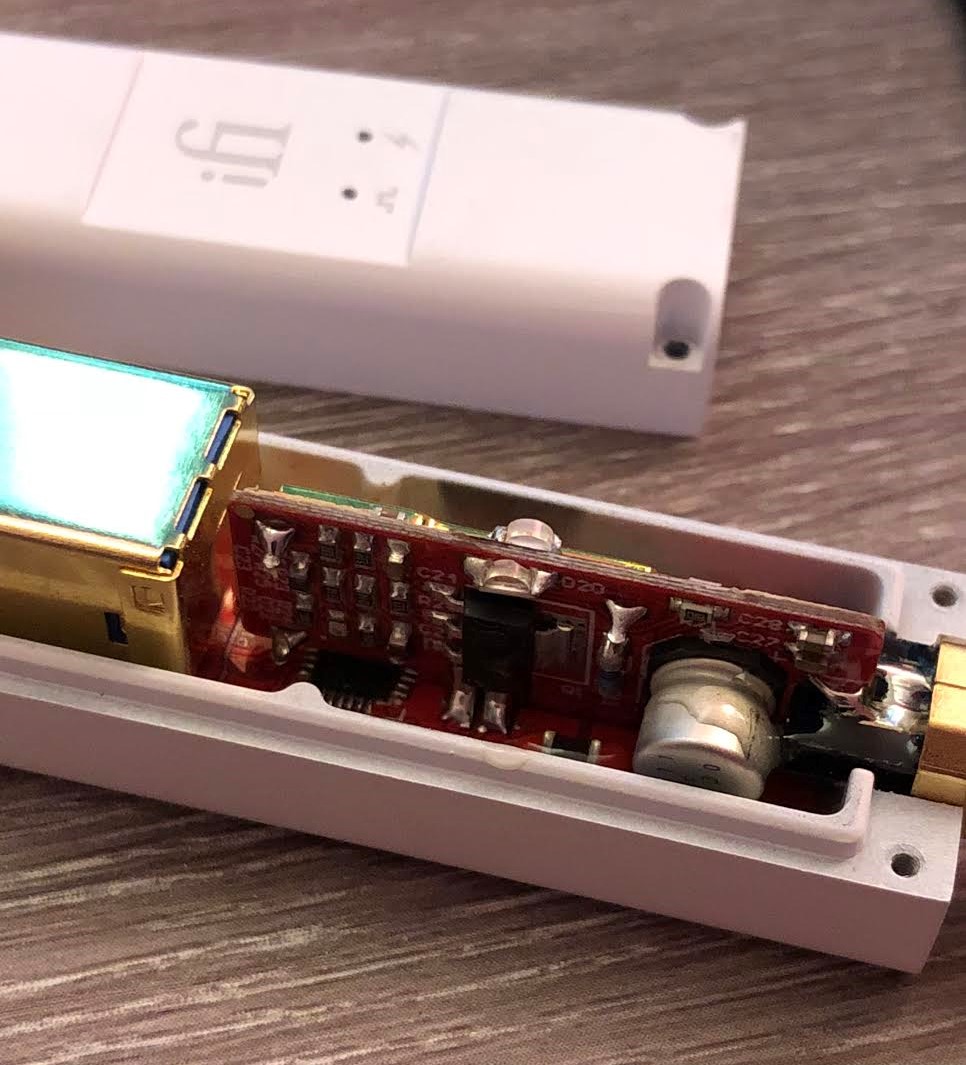
What is a MELF resistor? I originally read it as something different, but I did not have my glasses on ;)

Joking aside, I can’t believe that this device does not act as an electromagnetic USB isolator at this price point. At least it would have some sort of purpose then.
 
What is a MELF resistor? I originally read it as something different, but I did not have my glasses on ;)

Joking aside, I can’t believe that this device does not act as an electromagnetic USB isolator at this price point. At least it would have some sort of purpose then.
MELF is basically a through-hole resistor body with no leads, but SMT pads. They enjoyed a brief popularity until the modern SMT parts appeared in force. I bet there are billions out there available for almost nothing.

Yeah, for $20 this thing might be cheap insurance. Still easier to just buy competent electronics.
 
Amir, would you be willing to test such devices in reverse?

In my experience, the pre-amp + ADC found in USB measurement mics are a lot more sensitive to power supply issues than a typical DAC. Admittedly this is a niche use case, but it might be a real one.
I'm interested in this as well as I recently bought a miniDSP Umik-2 and was suprised by the noise my PC power supply adds to the measurements. Would be interesting to know if a device like this would allow for better noise floor on these things.
 
MELF is basically a through-hole resistor body with no leads, but SMT pads. They enjoyed a brief popularity until the modern SMT parts appeared in force. I bet there are billions out there available for almost nothing.

Yeah, for $20 this thing might be cheap insurance. Still easier to just buy competent electronics.
Commonly found as input protection in DMMs.
 
Commonly found as input protection in DMMs.
Interesting. Higher breakdown voltage than regular SMD, maybe?
 
ifi iPurifier3 Measurements
Isn’t it the first “cleaning” device that really works?

For that reason I voted “Great” :p:facepalm:
 
How does it determine what is noise and how does it take it out?
The noise is on the power and/or ground line, not on the data line. Therefore, anything that isn't 5 V DC can be filtered.

The claim of "re-clocking" and all the other mumbo-jumbo probably describes nothing more than a USB repeater IC.
 
So new properly designed DACs already implement this "noise cleaning"/filtering by adding these few components inside the dac, in a more cost effective way and offering excellent performance without needing any unnecessary external device.
That surprised nobody... at least in this forum.
At least the iPurifier actually works as intended, which is not always a given.
 
There was a ton of noise in the FFT spectrum with the noise floor jumping up and down every few seconds (no doubt due to activities in my PC). That in turn caused the SINAD to vary continuously between 84 and 91 dB. This variation is system specific and could be worse (or better) on other host computers.
Since every computer is different in this regard ( of outputting noise over USB) A proper test for this category of products (and DACs) would be CMRR vs frequency from the USB.

Some DACs are sensitive some not, some PCs output a tonns of noise, some don’t.
This can make huge difference as some USB DACs that measure "perfeckt" with SINAD over 110dB can perform worse then a mid range DAC with Optical input if you have a noisy USB port.

So new properly designed DACs already implement this "noise cleaning"/filtering by adding these few components inside the dac,
You would be surprised... many "high end" (measuring) DACs directly share the USB and Analog GND.
Only very view have true (galvanic) isolation.
 
I really wanna see this compared to the Holo Audio Titanis.
If my 20$ chinese dac is capable of filtering my laptops noisy usb with no audio dropouts or artifacts them its safe to assume that most dac's can filter it as well.
 
Back
Top Bottom