• Welcome to ASR. There are many reviews of audio hardware and expert members to help answer your questions. Click here to have your audio equipment measured for free!

Class A vs AB -- Do They Really Sound Different?

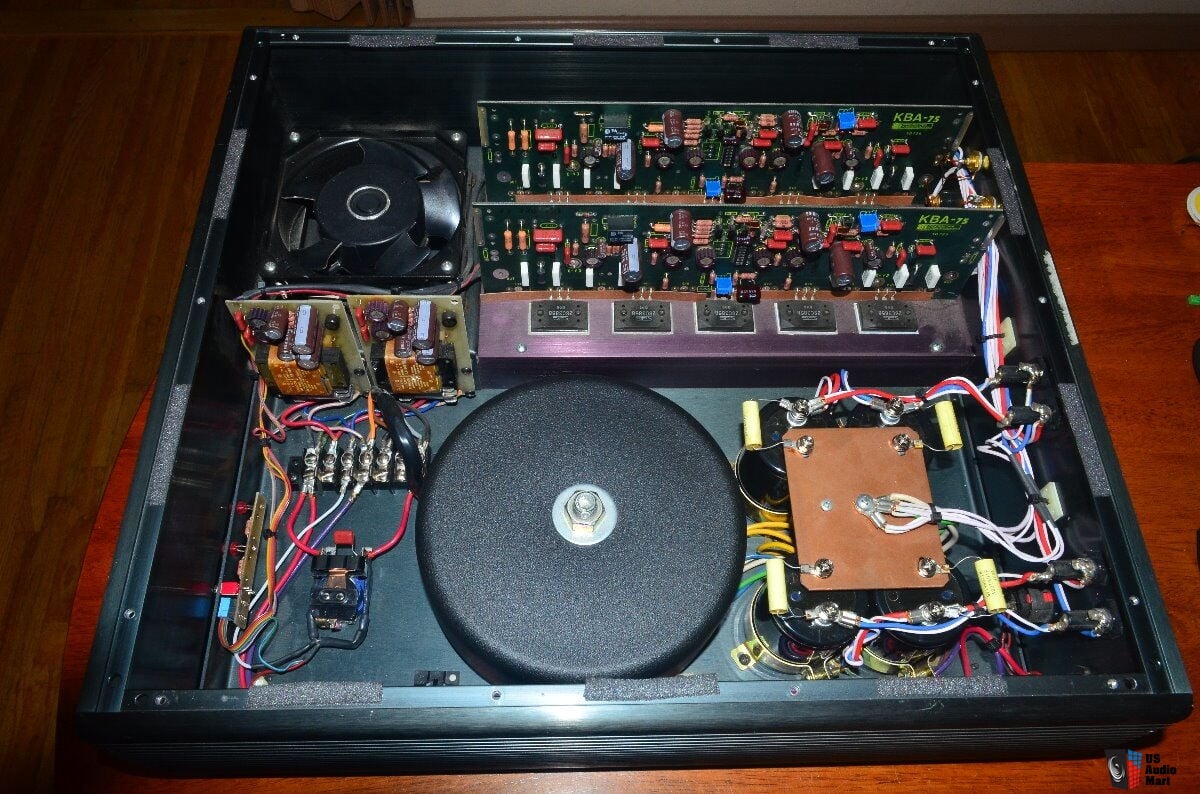
I've used dozens of big and small class A amps and never noticed a difference except for 1 amp. A Kinergetics Research KBA75. It's 75w/ch @ 8 Ohms, 150 into 4 and 300 into 2. It uses feedback so there's no snake oil there. It comes in rack mount black or non-rack mount platinum. The internal layout of the two is different but they are the same amp. It has a 1KVA torroidal, 40,000 micro Farad power supply reserve and very beefy output transistors. It uses a silent fan for temp regulation. I attribute the great sound to it being near linear and a great design. I've owned both the rack mount and the platinum versions and reallly enjoyed them.
http://www.watchobs.com/Share/KBA 75.pdf
Platinum version>
DSC02874-1024x437.jpg

2480726-77b9bcb6-kinergetics-research-kba-75-platinum-pure-class-a-power-amplifier-one-off-completely-restored.jpg

Rack mount version>
Amplificatore-finale-Classe-A-Kinergetics-KBA-75-USA.jpg


Wow . Makes be nostalgic for the Kinergetics-Spica setup I rode 35 years ago.
 
Last edited:
By and large most of the "pure" class A amplifiers I had or heard over the years performed more poorly than their class AB (and now D) counterparts. For low-level signals they might do better, but generally were more load-sensitive, bias- and temperature-sensitive, and had higher noise and distortion. That includes some well-regarded amps of the day like the Levinson and Krell behemoths.
 
I had an early Classe DR3 HC. 30 watts class A, but actually one of those amps biased heavily into A for 30 watts and becoming a 200 watt AB amp at higher levels. The HC version was capable of much higher current. THE choice for Apogee ribbons where you really needed current.
 
I had an early Classe DR3 HC. 30 watts class A, but actually one of those amps biased heavily into A for 30 watts and becoming a 200 watt AB amp at higher levels. The HC version was capable of much higher current. THE choice for Apogee ribbons where you really needed current.

The L-590AXII basically plays the same trick.

Officially it's rated as Class A for 30 watts into 8 ohms / 60 into 4 ohms, but the tests from Miller Labs says it switches to AB and puts out more like 95 / 165.

"Luxman's 30 wch rating may apply only to its billing as a Class A amp as this is no 30-watter in its real-world behaviour."

Which is an interesting marketing game to play....
 
Last edited:
Interesting thread,,,

I recently intensively compared Accuphase E-460 (Class-AB integrated) with A-36 (pure Calss-A) in single amplifier plus LC-network configuration, and also in multichannel multi-amplifier configuration without LC-network.

I found that, at least with the Accuphase amp series, Class-A gives relatively a little bit warm and soft sound characteristics compared to their Class-AB; the tendency is well reviewed in Japan and also Accuphase itself wrote/announced so... This may be Accuphase's intentional tuning or coloration for characterization of their amp series, I may assume.

By the way, I heard interesting four comments from one of the top audio engineers in Japan regarding the selection of Class-A, Class-AB and Class-D amps for my multichannel multi-amplifier project as shared here, but someone said these four comments are really nonsense. I would appreciate having further your thoughts on these four comments, if you would be interested.

As for quasi-Class-A amplifiers, I know Sony's TA-A1ES has been occupying quite unique position for rather long period after its launch in 2013 and it is still available in the market as Sony's present Hi-Fi audio gears. It is said that TA-A1ES behaves as pure Class-A (a little bit hot though) under about 10 W output power range, and behaves as Class-AB above 10 W. I am interested in trying TA-A1ES to directly/dedicatedly drive Beryllium tweeters plus horn super tweeters, very high efficient drivers, hopefully in Class-A mode in my multichannel multi-amplifier project.
 
Last edited:
I found that, at least with the Accuphase amp series, Class-A gives relatively a little bit warm and soft sound characteristics compared to their Class-AB; the tendency is well reviewed in Japan and also Accuphase itself describs/announces so... This may be Accuphase's intentional tuning or coloration for characterization of their amp series, I may assume.

I've heard the same thing said about other Japanese amps...that the Class A models are intentionally tuned to sound a little different.

Which means it's not really an aspect of Class A, per se, that is being heard.

It sounds similar to what Nelson Pass does with some of his products.
 
Something else to take into account here is "how much negative feedback is the amp using?". Some Class A amps (e.g. many SET tube amps using 300Bs, 2A3s, etc) don't even have global NFB which will have a fairly significant impact on the output impedance and therefore the frequency response, never mind the distortion levels.
 
A typical tube SET class A amplifier doesn't have a whole lot of loop gain to begin with. Mine have about 15dB of overall gain, of which I'm using about 13dB for global negative feedback - that leaves the amp with only 2dB of gain which is perfectly fine with my HF horns which have something like 107dB for 1 watt efficiency. The thing is, components have to be selected to fit into an overall system. A single ended class A amp would be stupid to the extreme to use as the main amplification for powering a moderate to low efficiency speaker with traditional passive crossovers. The vast majority of people have conventional speakers like this, so in a way the premise of this thread is kind of a moot point. People who need low power class A amplifiers know who they are, and they will seek them out. The rest of users are best served by conventional higher powered class A/B or D amplifiers.

In other words, move on, there's really nothing to see here. :oops:
 
<sarcasm>

Actually, pure class A will be quieter. What's that you say? Well, yes, in the winter, it will be quieter. As you use your class A amp more, the heating thermostat for your room will operate less often, giving you a quieter listening session. :p

</end sarcasm>
 
Interesting thread,,,

I recently intensively compared Accuphase E-460 (Class-AB integrated) with A-36 (pure Calss-A) in single amplifier plus LC-netwaork configration, and also in multichannel multi-amplifier configuration without LC-network.

I found that, at least with the Accuphase amp series, Class-A gives relatively a little bit warm and soft sound characteristics compared to their Class-AB; the tendency is well reviewed in Japan and also Accuphase itself describs/announces so... This may be Accuphase's intentional tuning or coloration for characterization of their amp series, I may assume.

By the way, I heard interesting four comments from one of the top audio engineers in Japan regarding the selection of Class-A, Class-AB and Class-D amps for my multichannel multi-amplifier project as shared here, but someone said these four comments are really nonsense. I would appreciate having further your thoughts on these four comments, if you would be interested.

As for quasi-Class-A amplifiers, I know Sony's TA-A1ES has been occupying quite unique position for rather long period after its launch in 2013 and it is still available in the market as Sony's present Hi-Fi audio gears. It is said that TA-A1ES behaves as pure Class-A (a littlwe bit hot though) under about 10 W output power range, and behaves as Calss-AB above 10 W. I am interested in trying TA-A1ES to directly/dedicatedly drive Beryllium tweeters plus horn super tweeters, very high efficient drivers, hopefully in Class-A mode in my multichannel multi-amplifier project.

Uh huh.
 
I heard one amp in the 80's that was supposedly class A and it sounded phenomenal. It was a car stereo amp from a company called Alphasonik that my brother had in his car running a pair of rear deck 6x9's. Seriously, the sound was amazing and i could listen to that system for hours. I can't remember the model but it wasnt very big and ran EXTREMELY HOT. It would shut down in the summer if you tried to play it any length of time. Also, if my Brother ran his stereo without the car running it would kill the battery very quickly.

Looked something like this.

alpha.jpg

It wasnt the tape deck or speakers because I remember my Brother bragging how little he spent on both of these.
 
Beware that some manufacturers claim "Class A to 10 W" or something similar. I would call that a high-bias Class AB. You'll get Class A performance below 10 W and worse than optimally biased Class AB performance above 10 W. That's not my idea of a good time.

My Parasound A51 claims something like this I think. It is a great sounding amp.
 
My Parasound A51 claims something like this I think. It is a great sounding amp.

Some of the Luxman amps only publish their Class A numbers, saying, for example, it's only a 30 W amp...when, it fact, it puts out 3x that in testing.

They don't even publicly acknowledge that it can go higher than what it does in Class A.
 
Push-pull class A easily transits to class AB. It is all about idle current and load impedance. No mysteries here. There may be variable bias as well, or class A+. Marketing x user's education, as always. Study, though it is not easy.
 
For as long as I can remember, Class A solid state amps were touted as somehow 'sounding better' than AB amps, despite being much hotter and often lower power output for a given size / cost.

How much truth is there in this trope?

And if it's more of a myth than reality, why bother with the engineering headaches (heat, inefficiency) of Class A amps?
all one has to do is listen.
 
A typical tube SET class A amplifier doesn't have a whole lot of loop gain to begin with. Mine have about 15dB of overall gain, of which I'm using about 13dB for global negative feedback - that leaves the amp with only 2dB of gain which is perfectly fine with my HF horns which have something like 107dB for 1 watt efficiency. The thing is, components have to be selected to fit into an overall system. A single ended class A amp would be stupid to the extreme to use as the main amplification for powering a moderate to low efficiency speaker with traditional passive crossovers. The vast majority of people have conventional speakers like this, so in a way the premise of this thread is kind of a moot point. People who need low power class A amplifiers know who they are, and they will seek them out. The rest of users are best served by conventional higher powered class A/B or D amplifiers.

In other words, move on, there's really nothing to see here. :oops:
I'd bet pentode/beam tetrode based tube amps have a whole bunch more global NFB, just by nature of both types having dramatically more available gain - I've not checked the loop gain of any myself, but it's a hunch.
 
Back
Top Bottom