• Welcome to ASR. There are many reviews of audio hardware and expert members to help answer your questions. Click here to have your audio equipment measured for free!

Otari MX-5050 Review (Reel to Reel Tape Deck)

Above 20kHz there are harmonics of audible signals. Also if you learned advanced calculus, you know that there is a dependency between signal raise time and frequency range. Sharp transient cannot be reconstructed if frequency range is limited. The same limit is the source of pre- and post-ringing of filters. I do not know how brain processes audio, but if you are trained, you can hear distortion sourced from brick wall filter. Some music content makes it easier, other harder. But it is always there. 20kHz limit may be good enough if analog source is limited to 10kHz or less above noise level, but if source has content up to 20kHz before brick wall in ADC, you will hear the difference. Ideally to avoid issues with filtering sampling rate should be more than 5 times higher than source content above noise level. In that case physical limitations of filtering will have very little impact on ADC (or digital downsampling) process. But this is NOT a topic of this thread. Let's go back to R2R tape vs. vinyl.
The converse is also true: If a sharp transient is steep enough to require a frequency capability higher than 20KHz, then so is the device that creates that transient, the device that records it, and the medium that distributes it, the system that plays it back, the speakers, and the ears of the listener. It's those ears where it all comes home to roost, even if we solve the problem at every other link in the chain.

I've looked at a lot of waveforms of recorded music, including music that I've recorded. I've never seen a transient in a recorded signal that was anywhere near as steep as, say, a record pop from a scratch on the vinyl. And yet my system, even when constrained to 20 KHz, is fully capable of making that distinction.

But your statement that one will hearing the ringing of a steep filter set to 22 KHz (and let's put it where it happens) just because the musical content exceeds 10 KHz is unevidenced, unless you engage unrealistic and specialized listening techniques.

Rick "whose TEAC A4300 runs out of steam at about 22 KHz" Denney
 
1) If you hear hiss it's far more likely the result of your amplification chain than a Redbook digital source. You mentioned your interest in tape playing between 20kHz and 30kHz. 2) Are you telling us there is musical content there from any source - at all - and that you can hear it?

1) Hiss? Not my amplifier and not on my loudspeakers--Benchmark with La Scala, the latter being prone to audible amplifier hiss due to it's 101dB/watt/meter sensitivity. But if hiss is part of the recording, it's heard.

2) To your second question, I'm reminded of an old Stereo Review take-down of the Pioneer CT-F 9191, a mid priced cassette deck from the '70s. Hirsch found it to be good value, measuring flat to about 12KHz (probably at -20dB VU, but maybe it was 0dB, I don't recall). He wrote (paraphrasing) that that might not sound like it was very good, but there isn't much HF material anyway once you get past about 15, and in any case most people's hearing doesn't go that high. It was Julian's way of saying that the Pioneer was probably OK for most people, but if those x-tra hertz are important, then you're just going to have to open your pocketbook a little wider and spring for the Nakamichi. :)

For me? I could never hear that twenty kilohertz stuff. I'm not the Batman.
 
Cassetes (Compact) go from 35 Euro's (EACH!) for (Type2 Chromium 90 minutes) all the way up to 160 Euro's for (Type 4 Metal) from TDK and Maxell and some other brands, but for that price they are NOS and thus sealed.
Absolutely nuts.
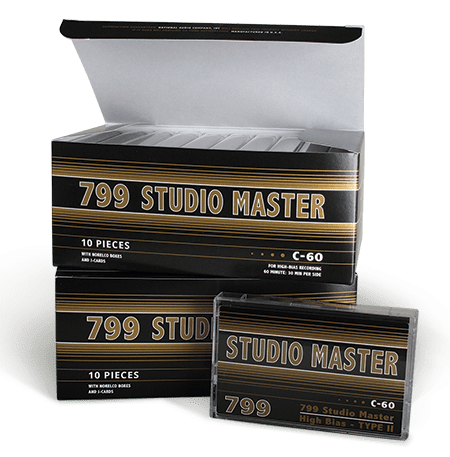
An outfit in the US manufactures I and II tapes. I don't think anyone makes IV anymore. From my 1980s memory IV were generally the best quality.

 
Speaking of tapes (might have been mentioned before), in the late '70s I guess it was, Maxell and a few others sold Type II higher bias open reel tape. I used an Akai GX-646 for a while and it featured a switch for 'EE' tapes, but I never bought one so I have no idea about them from experience.

Generally for home use, 7ips with Maxell UD35 XLI was sufficient for my purposes. I routinely bought Maxell at my local guitar store. Once Maxell quit, I could find Quantegy (Ampex) through the mail, but eventually they went out of business. By then I was out of the game.


Maxell-XLII-Reel-Tape-Box-scaled.jpg
 
Cassetes (Compact) go from 35 Euro's (EACH!) for (Type2 Chromium 90 minutes) all the way up to 160 Euro's for (Type 4 Metal) from TDK and Maxell and some other brands, but for that price they are NOS and thus sealed.
Absolutely nuts.
Wow. Seems I'm sitting on a gold mine with 3 TDK MA 60 and 5 Maxell XL II 100 ...
 
Went to new a local pizza place with two teac reel to reel decks as music sources placed right at the front. They were in mint visual condition. Very sexy.

Also a bit silly, since the music was a mix and recent. I guess they recoded a Spotify playlist…lol.

But darn, I sort of want one now as decoration.
 
Went to new a local pizza place with two teac reel to reel decks as music sources placed right at the front. They were in mint visual condition. Very sexy.

Also a bit silly, since the music was a mix and recent. I guess they recoded a Spotify playlist…lol.

But darn, I sort of want one now as decoration.
Yep, same feeling here, these things are/were Beautiful.
 
What I always wanted
Me as well. A lot of people try to refurbish the Technics and sell them for a lot of money. Truly an iconic prosumer tape deck.

Sad to read long time ago that Panasonic destroyed all the remaining parts when they quit the business!
 
Sad to read long time ago that Panasonic destroyed all the remaining parts when they quit the business!
I didn't know that.
It reminds me of the destruction of machines for manufacturing mechanical watch movements in Switzerland and Germany, at manufacturers who went bankrupt in the wake of the quartz crisis.
Today, attempts are being made to reconstruct these very machines, but it's not as easy as expected because a lot of detailed knowledge has been lost.
Matsushita, on the other hand, never went bankrupt—they should have just kept the business going. It would still be a bestseller today.
In my opinion, the most beautiful of all tape recorders.
 
I still keep an A77 (with dolby) around, and am restoring a B77 - which I had when I was younger. At that time I had the B77 and the Technics - at the same time, but went to 2 x PR 99's in the end. Mostly Radio work. It's something of a blessing that in this day and age, one can still get new tape stock, and enjoy technology that has such an amazing history. If I ever make it into a bigger house, an Otari MTR 90 is not without possibility.
Miss working on those.

Cheers
 
To this end, Revox has resumed production of tape recorders.
For the bargain price of €17,000, you can purchase a device from the current production run.

1771493082167.jpeg

 
To this end, Revox has resumed production of tape recorders.
For the bargain price of €17,000, you can purchase a device from the current production run.

View attachment 512096

Sure, but they should have brought back the PR 99 instead, for a reasonable price - one can get a B77 with 15 IPS for about 2k, and be well. Not in black, but I like the original color better, anyway. Sad. My 2 cents.

Edit: For that kind of money I'd go for an Ampex ATR, did a lot of editing on those and always liked it.
 
Last edited:
An old 'Klangfilm' Lichtton Sound System

1000048189.png
 
What I always wanted

View attachment 512084

What I had (long time ago)


View attachment 512086
I've never seen the Technics in person. The 3M Iso-loop came before and I used them. On the 3M, the upper wheel was the capstan. It was ridged so had 2 diameters and the pinch roller on each side were different. That created tension across the lower idler. Erase and record heads on the left and playback head on the right.

 
Analog tape makes no sense in modern times but it can be fun.
I've owned a Technics RS-1500 for several years. It's probably the best performing consumer deck ever? I typically use Maxell UD and XLI tape as it simply is the most durable with good performance that I have found.

IMG_0979 (net).jpg


I do all my recording on a Sony APR 5003

IMG_0984 (net).jpg


It is one of the greatest analog recording devices the industry ever created. Actually made in America by MCI after Sony bought them. It was a marriage made in heaven! The reels are the 12" used more common on the digital recording version of the deck but their size comes in handy.
 
Last edited:
Needed a change of pace so decided to go after a project I planned almost five years ago, namely measuring my Otari MX-5050 BIII-2 Reel to Reel take deck! Otari was the last company in the world making Reel to Reel tape recorders and sadly, ceased production a few years ago. I got my sample from the Reel to Reel master, Ki Choi. I think it cost something like $5,000 to $6,000 new. Used ones go from a range of prices from $2K to $4K from what I see. As always, it is a risky thing to buy one online as conditions of these decks is all over the place and service is not cheap. Mine is extremely clean and as the sub-model indicates, is a more recently sample

Here is a shot of the beast as best as I could fit it in my lightbox:

View attachment 155831

What makes this model unique and valuable among tape heads these days is that it comes with both NAB and IEC equalization. The latter is what is used for a lot of tape production today (what little of it there is). A lot of consumer decks don't support it and require a hack or outboard equalization/amplifier. The fancy red spool is aftermarket which I bought at an audio show. Costs a couple hundred dollars just for that! Blank tapes are $60 from what I recall. And pre-recorded ones like the one on it are $290 but go way up to something like $600. Each! For some 30 minutes of music as these are recorded at 15 inches/second. So not a practical format for most people. But for those of us who wished we had such a nice unit when young and poor, it brings bag fond memories and good listening as you watch the spools turn and meters dance.

Being rather old, there is hardly an measurements of them by today's standards. There is also chicken and egg problem of how to get an accurate test tape. The de-factor ruler in that world is MRL and that is the tape I used for my testing. It has just a set of test tones and it too is very expensive. How good it is, I don't know. The measurements in the box come from a chart recorder! Let's say it is a few generations behind my Audio Precision analyzer. :)

Otari MX-5050III-2 Measurements
1 kHz tone has been the standard forever in audio and hence it naturally came on the MRL tape so I used it to run our usual dashboard:

View attachment 155832

Distortion is at -57 dB or so but add a bunch of them and some noise and we land at SINAD of 46 dB. It is strange to see the elevated low frequency noise. Subtracting FFT measurement gain gives us a noise floor that is in the 40s! I wanted to see how much of it was the tape format and how much was the machine so I stopped the playback and measured the noise out of the unit:

View attachment 155833

Yuck. There is that rising low frequency noise floor but also a bunch of solid tones. What on earth is the 1 kHz and its harmonics coming from? No wonder folks get outboard electronics for these decks (although who knows how good they are).

BTW, the convention for measuring these older electronics is a-weighting so I thought I turn on that filter and see if SINAD gets better:

View attachment 155834

It goes up 3 dB so that low frequency noise is hurting it some. BTW, this is why I don't use a-weighting in my measurements. It really hides a lot of sins in equipment performance at lower frequencies.

There are skirts around the main tone if you look carefully which indicates jitter/speed variations. Watching the dashboard in real time showed a ton of variations. It is a jarring experience coming from today's systems. At 20 kHz, I measured 19.8 kHz frequency so we have about a 1% speed error.

There is not a whole lot more on the tape than a set of fixed frequencies to measure frequency response. My old Audio Precision analyzer could run a sweep against external sources like this by detecting the frequency and then plotting its level. The new APx555 I have now can't do that. It expect you to record its own sequence on the unit and play that to get asynchronous measurements. So I had to resort to the real-time recorder to plot the frequency on the right, and level on the left:

View attachment 155835

The first frequency is 32 Hz and highest is 19.8 kHz. I set reference at 1 kHz to 0 dB. We see a bass boost at 32 Hz by 1.6 dB or so. And a massive droop at 16 and 20 kHz. Not sure if this is a fault of this unit or in general. It might be this unit as the other channel took a nose dive above 1 kHz! I had cleaned the heads and could see nothing obvious that could cause this externally. Worse yet, I don't know if the tape is bad this way (I assume not but it is possible). I loaned out my last blank tape so need to buy another to record and playback and see how that behaves.

Conclusions
I sort of assumed SINAD would land in 40s and it did. I didn't expect the rest of the garbage this deck produces, nor the one bad channel. Need to find the time to tear it open and see what could be done to improve it. I have not listened to it in months. When I did, my favorite second generation master tape from rock music of 1970s is superb. It easily outperforms the digital ones which have been remastered to death. It is eye and ear popping how much nicer they sound than digital. I often play that tape when people come over first and their jaw drops on the floor in how good it sounds. Tape hiss is there during gaps between tracks and the highs sound a bit distorted to me but neither takes away from enjoyment of that tape. It makes me grin thinking about it as I type this!

Tape gives me the experience of the analog recording without loudness wars and remastering without the limitations and aggravation of LP. I also find the format so much more gorgeous to look at as it plays than anything out there, digital or analog. It is a shame that its popularity has pushed the price of used decks so high.

Anyway, we have first super hard set of measurements of any tape deck now. Gives us some anchoring as far as objective results are concerned.

-----------
As always, questions, comments, recommendations, etc. are welcome.

Any donations are much appreciated using: https://www.audiosciencereview.com/forum/index.php?threads/how-to-support-audio-science-review.8150/
A careful alignment & calibration would sort out a lot of these issues. Not easy or inexpensive these days though. Just finding an experienced tech is tough.

I have a Teac A3340S (circa 1975) in mothballs that needs a bit of work on the supply reel brake. And a service manual. Just need to take some time to set aside other projects and dig into it.
 
Last edited:
To this end, Revox has resumed production of tape recorders.
For the bargain price of €17,000, you can purchase a device from the current production run.

View attachment 512096
And price of that new machine is not very high, when you look at price of original and account for inflation and currency valuation trend.
 
Back
Top Bottom