• Welcome to ASR. There are many reviews of audio hardware and expert members to help answer your questions. Click here to have your audio equipment measured for free!

Do I need a "surge protector" ?

tamtam

Member
Joined
Apr 19, 2020
Messages
84
Likes
24
Hey folks,

I'm trying to understand the type of protection my gear needs, if at all.
A lot of discussions about power conditioner, but I'm not trying to improve the sound.
We have a pretty stable electricity supply - 220v, but having short blackouts, mostly during storms. Approximately 5 times a year.
If I understand correctly, after a blackout there will be a spike when power goes up.
So I'm looking to buy a surge protector, one of the best I can find in the area I live.
Specs say <180Vac and >270Vac range, when not in a range it will disconnect. Can absorb 1000J. Rohs/CE/CB certification.
It also protects from over and under voltage.

Is it on a level of snake oil or it actually helps?
I'm also aware this device if not properly made it can "burn" the downstream electronics, that's why I'm looking at certifications.
I have purchased some "high-end" audio gear recently and want to keep it safe.

Thanks
 
Everything you need to know:


Thanks, so I understand they do offer an additional protection and increase the life of electronics.
I found this device, probably the best I can find where I live. Is it any good?
I saw some people mention these devices make sound worse? Sounds like a placebo effect, right?
Trying to get some reliable opinions without doing a PhD in electronics...
 
Surge protectors can only clamp very short peaks (transients) and not longer over voltages. Usually they clamp well over the nominal mains voltage.

They will not do much against lightning strikes (near-by).

I would recommend stuff like this installed in the breaker box when you are plagued by lightning strikes reasonably near-by:

It won't protect for longer term overvoltage though.
 
Last edited:
If I understand correctly, after a blackout there will be a spike when power goes up.
Not necessarily. Almost any kind of fault is possible.

My power in California is more reliable than yours but I've never had anything damaged by a power surge.

Specs say <180Vac and >270Vac range, when not in a range it will disconnect. Can absorb 1000J. Rohs/CE/CB certification.
It also protects from over and under voltage.
I've never heard of one that disconnects with low power but possibly it does.

Is it on a level of snake oil or it actually helps?
it can, but it won't protect against everything. A direct lightening strike to a nearby power line (or anything extreme) can probably still do damage.

I'm also aware this device if not properly made it can "burn" the downstream electronics, that's why I'm looking at certifications.
That won't happen. But if the device itself is badly made it could burn-up or shock you.

I saw some people mention these devices make sound worse? Sounds like a placebo effect, right?
If you have electrical noise on the power line that's causing noise in your speakers/headphones it might help. But it won't filter-out everything and your audio equipment already has built-in filters.

It won't protect for longer term overvoltage though.
Actually, they can. They work by "shorting" when there is excess voltage and there's usually a built-in fuse or circuit breaker that blows to cut-off power if the over-voltage lasts long enough.
 
I've never heard of one that disconnects with low power but possibly it does.
...

Actually, they can. They work by "shorting" when there is excess voltage and there's usually a built-in fuse or circuit breaker that blows to cut-off power if the over-voltage lasts long enough.
It's called Under voltage protection and Over voltage protection.
Usually it comes with a delay of 3-5 minutes, when the threshold is passed.
I saw someone tested this kind of device, and the the lower threshold the UVP stuck in an indefinite on/off loop potentially causing more damage to the electronics than helping. Also, I don't see many devices have this feature.

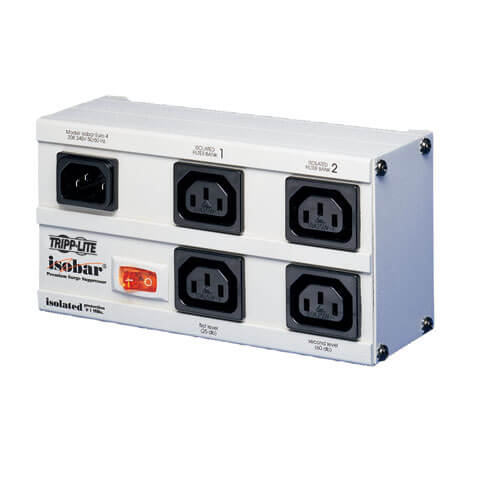
The second device, Tripp Lite Isobar has a
  • Automatic shutoff permanently cuts power to outlets if protection circuit is incapacitated, preventing equipment damage and indicating replacement is required
and
  • An integrated 9A circuit breaker protects all outlets and shuts down connected equipment in the event of an overload.
However, not sure if this is the same Over voltage protection as in the first device.
 
Surge protectors can only clamp very short peaks (transients) and not longer over voltages. Usually they clamp well over the nominal mains voltage.

They will not do much against lightning strikes (near-by).

I would recommend stuff like this installed in the breaker box when you are plagued by lightning strikes reasonably near-by:

It won't protect for longer term overvoltage though.
I worked for a company that makes a variety of surge protection devices among other things, and the first line of defense against lightning surges was a carbon block spark gap device that could clamp the let-through voltage to under 1kV. after that, secondary surge devices such as GDTs (Gas Discharge Tubes), active surge suppressors and MOVs, could be deployed to clean up the rest of the surge energy. However, a really large direct hit could just blow everything up.
 
Yep, a direct hit (or very close by) will destroy just about anything.

The OP seems more worried about brown/black-outs where on 'start-up' the mains voltage is temporarily too high.
This is possible when the OP is closer to the mains generator than most of the other users which will all 'dip' the generator on power-up with all their inrush currents.

Here these nor any TVS/MOVs/gastubes can be of any value.
In such case an UPS with over/under voltage protection might be fast enough or the usage of a regenerative UPS might be a good option.
When it is to protect high$ audio gear this might be an option.
 
Last edited:
At worst they're harmless. The last test of surge protectors I've seen was in the '90s. At that time nothing on the market could protect against a lightning strike. I've had a couple of them since the late '80s. Neither has ever tripped. Today's gear may be substantially better. I don't know.
 
Thanks everyone, got the Tripp lite isobar with filtering.
I don't know if this is placebo, but sound became slightly better.
 
I've lost electronic equipment due to surges caused by power interruptions. That includes things like control boards in appliances and the like. I've never lost anything that was plugged into a decent surge suppressor (and Tripp-lite is reputable) or a UPS with (additionally) surge-protected outlets. What I have lost was not so protected.

In my new shop, where I did all the electrical work, I installed panel surge-suppression devices. What makes them work well is the low-impedance path to a good earth ground, one that is kept very short (in my case, five feet). In that building, it's a Ufer ground that provides a ring of equal potential around the perimeter of the building.

Rick "preferring the panel manufacturer's panel-mounted surge protector to any downstream alternative, but only if the panel's ground is close and of good quality" Denney
 
Unfortunately, what I thought as a better sound actually just a saturation from filter banks. On the bank with the "better" filtering - more saturation.
Sound from the main socket sounds cleaner and more detailed. :facepalm:
However, it's easier now to hear dynamics.
Having a mixed feeling about this now.
 
Last edited:
I too wanted mains protection for my audio and video gear. The use case is not lightning strikes, though that would be great too. The primary use case is some cock-up in the mains supply before it reaches my apartment, and I get the full potential difference between two phases, instead of the difference between one phase and neutral. So, instead of the usual 220V, my entire apartment is hit by 400V. The other use case is brownouts.

This sort of thing happens to one or two blocks of buildings in my city once every few years, and then I hear stories of half the TVs in more than a hundred homes blowing out. (No one around me is insane enough to want to listen to high-quality music, we are a dying breed. If music is to be listened to, use your cellphone and stream from YT Music, seems to be the norm.) So, it's usually TVs and fridges which fry.

So, these are my use cases, and it doesn't last for a millisecond -- it lasts for minutes.

I have fitted a Hager RCCB (RCBO?) and a Hager overvoltage-undervoltage protector in my main DB (distribution box -- It's a closed-door box on the wall with DIN rails with all the MCBs.) And for the audio, TV and fridge, I have bought a few units of this: https://www.amazon.in/Smart-Plug-Protector-16Amp-Protection/dp/B00O0L5DDE/

Most recommendations I see here are for passive MOV-based devices. Those are probably great for very narrow high-voltage surges.

What would you suggest?
 

Attachments

Last edited:
Hey folks,

I'm trying to understand the type of protection my gear needs, if at all.
A lot of discussions about power conditioner, but I'm not trying to improve the sound.
We have a pretty stable electricity supply - 220v, but having short blackouts, mostly during storms. Approximately 5 times a year.
If I understand correctly, after a blackout there will be a spike when power goes up.
So I'm looking to buy a surge protector, one of the best I can find in the area I live.
Specs say <180Vac and >270Vac range, when not in a range it will disconnect. Can absorb 1000J. Rohs/CE/CB certification.
It also protects from over and under voltage.

Is it on a level of snake oil or it actually helps?
I'm also aware this device if not properly made it can "burn" the downstream electronics, that's why I'm looking at certifications.
I have purchased some "high-end" audio gear recently and want to keep it safe.

Thanks
Essentially, most devices available to consumers are useless and a waste of money.
In the event of a real lightning strike near you, the energy is so strong that it can easily travel distances of 5-50 cm, rendering standard power strips and other small devices useless.

In the event of a power surge, you need something that switches on quickly enough. Likewise, in the event of a power outage, the connection can only be restored once the voltage is restored and within a safe range.

A good electrician can offer such solutions for permanent installation in the fuse or switch box. Electricians and companies that regularly handle larger smart home installations are usually familiar with this type of thing. The same applies to electricians who manage electrical installations for small and medium-sized businesses.

Of course, there are also industrial devices for this, but this is a high financial outlay and only worthwhile if you live in an area at high risk. Most people never experience something like this.

My advice: pay a premium on your insurance to ensure this is covered.
 
I too wanted mains protection for my audio and video gear. The use case is not lightning strikes, though that would be great too. The primary use case is some cock-up in the mains supply before it reaches my apartment, and I get the full potential difference between two phases, instead of the difference between one phase and neutral. So, instead of the usual 220V, my entire apartment is hit by 400V. The other use case is brownouts.

This sort of thing happens to one or two blocks of buildings in my city once every few years, and then I hear stories of half the TVs in more than a hundred homes blowing out. (No one around me is insane enough to want to listen to high-quality music, we are a dying breed. If music is to be listened to, use your cellphone and stream from YT Music, seems to be the norm.) So, it's usually TVs and fridges which fry.

So, these are my use cases, and it doesn't last for a millisecond -- it lasts for minutes.

I have fitted a Hager RCCB (RCBO?) and a Hager overvoltage-undervoltage protector in my main DB (distribution box -- It's a closed-door box on the wall with DIN rails with all the MCBs.) And for the audio, TV and fridge, I have bought a few units of this: https://www.amazon.in/Smart-Plug-Protector-16Amp-Protection/dp/B00O0L5DDE/

Most recommendations I see here are for passive MOV-based devices. Those are probably great for very narrow high-voltage surges.

What would you suggest?
MOVs will work in your use case, but will often blow apart. Ask how I know. I lost the control boards for a heating system, a treadmill, most surge protectors, several UPSs, and all four control boards for the commercial door openers in my shop. Insurance paid (handsomely) to replace the devices, and I used that to replace the boards and equip my repair shop so I could fix them myself. All I needed were MOVs and fuses. The next time it happened I made no insurance clam because I had repaired boards “in stock”. Fixing surge protectors is easier than opening up TVs, it is true. My point is that MOVs absorb short hits but short out (and then burn up) with long hits and blow fuses and circuit breakers. They usually still protect the downstream device.

(The whole house protectors in my panels weren’t enough.)

Rick “keeps MOVs in stock” Denney
 
MOVs are good for short burst (voltage spike) protection, but not for a continuous overload situation. MOVs don't become a short circuit when an over-voltage condition occurs. They clamp at a fixed voltage that is set above the voltage that they must allow pass. The result of this is that under a continuous over-voltage condition, the MOV will dissipate amounts of power vastly above its dissipation rating and promptly burn out. Another thing about MOVs is that they wear out under repeated over-voltage clamping cycles.
 
MOVs are good for short burst (voltage spike) protection, but not for a continuous overload situation. MOVs don't become a short circuit when an over-voltage condition occurs. They clamp at a fixed voltage that is set above the voltage that they must allow pass. The result of this is that under a continuous over-voltage condition, the MOV will dissipate amounts of power vastly above its dissipation rating and promptly burn out. Another thing about MOVs is that they wear out under repeated over-voltage clamping cycles.
Promptly = Explode apart. I have photos.

And they do short along the way, because the fuses are gone, too.

Rick “typical post-brownout surge” Denney
 
Back
Top Bottom