• Welcome to ASR. There are many reviews of audio hardware and expert members to help answer your questions. Click here to have your audio equipment measured for free!

Questions about AoE

PortalKeeper

Member
Joined
Feb 8, 2023
Messages
73
Likes
7
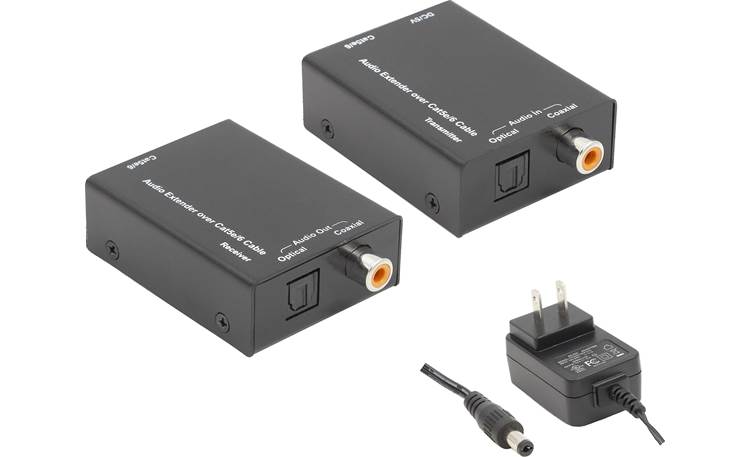
Hello, I’m looking at this product:


to use instead of an optical extender from my Windows 10 PC to my Topping E70.

My questions are: what type of protocol does audio over Ethernet use. To my understanding there are different layers to Ethernet that can be used to send this information. Dante for instance works on layer 3 (I think). How is this communication different from SPDIF, and how is the latency and jitter performance? Would this product introduce more latency than say a pure optical or coaxial connection?

Also, this isn’t too relevant but there are versions of these receivers and transmitters on Amazon that I’d love to see reviewed and compared to more known products (such as the Focusrite Dante ones) cause maybe there is no audible difference.

Thanks for your input.
 
That just uses "Ethernet wiring". There is no Ethernet protocol. ;)

Actual Ethernet (with error detection and correction, and collision correction with a shared connection, etc.) will add some latency but Dante is supposed to be optimized for audio.
 
There is no Ethernet protocol.

Well, I'd say there is.

Whatever data you are sending will be packed into the payload packets of one or more Ethernet Frames.

1710868231324.png


Last edited:
Whatever data you are sending will be packed into the payload of one or more Ethernet Frames.
I think @DVDdoug is right - this is just point to point over CAT6 wiring, not routable ethernet. Probably just an optical receiver, diff line driver, diff line receiver, coax and optical out. Maybe some clock recovery / retiming and error checking. No need for actual ethernet.
1000003012.jpg
 
Last edited:
I see...
 
Hello, I’m looking at this product:


to use instead of an optical extender from my Windows 10 PC to my Topping E70.

My questions are: what type of protocol does audio over Ethernet use. To my understanding there are different layers to Ethernet that can be used to send this information. Dante for instance works on layer 3 (I think). How is this communication different from SPDIF, and how is the latency and jitter performance? Would this product introduce more latency than say a pure optical or coaxial connection?

Also, this isn’t too relevant but there are versions of these receivers and transmitters on Amazon that I’d love to see reviewed and compared to more known products (such as the Focusrite Dante ones) cause maybe there is no audible difference.

Thanks for your input.
Are you doing this to go a long distance?

My guess on that specific device is that it is a proprietary coding. Reach out to technical support at MetraAV, the maker, and ask them. There are several standards for audio over Ethernet and IP you can find by the term Audio Networking.

Generally the delays in digital audio are in the A to D and compression, then if using wireless, getting on a shared channel. Professional digital audio tries to minimize delay because a device may be in a chain of gear, each with its own delay.
 
This seems to be another repackaging of a simple point-to-point link over Cat6 but not over any network. Very common with variable satisfaction according to consumer comments.

Using Dante (or AES67 or Ravenna) is very much likely to be better at several times the cost.
 
Thanks everyone. I’m looking to max out the technical max limit for toslink optical from my PC to my DAC (10m) and was wondering whether this product or another would be more robust than a single 10m long optical cable.
 
Buy one and try it. Better yet, send it to Amir for review.
 
FWIW I have some spdif and adat optical tie lines in my studio which are over 10m and they work fine. Can't remember how long they are. Maybe 15m?

I've rarely found budget extenders which really work seamlessly. There's always something glitchy at some point. Not saying there's anything wrong with the product you linked, but if you can get away without it, that's what I'd do.
 
I use generic XLR to Ethernet boxes to send 2in 2out AES3 (pro version of spdif coax, like rca vs XLR) streams over 100ft cat5 passively without a hiccup.

Digital audio is much more resilient than most people realize.
 
Not tried optical, but regularly use a 15m length of ordinary cheap coax for S-PDIF without any problems. It may be that the cable happens to be around 75 ohms impedance, but it was bought just as a stereo extension cable.

Digital audio is incredibly rugged, far more than the audiophile scammers would have you believe.

S.
 
Back
Top Bottom