• Welcome to ASR. There are many reviews of audio hardware and expert members to help answer your questions. Click here to have your audio equipment measured for free!

York DSP devices

Thank you! :)

I am trying to decide between buying another one of these excellent boards or wait for the board with built-in DACs.
These above have ADC and DACs - 4 channel analog outputs, PCM5242.
Or you mean 8 channel version?
 
I mean the 8 channel version that @Koifarm tested and provided comments to you. I am reaching a point where I will have more variations of DSP boards than actual active speaker designs I am building. Too much fun so I am not complaining. :D
 
It has already occured to me that I could buy one more York DSP board and dedicate the old one to a 4 way speaker and the new one to a 4 way speaker. I am guessing if I use an SPDIF splitter, I can send L signal to one board and R signal to other board. I like using Toslink SPDIF for signal sources whenever possible.
 
It has already occured to me that I could buy one more York DSP board and dedicate the old one to a 4 way speaker and the new one to a 4 way speaker. I am guessing if I use an SPDIF splitter, I can send L signal to one board and R signal to other board. I like using Toslink SPDIF for signal sources whenever possible.
Yes, that would work :) basically one board/channel.
 
May be you even do not need a sdpif splitter. I think you can route L and R separate in software.

IMG_1420.jpeg
 
May be you even do not need a sdpif splitter. I think you can route L and R separate in software.

View attachment 562114
So if i understand correctly, I can route any input to any output I choose in the software? That is a very powerful feature. I know it can be done in Sigma Studio using Mux blocks but so much easier if it can be done in York Studio.

I would try using SPDIF as input on one board and then route a pass through signal to SPDIF out on same board to send unfiltered signal to board #2.
 
So if i understand correctly, I can route any input to any output I choose in the software?
Yes, indeed.

The only thing to consider: if S/PDIF signal enters DSP, then goes via DSP core (filters, gain), there will be some delay added, if you compare S/PDIF output vs S/PDIF input.
However, this delay is deterministic, can be measured and compensated.

Another option could be to bypass DSP core - there is option to connect S/PDIF receiver to S/PDIF transmitter directly. I think such bypass feature may be useful for the use case you described. Let me do some measurements, and if it works indeed - I'll add this feature to firmware and software.
 
I just ordered another York DSP board. With what is likely to be more than one way to use 2 boards for a 4 way stereo speaker design, i am going to start working on it. Thanks @eclipsevl and @Koifarm !

I feel like I should mention that I am already doing this with the PDAC-100D DSP amplifier boards from @uriy-ch. I am building a clone of the NHT VT-3 home theater speaker from many years ago and making it with DSP crossover filters and PEQ. Both @eclipsevl and @uriy-ch have done the DIY community a great service by designing these boards and supporting them with excellent technical information.

If anyone is curious, here is an old article about the VT-3 speakers. i am not building clones of the center channel and surrounds. Just doing the L R tower speakers.

 
Just did a test with 2xDSP modules, signal path is USB->DSP1->S/PDIF output->DSP2
Both DSP configurations are like this:
1790880237892.png


I am comparing phase diff between "DSP1->Out1" and "DSP1->SPDIF out->DSP2->Out3"
The difference is ~0.55ms or exactly 53 samples. When delay for DSP1 Out1 is set to 0.55ms, phase difference is zero (checked at 10kHz sine bursts)

I'll do the bypass test on the weekend.
 
Distribution / splitters are so cheap
The beauty of this approach is it makes realizing an 8 channel DSP amplifier fairly easy to build without high priced high end DACs that might sound better but I stress MIGHT sound better. Human ability to hear the difference between 100 dB SNR and 120 dB SNR is doubtful. Same goes for the difference between 0.1% THD and 0.01% THD. In any case, I will build this combination and test it. I have more than enough 2 channel amplifiers in my collection to try it with TPA3255 boards and some old well regarded Class A/B amps. I have a Hafler XL280, Adcom GFA5500, and B&K AV5000 in addition to the equipment in my signature line. I bought most of these old A/B amps used in the 1990's when they were not expensive.
 
Last edited:
Just did a test with 2xDSP modules, signal path is USB->DSP1->S/PDIF output->DSP2
Both DSP configurations are like this:
View attachment 562134

I am comparing phase diff between "DSP1->Out1" and "DSP1->SPDIF out->DSP2->Out3"
The difference is ~0.55ms or exactly 53 samples. When delay for DSP1 Out1 is set to 0.55ms, phase difference is zero (checked at 10kHz sine bursts)

I'll do the bypass test on the weekend.
Does York Studio have capability to program the DSP to have a switch for source selection? I know how to do it in Sigma Studio but have not worked with York Studio enough to know if it is possible with your software. Toslink is my preference but it would be cool to also be able to switch to RCA level line input and possibly more than one line level input.

@eclipsevl I am also wondering if it will be possible in the future to design part of the signal processing chain in Sigma Studio and then have that function called the way a subroutine is called in conventional programming? I am thinking specifically of designing an automatic source selection processing block in Sigma Studio and getting it to work with York Studio. I copied this from a Sigma Studio program for a TinySine TSA1453B board I used to build a DSP amp for a friend. It has line level, bluetooth, and SPDIF inputs and automatically selects whichever line has an active signal.

I can already see with your software it will be possible to manually select inputs using Presets. That will be good enough for me. Just curious if in the future, a Sigma Studio processing block can be integrated with York Studio. Writing code is not my strong suit. I know enough to get myself in trouble and that is about it. ;)
 
Last edited:
I’m pretty sure his ui is just on top of sigma studio+
I think you are correct. That is why I am speculating that it may be possible to integrate blocks developed in Sigma Studio with York Studio. I am just not a skilled enough programmer to figure it out without many, many hours of studying first.
 
I’m pretty sure his ui is just on top of sigma studio+
Yes, it is. The project is done in sigmastudio and the UI controls the design exported from SigmaStudio.
But the initial idea (~2024) was to use York platform to load custom ADAU projects (still exported from the SigmaStudio but without "hardcoded" controls).

It looked like that, the "circuit" is loaded from Sigmastudio export:
1790954504323.png


This is to allow custom (to some extent) DSP projects to be used on this hardware platform. It is still the plan but not released yet
1790954746927.png


So the idea is to have "basic"/"advanced" modes.
The "advanced"mode is also possible with just SigmaStudio+USBi so not sure if there is a point to release such thing, because it will be a nightmare to support...

Sigmastudio still can't be replaced because it has the compiler for the ADAU DSP.
 
I agree Sigmastudio should remain the "advanced mode" don't waste time reinventing the wheel.

The UI you code as a "beginner's overlay" should remain basic, put your dev time into accelerating the release of better / cheaper hardware releases.

I personally do not want DSP "hard coded" integrated with the power amp stage, if I have to pay for that just to use line-out so be it, but separate amp modules are much more attractive, optimised for flexibility.

Integration with BNC Word Clocking would REALLY be a plus to enable phase alignment of multiple boards, up to 32ch if not 64...
 
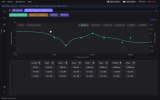
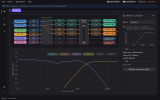
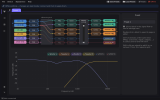
Published an update to the software, v2.0 of the YorkStudio

1. Signal flow as the main view: redesign of the signal flow diagram (see which was hidden by default in old version) and the “combined response” section into one, bow the main view. Click a block to see its settings in the side panel, double-click to open its editor, rename channels there.

2. Linking per block: Ctrl+click to select several, then link PEQ, crossover, compressor, gain/mute or the whole chain, for inputs and outputs. Linked blocks get colours, link badges and gradient wires.

3. Custom SigmaStudio projects (beta): Advanced mode, not fully implemented yet. Allows to load custom adau project (xml export) into YorkStudio.
Let's see how it goes and maybe after some feedback it will be more clear what to do with it...

4. PEQ/Xover/Limiter plots got mouse controls.

5. Added master Mute, also the master gain is now displayed on the main view instead of being hidden on device settings view

And, of course, many other small fixes

Also this time the software released for all platforms.

https://york-devices.com/index.php?page=sw&tool=yorkstudio

More about the updates:

https://york-devices.com/index.php?page=guide&tool=studio&tab=whats-new
 

Attachments

  • _community_attachments_img_9905.png
    _community_attachments_img_9905.png
    112.4 KB · Views: 48
  • _community_attachments_img_9906-.png
    _community_attachments_img_9906-.png
    181.1 KB · Views: 48
  • _community_attachments_img_9907.png
    _community_attachments_img_9907.png
    182.4 KB · Views: 43
Just did a test with 2xDSP modules, signal path is USB->DSP1->S/PDIF output->DSP2
Both DSP configurations are like this:
View attachment 562134

I am comparing phase diff between "DSP1->Out1" and "DSP1->SPDIF out->DSP2->Out3"
The difference is ~0.55ms or exactly 53 samples. When delay for DSP1 Out1 is set to 0.55ms, phase difference is zero (checked at 10kHz sine bursts)

I'll do the bypass test on the weekend.
Hey everybody!

I'm following because it's exactly my intended use case, as Mark185 suggested, using SPDIF input to one board then sending one channel thru SPDIF to the other board. I mentioned doing that to you previously by email, Eclipsevl.

And yes Koifarm, your suggestion would have been much easier but not in my particular goal.

Thanks again Eclipsevl for your work and everybody participating. My 2 boards are arriving soon.

​

 
Only negative for me is if I understand correctly, the first gen DSP board will not work with the latest software. I only ordered one new DSP board. I have already had some success setting up the first one with Sigma Studio so maybe I will experiment with exporting the schematic and trying the advanced software option even though it is not certain to work. Half the fun is trying and figuring things out when it doesn't work the first time.
 
Back
Top Bottom