• Welcome to ASR. There are many reviews of audio hardware and expert members to help answer your questions. Click here to have your audio equipment measured for free!

WiiM Sound Lite Speaker Review

Rate this lifestyle speaker:

  • 1. Poor (headless panther)

    Votes: 21 15.9%
  • 2. Not terrible (postman panther)

    Votes: 69 52.3%
  • 3. Fine (happy panther)

    Votes: 40 30.3%
  • 4. Great (golfing panther)

    Votes: 2 1.5%

  • Total voters
    132
One would think that the software would ask you which phone you have and apply some kind of correction based on measurements of its mic. Otherwise, there is no way to properly do what they say.

I have not read but I assume they accept an external mic for calibration as well? Or is it just the phone?


Yep. Check out "Built-in Mic Compensation", only for iOS and Wiim Home does accept an external mic
 
There are alternative speakers using WiiMOS from Edifier (a founding investor in Linkplay) and Audio Pro.
 
For me, they just don't play loud enough. And it's not a matter of wanting to play everything at a baseline of 81+db, it's that it will clip at peaks even when playing stuff in the low to mid 70's. That's just not an audiophile product. Would be great to see them come out with something larger. With their engineering talent, they can certainly do better.

Thanks for the nice review, Amir.
I am not so sure: Developping top class speakers asks for completely different engineering skills than needed for electronics.
 
I can see a use as background music speaker (in smaller shops or so), but for any half serious listening this does not get loud enough and lacks defined bass. It's not bad for what it is and how much it costs altough, and with a wiim streamer could be a great easy and relative cheap tool for the use i mentioned above.
 
Wiim better stick with streamers and leave everything else alone.

These kind of speakers are supposed to be fun and even if a wonky FR is excused, output should be up there and all the tricks that even remotely resemble bass must be used.

Hard pass, thanks Amir!
 
Once the process was done, I noticed an immediate but subtle improvement with the sound seemingly opening up. Then I looked and the Roomfit calibration was still set to Off!!! In other words, I imagined it. :(
Nice to see a honest Dokumentation. Imagine some YouTubers Change xover components to some more expensive parts and beeing amazed by the Sound Change, or some op-amp switchers to notice the better Soundstage

I have one of this Sound Lite with my wiim ultra to use as Wireless Surround speaker, quite nice easy Setup. Since the Last Update you need two of them to use them as sorrounds. Now its in my kitchen... Want to try it as a Center speaker but after this review it will stay in the kitchen
 
well, it's the equivalent of a cheap transisstor radio that was used in many kitchens in the past. So yes, it could be a great speaker for that. But my parents wanted good sound while cooking so they installed relative good speakers powered by a good integrated in the late 1970's. And today smaller active monitors with a wiim streamer do that a lot better for not that much more.
 
Thanks @amirm for the suggested EQ-settings. It improved the sound quality of my two Sound Lite being used as surround left and right speakers.
 
I use my WiiM Sound as a bedside speaker and am disappointed in the sound quality. Classical piano and guitar sound "tinny" to me, and symphonic music just isn't "full" (sorry about using subjective adjectives ;)). By comparison, I prefer the sound of my old JBL Link Portable, imperfect as it is.

I tried RoomFit with a calibrated UMIK-1 but preferred the sound out of the box. I'll try your PEQ to see if that's any better.

I love my WiiM Ultra and Pro Plus as components for true hi-fi systems, but the Sound doesn't work well for me.
 
Thanks for the review, Amir. Two tweeters—it reminds me of 70s-era speakers, which sometimes featured quite a few tweeters. Carlsson OA speaker models, for instance, were popular in Sweden:
nedladdning.jpeg893741e718a54536b1ec6c6b6ac55b30.webp
Some of them actually measured reasonably well—the OA12, ..
sonab-oa12-49342_grande.webp
for example,if I recall correctly.
(The one in the picture has been upgraded with modern drivers and a newly developed crossover.)

Anyway, with all the soundbars around these days, I suspect this design—using multiple tweeters and/or full-range drivers placed all around the unit—has become quite common again. (Just a guess, mind you.)

As for the WiiM Sound Lite Speaker itself—well, perhaps, but it has to be compared against something else, and in that context:
If you compare this to the previously reviewed Google Nest Audio, it seems like Google's engineering is definitely superior for this form factor. However, I'd still probably go with the Wiim just for the software, and because eff Google.

...the Google Nest speaker becomes more interesting. Even though that model is no longer being sold. However, @kyuu , you have a point about the WiiM software.
 
Last edited:
Thanks for the review Amir. Tricky little thing!

The data that confuses me the most is the big dip in the response at ~130Hz. Not sure why that would happen with a sealed enclosure. A 4” driver should be able to get down to 60-70Hz. The dip looks like the design is broken in some way - wavelength far too long for it to be a enclosure null?. I’m surprised you were able to fill it in with EQ boost too. Wouldn’t that put even more strain on the system?

Very generous recommendation imo.
If you have a Wiim system, it makes sense for the integration and we all agree their software is wonderful. As a speaker this look barely good enough.
 
Si les aigus offraient de jolis effets spatiaux, le rendu était tout simplement trop brillant à mon goût. J'ai donc décidé d'essayer WiiM Room Fit. J'ai utilisé mon téléphone Samsung S23 Ultra pour le calibrage, avec tous les paramètres par défaut. Les tonalités de test étaient assez fortes et semblaient insensibles au contrôle du volume. Heureusement, le processus est très rapide : quelques tonalités aiguës, puis un balayage CHIRP. Voici les graphiques de réponse obtenus :
WiiM Sound Lite Smart Speaker Roomfit room EQ.png


Sur le petit écran de mon téléphone, je n'arrivais pas à déchiffrer les informations. J'ai réalisé plus tard que la plage de correction standard allait de 50 à 500 Hz. L'entreprise devrait vraiment utiliser des couleurs plus distinctes, car il est difficile de différencier les quatre graphiques. Un trait pointillé ou autre permettrait de réduire l'encombrement. L'échelle verticale devrait également être de 50 dB, conformément à la norme CEA-2034. Elle semble deux fois plus élevée actuellement.

Thanks Amir for the test. Actually, you can configure Roomfit and modify the frequency range and smoothing.
Could you please give a tty with these parameters ? :

-Target Curve: Harman
-Correction Mode: Bass Only (50 Hz - 400 Hz)
- Smoothing 1/3 Octave (or the Variable option) : To get closer to the CEA-2034 standard
FOR ME : 1/12 Octave is better for surgical treatment
-Boost Option: Enable "Non-Boost Mode"
-Maximum Quality Factor: Q Max = 6.0
-Min Gain : -12 dB
-Max Gain : 0 dB since we are using Non-Boost Mode
-MMM enabled
NB : It would be wise to use the individual channel measurement mode since you only have one speaker.

Then take another quick measurement with your Klippel after the Roomfit correction (ON) to see how effective it is?
 
Last edited:
Thanks for the review Amir. Tricky little thing!

The data that confuses me the most is the big dip in the response at ~130Hz. Not sure why that would happen with a sealed enclosure. A 4” driver should be able to get down to 60-70Hz. The dip looks like the design is broken in some way - wavelength far too long for it to be a enclosure null?
Pretty sure the dip is from just a poorly designed (excessive Q) PEQ to boost the bass rather than something of physical origin
 
FWIW my experience using similar speakers (Sonos Era 100) is that the best sound is provided when they are placed at opposite ends of the room playing mono. Overall everything is much more balanced throughout the room.
 
Thanks Amir for the test. Actually, you can configure Roomfit and modify the frequency range and smoothing.
Could you please give a tty with these parameters ? :

-Target Curve: Harman
-Correction Mode: Bass Only (20 Hz - 400 Hz)
- Smoothing 1/3 Octave (or the Variable option) : To get closer to the CEA-2034 standard
FOR ME : 1/12 Octave is better for surgical treatment
-Boost Option: Enable "Non-Boost Mode"
-Maximum Quality Factor: Q Max = 6.0
-Min Gain : -12 dB
-Max Gain : 0 dB since we are using Non-Boost Mode
-MMM enabled

Then take another quick measurement with your Klippel after the Roomfit correction (ON) to see how effective it is?
Isn’t the minimum setting 50 Hz for the Sound speakers in the app?
 
Isn’t the minimum setting 50 Hz for the Sound speakers in the app?

You re right I think :
Default Range: Often starts at 20 Hz (or 50 Hz on specific devices like the WiiM Bar using built-in mics).
No idea for the WiiM Sound Lite Speaker...

But just made a search :

"The default frequency range for RoomFit™ measurements and correction on the WiiM Sound Lite is 50 Hz to 2,000 Hz when using your smartphone's built-in microphone, and up to 4,000 Hz with an external microphone."

Thank you for pointing that out. :)
 
Pretty sure the dip is from just a poorly designed (excessive Q) PEQ to boost the bass rather than something of physical origin
Hmmm. So you think the natural roll-off of the woofer is around 180Hz and the Wiim added a huge PEQ boost at 80Hz to compensate? Wouldn’t a low shelf have been a better bet?

I’m still not convinced that a 4” woofer designed for LF would roll off that high, though. Something ain’t right.

IMG_2444.jpeg
 
Hmmm. So you think the natural roll-off of the woofer is around 180Hz and the Wiim added a huge PEQ boost at 80Hz to compensate? Wouldn’t a low shelf have been a better bet?

I’m still not convinced that a 4” woofer designed for LF would roll off that high, though. Something ain’t right.

View attachment 568878


I'm not entirely sure... Amir wrote that he deactivated RoomFit and then reactivated it afterward. RoomFit then applies an automatic correction.
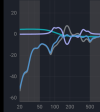
RoomFit shows a significant dip (null) centering around 80 Hz where the volume drops steeply toward -20 dB. This is immediately followed by a sharp peak (room mode) between 100 Hz and 130 Hz, climbing above +5 dB. From 150 Hz to 300 Hz: The raw measurement shows another sharp drop right before 200 Hz (dipping to around -10 dB), before stabilizing and flattening out as it approaches 300 Hz. The purple line tries to lift the valleys at 80 Hz and 180 Hz
The WiiM software applies an inverse filter curve to smooth out these issues see Equalization = Purple Line.

We should therefore ask Amir if he is certain that the Roomfit correction was indeed deactivated during his measurements...
And it would also be very interesting to know if RoomFit is truly reliable, which I doubt (in this specific case) given the lack of an external measurement microphone.
 

Attachments

  • 1793627301643.png
    1793627301643.png
    87.1 KB · Views: 13
I'm not entirely sure... Amir wrote that he deactivated RoomFit and then reactivated it afterward. RoomFit then applies an automatic correction.
RoomFit shows a significant dip (null) centering around 80 Hz where the volume drops steeply toward -20 dB. This is immediately followed by a sharp peak (room mode) between 100 Hz and 130 Hz, climbing above +5 dB. From 150 Hz to 300 Hz: The raw measurement shows another sharp drop right before 200 Hz (dipping to around -10 dB), before stabilizing and flattening out as it approaches 300 Hz. The purple line tries to lift the valleys at 80 Hz and 180 Hz
The WiiM software applies an inverse filter curve to smooth out these issues see Equalization = Purple Line.

We should therefore ask Amir if he is certain that the Roomfit correction was indeed deactivated during his measurements...
And it would also be very interesting to know if RoomFit is truly reliable, which I doubt (in this specific case) given the lack of an external measurement microphone.
But if RoomFit was on during the measurement, how was it then able to be used to correct what you're saying was already a result of the correction being on?
 
Back
Top Bottom