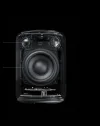
This is a review, listening test, EQ and detailed measurements of the WiiM Sound Lite powered lifestyle speaker review. It was sent to me by the company and costs US $229.

The look is as expected in this class which is to say solid. The non-lite version sports a colorful round LCD which can show clock, track information, etc. There is a touch panel on top to adjust levels and skip/rew the track. For the rest, you need the WiiM app which I used to set the volume to max for my testing using AUX analog input.
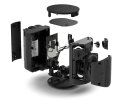
Speaking of inputs, I appreciate unusual inclusion of Ethernet RJ45 jack. So many are limited to WiFi only. Power supply is thankfully built-in. All the connections are underneath the speaker with a channel to round the cables out.
The actual configuration of the speaker is a 4 inch mono woofer and two tweeters flanking each 45 degree top corner. Speaker can be configured to run mono, stereo or left/Right only. For measurements, I configured the speaker for Left. Listening tests were performed using stereo.
Dual tweeters are there to provide spatial effects despite both being housed in the same box. The challenge with that from measurement point of view is that the two will interfere at higher frequencies creating a very complex soundfield. That complexity requires high sample rate for Klippel NFS to resolve. Not wanting to spend 2 days measuring , I opted to still use my 1000 point measurement sampling. I was pleasantly surprised that degradation (accuracy loss of higher than 1%) didn't occur until above 10 kHz.
WiiM Ultra Lite Speaker Measurements
As usual we start with our anechoic measurements:

I did not realize that by default there is a volume dependent bass boost until went to listen to the speaker after the measurements. Subjective effect is small at high playback level that I used for measurements but it may be responsible for that hump around 80 Hz. If so, I don't know why that was the selected boost, leaving a deep notch above 100 Hz. There is elevated treble response, likely due to summing of both tweeters. Or maybe that is intentional tuning. Directivity is quite uneven due to two tweeters beam forming:

Which naturally causes off-axis response to be uneven:

But somehow doesn't sum too badly:

Slope is rather flat though so signature may be bright.
Back to directivity, vertical response as usual requires staying at tweeter axis:

Even at max volume, I could not the WiiM to play at 86 dBSPL so opted for 81 which was -3dB lower:

But you expect that for the class.
Waterfall shows some resonances:

Step response starts a bit strange:

WiiM Sound Lite Listening Tests and EQ
I started listening in stereo mode as mono was kind of unexciting. I immediately noticed some tubbiness which led me to finding out about the bass boost. Its effect was very subtle at higher volumes where I did most of my listening. Still, I turned that off.
While the highs gave out nice spatial effects, the signature was just too bright for me. So I decided to give WiiM Room Fit a try. I used my Samsung S23 Ultra phone for the calibration using all the defaults. Test tones were quite loud and seemingly not impacted by the volume control. Fortunately the process is very quick with some high pitch tones and then a CHIRP sweep. Reported response graphs looked thusly:

On the tiny phone screen, I couldn't figure out what was what. It was later that I realized the standard correction window was from 50 to 500 Hz. Company should really use more differentiated colors as it is hard to tell the four graphs apart. Maybe make the target dashed or something to reduce clutter. Vertical scale should also be 50 dB per CEA-2034 standard. Looks twice as high right now.
Once the process was done, I noticed an immediate but subtle improvement with the sound seemingly opening up. Then I looked and the Roomfit calibration was still set to Off!!! In other words, I imagined it.
I turned it on but noticed very little change. Due to limit of 500 Hz, the harsh highs were still with me. And so was some of that tubbiness.
I ran another test with the settings full range. Now the highs became way too muffled with no other improvement. Using a phone microphone is likely a recipe for poor measurements.
I gave up and developed my own simple filters based on anechoic response:

I first dialed in that quick and dirty high shelf which nicely tamed the high frequencies. Yes, I gave up some spatial qualities but it was well worth the trade off.
I then filled in that bass hole which brought some welcome warmth. Note however that room modes impact what one is doing here with anechoic measurements.
Bass quality though was still problematic at the levels I was listening (at or near 100%). So played around with a sharp high pass and that seemed to do the trick.
The above filter can nicely be dialed into the speaker itself with multiple profiles to boot.
With all of this in place, fidelity rose to "audiophile" levels most of the time. This is an unfair standard of course but I don't know how to grade on a curve for this class of speaker. For us audiophiles, every product needs to be able to play loud enough, clean enough and with neutral response.
Conclusions
There is a lot of hardware and especially software here at a very good price to give likes of Sonos a run. The response could have been highly chewed up but it is not. There is a bass hole and some brightness which was easily managed through manual EQ. The automated Roomfit seemed to give it the old college try but in the amount of time I tested it, and with the phone mic, it didn't seem to produce anything likable.
Overall, I am going to recommend the WiiM Sound Lite.
-----------
As always, questions, comments, recommendations, etc. are welcome.
Any donations are much appreciated using: https://www.audiosciencereview.com/forum/index.php?threads/how-to-support-audio-science-review.8150/
The look is as expected in this class which is to say solid. The non-lite version sports a colorful round LCD which can show clock, track information, etc. There is a touch panel on top to adjust levels and skip/rew the track. For the rest, you need the WiiM app which I used to set the volume to max for my testing using AUX analog input.
Speaking of inputs, I appreciate unusual inclusion of Ethernet RJ45 jack. So many are limited to WiFi only. Power supply is thankfully built-in. All the connections are underneath the speaker with a channel to round the cables out.
The actual configuration of the speaker is a 4 inch mono woofer and two tweeters flanking each 45 degree top corner. Speaker can be configured to run mono, stereo or left/Right only. For measurements, I configured the speaker for Left. Listening tests were performed using stereo.
Dual tweeters are there to provide spatial effects despite both being housed in the same box. The challenge with that from measurement point of view is that the two will interfere at higher frequencies creating a very complex soundfield. That complexity requires high sample rate for Klippel NFS to resolve. Not wanting to spend 2 days measuring
, I opted to still use my 1000 point measurement sampling. I was pleasantly surprised that degradation (accuracy loss of higher than 1%) didn't occur until above 10 kHz. WiiM Ultra Lite Speaker Measurements
As usual we start with our anechoic measurements:
I did not realize that by default there is a volume dependent bass boost until went to listen to the speaker after the measurements.
Subjective effect is small at high playback level that I used for measurements but it may be responsible for that hump around 80 Hz. If so, I don't know why that was the selected boost, leaving a deep notch above 100 Hz. There is elevated treble response, likely due to summing of both tweeters. Or maybe that is intentional tuning. Directivity is quite uneven due to two tweeters beam forming:Which naturally causes off-axis response to be uneven:
But somehow doesn't sum too badly:
Slope is rather flat though so signature may be bright.
Back to directivity, vertical response as usual requires staying at tweeter axis:
Even at max volume, I could not the WiiM to play at 86 dBSPL so opted for 81 which was -3dB lower:
But you expect that for the class.
Waterfall shows some resonances:
Step response starts a bit strange:
WiiM Sound Lite Listening Tests and EQ
I started listening in stereo mode as mono was kind of unexciting. I immediately noticed some tubbiness which led me to finding out about the bass boost. Its effect was very subtle at higher volumes where I did most of my listening. Still, I turned that off.
While the highs gave out nice spatial effects, the signature was just too bright for me. So I decided to give WiiM Room Fit a try. I used my Samsung S23 Ultra phone for the calibration using all the defaults. Test tones were quite loud and seemingly not impacted by the volume control. Fortunately the process is very quick with some high pitch tones and then a CHIRP sweep. Reported response graphs looked thusly:
On the tiny phone screen, I couldn't figure out what was what. It was later that I realized the standard correction window was from 50 to 500 Hz. Company should really use more differentiated colors as it is hard to tell the four graphs apart. Maybe make the target dashed or something to reduce clutter. Vertical scale should also be 50 dB per CEA-2034 standard. Looks twice as high right now.
Once the process was done, I noticed an immediate but subtle improvement with the sound seemingly opening up. Then I looked and the Roomfit calibration was still set to Off!!! In other words, I imagined it.
I turned it on but noticed very little change. Due to limit of 500 Hz, the harsh highs were still with me. And so was some of that tubbiness.
I ran another test with the settings full range. Now the highs became way too muffled with no other improvement. Using a phone microphone is likely a recipe for poor measurements.
I gave up and developed my own simple filters based on anechoic response:
I first dialed in that quick and dirty high shelf which nicely tamed the high frequencies. Yes, I gave up some spatial qualities but it was well worth the trade off.
I then filled in that bass hole which brought some welcome warmth. Note however that room modes impact what one is doing here with anechoic measurements.
Bass quality though was still problematic at the levels I was listening (at or near 100%). So played around with a sharp high pass and that seemed to do the trick.
The above filter can nicely be dialed into the speaker itself with multiple profiles to boot.
With all of this in place, fidelity rose to "audiophile" levels most of the time. This is an unfair standard of course but I don't know how to grade on a curve for this class of speaker. For us audiophiles, every product needs to be able to play loud enough, clean enough and with neutral response.
Conclusions
There is a lot of hardware and especially software here at a very good price to give likes of Sonos a run. The response could have been highly chewed up but it is not. There is a bass hole and some brightness which was easily managed through manual EQ. The automated Roomfit seemed to give it the old college try but in the amount of time I tested it, and with the phone mic, it didn't seem to produce anything likable.
Overall, I am going to recommend the WiiM Sound Lite.
-----------
As always, questions, comments, recommendations, etc. are welcome.
Any donations are much appreciated using: https://www.audiosciencereview.com/forum/index.php?threads/how-to-support-audio-science-review.8150/