• Welcome to ASR. There are many reviews of audio hardware and expert members to help answer your questions. Click here to have your audio equipment measured for free!

Why are 1970's receivers so valuable now?

The numbers tell otherwise:
Vinyl growth continues as us sales hit 1 billion in 2025

It's not the dominant form altough, but still brings about 10% of the revenue of the music biz, that is not nothing. And the growth is steady at arround 10% each year. And yes, it's a technical inferior format than digital. But it seems that it's not that important to enjoy music like many think here...
Precisely. If you're happy listening to inaccurate sound reproduction, punctuated by godawful glitches caused by a crap medium, fine. Some people like being whipped, too.

But the level of such nonsense has risen to a misinformation campaign. I visited some friends who have a daughter in college. She was surprised I listen to CDs. After all, she explained, "Vinyl is a much better medium than digital."

This is nonsense. This is also what a scary number of people have been convinced is true. Total B.S.
 
Here are a few points raised by Kevin at Skylab Audio regarding the reasons behind the craze for vintage hi-fi:
Screenshot_2026-09-08_125916.121.jpg


The discussion on nostalgia also touched upon:
Anemoia (since many people buying or owning vintage gear weren't even born when the equipment they are now purchasing was originally made)

Also, the concept of self-efficacy—the belief in one's ability to handle a situation—is adressed regarding the "You Can Fit It" point.

The Money Argument; vintage vs. new, and the depreciation of the latter.

These points are explored further in the video below, which also features various nice images of vintage hi-fi gear.:)

Edit:
However, regarding what Kevin says about the topology—that most modern" high-end" amplifiers are still Class AB—well, I wonder: hasn't Class D taken over the "high-end" amplifier segment?
 
Last edited:
Precisely. If you're happy listening to inaccurate sound reproduction, punctuated by godawful glitches caused by a crap medium, fine. Some people like being whipped, too.

But the level of such nonsense has risen to a misinformation campaign. I visited some friends who have a daughter in college. She was surprised I listen to CDs. After all, she explained, "Vinyl is a much better medium than digital."

This is nonsense. This is also what a scary number of people have been convinced is true. Total B.S.
I honestly think that vinyl noise and distortion helps cover up minor system flaws. Also, some people find the perfectly quiet background of digital media to be unsettling.
 
To me, the 1970's receiver are not that valuable, but I can understand the appeal. With a few cheap accessories they can connect to blue tooth or Wi-Fi to be used with any digital source, the same as any new offering.
Performance wise, they will sound exactly the same as any new offering, but adding a vintage look, that many find attractive.
Over spending on them, is like over spending on art or any non essential item, it is more important for some than others, to each his own.
Not weirder than overspending on SOTA performance that make no difference on what we are hearing.
On my second set up, I use an older Onkyo AVR as a stereo device, it works flawlessly, was given to me, connects to everything, has a dedicated LFE output and, to me, looks much better than the mini box that are often tested here.
So an older receiver? why not?
 
Performance wise, they will sound exactly the same as any new offering, but adding a vintage look, that many find attractive.
Unless we’re talking about old low-power tube amplifiers with barely any damping factor/high output impedance—which can alter the frequency response depending on the speaker load.

The same applies to solid-state amps/receivers: as long as they perform reasonably close to spec, there’s no problem—but if components start to drift, it can become audible.

So an older receiver? why not?
Well....

I once had a Luxor 5082-R receiver that I bought for next to nothing—basically the price of a hamburger meal. However, it began to drift quite quickly. It became far too bass-heavy/ bass boomy, exhibiting a distinct—and definitely not imagined—uneven frequency response. I initially thought the loudness function was stuck in the "on" position, but that turned out not to be the case.

I gave it away to someone with more technical expertise, who I assume either replaced a few components or used it as a source of spare parts.

Luxor 5082-R receiver:
large_item_965793_edd9a96045.jpeg

 
Last edited:
it began to drift quite quickly. It became far too bass-heavy and boomy, exhibiting a distinct—and definitely not imagined—uneven frequency response.
Maybe it had an output cap? Those will definitely interact with many woofers.
 
Unless we’re talking about old low-power tube amplifiers with barely any damping factor—or high output impedance—which can alter the frequency response depending on the speaker load.

The same applies to solid-state amps/receivers: as long as they perform reasonably close to spec, there’s no problem—but if components start to drift, it can become audible.


Well....

I once had a Luxor 5082-R receiver that I bought for next to nothing—basically the price of a hamburger meal. However, it began to drift quite quickly. It became far too bass-heavy/ bass boomy, exhibiting a distinct—and definitely not imagined—uneven frequency response. I initially thought the loudness function was stuck in the "on" position, but that turned out not to be the case.

I gave it away to someone with more technical expertise, who I assume either replaced a few components or used it as a source of spare parts.

Luxor 5082-R receiver:
View attachment 557231
I agree, if you go with a technology that is notorious for sounding different like tube, one should not expect it to sound similar to transparent transistor amplification we have had for decade, ditto, if the unit is defective, which of course can happen.
Otherwise, it will sound the same.
 
And the older a guy gets, the more they want amplifiers they can no longer lift! :D

bought a Fosi v3 based off the reviews and quickly threw it in the back of a closet.. I was basically "how am I supposed to enjoy this?!" fucking wall wart it came with weighs more. lesson learnt - don't buy anything based on recommendations from plebs.
 
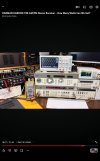
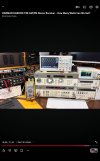
Since the Harman Kardon 330C was mentioned in the thread, here is its big brother—the Twin Power 730—on the test bench in the video below. Measured at 1 kHz with 0.04% distortion, it delivers 49.2 watts at the clipping point. That’s impressive for a fifty-year-old unit (note: it has been restored and serviced). :) The test starts at 17:15 in the video:
Screenshot_2026-09-13_114548.429.jpgScreenshot_2026-09-13_114635.597.jpg

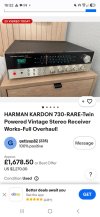
But look at the used prices.Final price in the bidding for the two different HK 730s: $360 vs. $644. There is barely a month’s difference between these two HK 730 listings on the same site:

Screenshot_2026-09-13_115027.752.jpgScreenshot_2026-09-13_115054.104.jpg
On paper—judging by the ads—they are in the same condition. The one that sold for the higher price actually appears to be in slightly worse shape (there is a fault in one of the phono channels).
And nope, it’s not the case that the one that went for the lower price—$360—was sold before the one that went for $644.

It’s fascinating when you’re selling—seeing who places bids and how many people do so.
The site where both were listed is Sweden’s largest auction site.
 
how am I supposed to enjoy this?!" fucking wall wart it came with weighs more. lesson learnt - don't buy anything based on recommendations from plebs.
LOL I went through the same thing. I had to put bricks on a stack of 4 ZA3 to keep a breeze from the front door from blowing them off the rack. I finally went and got my old pair of Mcintosh MC600s and sandwiched the whole stack between the pair. They just survived a couple of 90 MPH bursts from a local windstorm as the shingles flew off the backyard shed.

I added 5 pounds of peel-and-stick lead weights to a pair of Nord NC500 One Ups 10+ years ago.

I also spent 3 weeks in physical therapy after moving 30+ MC225s, MC240s, MC275s, MC30s, MC40s, MC60s, and MC75s. They kept checking me for a hernia; I just told them it was behind the good-looking nurse and that ain't a hernia! ‍‍

Regards
 
Back then I thought the Luxman R 1040 was the most gorgeous receiver I'd ever seen. I did admire the Marantz in particular and also Pioneer, Sansui models. But it was the elegant, symmetrical front facia of the Luxman, plus the beautiful wood case that really got to me about the Luxman.

20230312_125806.jpg
 
Since the Harman Kardon 330C was mentioned in the thread, here is its big brother—the Twin Power 730—on the test bench in the video below. Measured at 1 kHz with 0.04% distortion, it delivers 49.2 watts at the clipping point. That’s impressive for a fifty-year-old unit (note: it has been restored and serviced). :) The test starts at 17:15 in the video:
View attachment 558443View attachment 558444

But look at the used prices.Final price in the bidding for the two different HK 730s: $360 vs. $644. There is barely a month’s difference between these two HK 730 listings on the same site:

View attachment 558441View attachment 558442
On paper—judging by the ads—they are in the same condition. The one that sold for the higher price actually appears to be in slightly worse shape (there is a fault in one of the phono channels).
And nope, it’s not the case that the one that went for the lower price—$360—was sold before the one that went for $644.

It’s fascinating when you’re selling—seeing who places bids and how many people do so.
The site where both were listed is Sweden’s largest auction site.
Those 70's Hk's 330's, 430's and 730's are are classics in vintage SS gear. The 330a and 330b are also in demand. Most of the 70's integrated receivers were very stylish with a nice rich warm sound more tube like then later 80's and 90's models. Hk that existed in the 60's and 70's is long gone. All those Cambridge,Ma. companies like KLH and Advent have passed away as well.

Now we get boring clinical expensive components that cater to a completely different crowd of music lovers. It is good see younger people getting into vintage gear along with Lp's, one can see the same thing with film cameras from the 60's and 70's, vintage manual focus lens and mechanical watches.
 
To me, the 1970's receiver are not that valuable, but I can understand the appeal. With a few cheap accessories they can connect to blue tooth or Wi-Fi to be used with any digital source, the same as any new offering.
Performance wise, they will sound exactly the same as any new offering, but adding a vintage look, that many find attractive.
Over spending on them, is like over spending on art or any non essential item, it is more important for some than others, to each his own.
Not weirder than overspending on SOTA performance that make no difference on what we are hearing.
On my second set up, I use an older Onkyo AVR as a stereo device, it works flawlessly, was given to me, connects to everything, has a dedicated LFE output and, to me, looks much better than the mini box that are often tested here.
So an older receiver? why not?
I can understand the appeal, which is mostly nostalgia, wouldn't spend much $ on one. Modern gear sounds better and measures better.
 
So much of it is really handsome too.
I'll admit one of the biggest reasons I got my Marantz 2270 was looks.
What a beauty in that walnut case
I thought it was the best looking receiver at the dealers, that and the Marantz name.
Look on ebay for a rehabed 2270, about the highest priced ones around.
marantz_2270_stereophonic_receiver.jpg
Yes, some of the 70s receivers were beautiful. They all had the traditional analog tuner display and tuning meters which later were replaced with a numerical display. I loved my Pioneer SX750. My daughter has a SX650 now.
 
I can understand the appeal, which is mostly nostalgia, wouldn't spend much $ on one. Modern gear sounds better and measures better.
Yeah, I must have missed the nostalgia memo. I like the wood finish, and I'm glad the old stuff is being saved from the trash heap. But it's not for me.
 
I can understand the appeal, which is mostly nostalgia, wouldn't spend much $ on one. Modern gear sounds better and measures better.
It is not nostalgia, 70's gear sounds great, who cares about how it measures as long it sounds good. Give a 70's piece a try then see what you think about it for yourself. Would you rather have a 70's Leica lens or a modern Nikon lens? Would you rather have beautiful mechanical watch or a modern apple watch? If all these vintage pieces were just nostalgia people would not be buying them. How about vintage fender and Gibson guitars? Fender 60's tube amps, E36 BMW's ....
 
I can understand the appeal, which is mostly nostalgia, wouldn't spend much $ on one. Modern gear sounds better and measures better.
One might wonder, looking at Hifishark data for the HK 730 Twin Powered and its price:
€617 ($715) ▲ median price based on 33 trusted listings.
Screenshot_2026-09-13_163548.672.jpg
Some are priced even higher:
Screenshot_2026-09-13_162255.656.jpg
Is a complete overhaul worth the extra $1,500 or so compared to the average price?

I’m happy with my HK 330C, which I picked up as a bargain at a flea market for about a tenth of the price of an HK 730. Sure, I’ve spent around $50 on some replacement parts for it, but still. But upwards of $700 for something fifty years old? I don’t know—I’d have bought something new instead.
On the other hand, it’s not an (super) expensive hobby compared to many others. To each their own—as long as you’re happy and satisfied.:)
 
Last edited:
Back
Top Bottom