
-
Welcome to ASR. There are many reviews of audio hardware and expert members to help answer your questions. Click here to have your audio equipment measured for free!
You are using an out of date browser. It may not display this or other websites correctly.
You should upgrade or use an alternative browser.
You should upgrade or use an alternative browser.
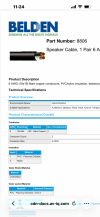
W.T.B. Belden 8806 speaker cables for project.
- Thread starter J.M.
- Start date

- Joined
- Aug 3, 2019
- Messages
- 1,851
- Likes
- 2,925
Right, it's hard to imagine a less demanding cabling application. Just about any decent jacketed cable with two stranded 6 AWG copper conductors will perform identically.Why those particularly (and in what length)? So many alternatives....
- Joined
- Aug 3, 2019
- Messages
- 1,851
- Likes
- 2,925
Belden 5t00upI just saw it would fit my needs at the time. Now am looking for just a good 10 awg speaker wire. Belden discontinued this speaker wire.

- Joined
- Oct 5, 2022
- Messages
- 850
- Likes
- 870
Out of curiosity, what is the application, and what size do you need? Is it an extremely harsh environment, or is there a requirement to guarantee the build by using only that specification?
Just wondering.
Regards
Just wondering.
Regards
OP

J.M.
Active Member
- Joined
- Dec 30, 2023
- Messages
- 214
- Likes
- 119
- Thread Starter
- #7
So, at the house we bought into we have an antenna that servers as a morse code hobby for my father in-law. We have always had trouble with beeps and certain noises throughy sound systems or computer speakers for years. I wanted to buy the biggest best wire to eliminate that noise. Second I have to run over a 50 feet of wire 1 way underneath the main sub flooring for my speaker system am putting in our bed room. There is a lot of old wires and a drop ceiling with a lot of metal plus the antenna from the morse code issue. Am looking to eliminate that problem from my speaker systems. My father in-law will not take or uninstall this antenna. I hope this makes sense? If anyone has any suggestions please share. Thanks so much. JeffOut of curiosity, what is the application, and what size do you need? Is it an extremely harsh environment, or is there a requirement to guarantee the build by using only that specification?
Just wondering.

First you should identify the path the noise enters your system. I wouldn't bet much on this being the speaker cables. Disconnect the speaker cables and try with a headphone whether noise is audible. If yes the cause is somewhere else, usually an input.
Edit: If it is the speaker cable either try a shielded cable, or better use an RF blocking filter at the output of the power amp. Your father in law, being a licensed amateur radio operator, should know how to get or make one.
Edit: If it is the speaker cable either try a shielded cable, or better use an RF blocking filter at the output of the power amp. Your father in law, being a licensed amateur radio operator, should know how to get or make one.
OP
J.M.
Active Member
- Joined
- Dec 30, 2023
- Messages
- 214
- Likes
- 119
- Thread Starter
- #9
I have looked and know where the path to the noise is due to the cables end being the room I have used. I cut the Morse codes cables end (I pushed it down under that rooms sub flooring. It was coming up through the sub flooring in a corner) I also got rid of the special wall plate. So. I have heard it through my head phones as well. It shows up out of no where and has no schedule or time or does it on a timely basis. It just goes beep beep beeps and rarely has the slightest humm to it as well. I have newer heavy duty Receptacles in that room and a new light switch as well. Wiring for the house is from 1979. If I could unplug the signal booster to this morse code antenna I would. I wonder if that could be the problem. I know my father in-law doesn’t use it anymore. It does just sit there plugged in. I could unplug it and see if that helps? maybe this will solve this problem over the years I keep dealing with? Jeff
OP
J.M.
Active Member
- Joined
- Dec 30, 2023
- Messages
- 214
- Likes
- 119
- Thread Starter
- #11
I checked and the morse code amplifie is not plugged in. I know he has a booster somewhere? I will ask and see if I can locate that device. I will see if I can record that sound? I don’t think it’s from a smart phone due to this being happening for over the last 30 plus years. I thought it was the router but, that’s in a different room now. We don’t have cable but, cable for our internet connection and then cat 7. I most forget there is direct tv mini satellite on the family room roof. It is not being powered and the cables were left intact but, not unscrewed or eliminated from the the satellite. That are still where they were installed in 1995 or 96. They had a toshiba 32 or 36 inch wide screen tv. So, also out main power cables running under the ground was replaced last Early November in 2025 Just before winter hit in michigan. I know this is a lot of variables and chasing a rabbit down a confusing road but, I am trying to find and lay out all I can so everyone sees the whole picture .Could you share a short recording of those beeps? I wonder if it may be caused by a smart phone. I don't think an unused transmitter could cause the problem.

Speedskater
Major Contributor
IF any nearby HAM Radio Operator causes interference (RFI) from Morse Code (Continuous Wave) or voice radio transmission.
Retired Audio Engineering Society committee chair on interference (EMI/RFI) and HAM Radio Operator has many papers on how to reduce your problem.
Retired Audio Engineering Society committee chair on interference (EMI/RFI) and HAM Radio Operator has many papers on how to reduce your problem.
OP
J.M.
Active Member
- Joined
- Dec 30, 2023
- Messages
- 214
- Likes
- 119
- Thread Starter
- #13
Okay . Nicely done. I will read through this later tonight. Sorry busy with projects. I Also greatly appreciate it.IF any nearby HAM Radio Operator causes interference (RFI) from Morse Code (Continuous Wave) or voice radio transmission.
Retired Audio Engineering Society committee chair on interference (EMI/RFI) and HAM Radio Operator has many papers on how to reduce your problem.
- Joined
- Oct 5, 2022
- Messages
- 850
- Likes
- 870
We used to have a horrible time in the 60s-80s when CHP would fly by the house in a chase and blast through the stereo.I hope this makes sense. If anyone has any suggestions, please share. Thanks so much. Jeff
I fixed ALL my problems with shield-specific RCAs and speaker cable that a buddy researched for me. I NEVER heard another peep from Ham, or hotroded CBs.
I found that usually the problem was on their end, not mine, BUT I've learned there are great solutions like shielded SOOW with high-grade copper, shielding, insulation, environmental protection, always very water-resistant and extremely chaff-resistant.
Remember routing properly is just as important as the type of cable you choose. It has never needed to be a name-brand like Belden, BUT at the same time I was raised on Belden NAPA from my earliest years of working on and around heavy equipment and farm equipment as a youngster. Everything was Napa Belden, with Napa Belden tinned copper butt connectors; the solder and the different types of tapes we used were Belden or 3M.
I still keep hundreds of feet of SOOW and JSoow cable in the shop for just about everything I do, especially speaker cables or if I happen to help out one of the local BOOM, BOOM boys in the neighborhood.
The right armor, shrink tube, and terminal ends go a long way for great, dependable, reliable, and quiet installations. Not to mention they look as good as the time you're willing to invest in making sure they LOOK that way.
LOL sure it did. What a bunch of nonsense.We used to have a horrible time in the 60s-80s when CHP would fly by the house in a chase and blast through the stereo.
I fixed ALL my problems with shield-specific RCAs and speaker cable that a buddy researched for me. I NEVER heard another peep from Ham, or hotroded CBs.
I found that usually the problem was on their end, not mine, BUT I've learned there are great solutions like shielded SOOW with high-grade copper, shielding, insulation, environmental protection, always very water-resistant and extremely chaff-resistant.
Remember routing properly is just as important as the type of cable you choose. It has never needed to be a name-brand like Belden, BUT at the same time I was raised on Belden NAPA from my earliest years of working on and around heavy equipment and farm equipment as a youngster. Everything was Napa Belden, with Napa Belden tinned copper butt connectors; the solder and the different types of tapes we used were Belden or 3M.
I still keep hundreds of feet of SOOW and JSoow cable in the shop for just about everything I do, especially speaker cables or if I happen to help out one of the local BOOM, BOOM boys in the neighborhood.
The right armor, shrink tube, and terminal ends go a long way for great, dependable, reliable, and quiet installations. Not to mention they look as good as the time you're willing to invest in making sure they LOOK that way.

Whilst shielding is probably the best answer as @OldHvyMec said, you can buy ferrite cores to clamp onto the cables that help eliminate HF radio interference. You can buy them from Amazon, Digikey, Parts Express, etc.
More than not, such silliness as ferrite cores or anything special is needed for speaker wire. Good grief.Whilst shielding is probably the best answer as @OldHvyMec said, you can buy ferrite cores to clamp onto the cables that help eliminate HF radio interference. You can buy them from Amazon, Digikey, Parts Express, etc.
Speaker wires were the most common entry point I found for RF interference after phono inputs. They were usually the longest unshielded cables in the system. Shielded speaker wires were rare, so I often bought copper shield braid and made my own, but ferrite cores usually worked and were easier. Many amplifiers include an output LC filter, but RF leakage was high enough through the filter (capacitive coupling across the output choke was typical) that the signal would couple through the outputs into the amplifier's feedback network to be rectified at the front end and spit back out the speakers in the audio band (or worse above, inaudible but killing tweeters). Of course it depends upon the amplifier's design (most modern amps include RF suppression filtering on their outputs, and inputs, usually a simple capacitor or Zobel circuit).More than not, such silliness as ferrite cores or anything special is needed for speaker wire. Good grief.
Might be silly to you, but has been a huge problem in the past, and present if the ham station is not "clean". Also an issue for locations near high-power commercial transmission towers for AM radio (FM and TV were rarely an issue). By far the biggest violators were back in the CB craze days when sweep-tube "linears" were all the rage. Most high-powered cheap RF "CB" amplifiers had no filters, high distortion, and splattered noise all over everywhere. Later, light dimmers were often an issue in the listening room (or just in the house), but a cap or ferrite on the dimmer usually worked.
Ferrite cores and similar materials (e.g. mu metal sheets) are a common solution to RF interference in my world.
Last edited:
Just do a web search, thousands of articles, those these days mostly focused on car audio. Ferrites are often marketed for car audio systems and do work. You can also check IEEE Journals, both JSSC and Consumer Electronics, or just take a course on amplifier design. The old ARRL Ham Radio Handbook, the various radiotelephone license books (interference reduction was part of the 1st and 2nd class license tests), and my ancient ITT Reference Data for Radio Engineers have good discussions about the problems and solutions, though they are focused on the audio output from radio/TV systems rather than explicitly on consumer audio systems, but the principles are the same. The ARRL handbooks used to have sections dealing with interference mitigation for Ham operators (I have not been a member for years so do not know what is in the current handbooks).Please show your breakdown/study of this bullshit....
Analysis these days is pretty straightforward if you set up an amplifier in SPICE and inject a signal on the speaker cables. But you need decent models of the passive components of the output filter to account for HF leakage and coupling, and transient rather than small-signal simulations (i.e. time-consuming) to demonstrate demodulation of the RF interferer. I thought I had a circuit set up for this but do not, and at this point it's past my bedtime and honestly with that attitude don't really have anything to prove to you.
I wasn't particularly focused on ferrites, and have never had any make a difference IME. I'm not much into car audio, tho.Just do a web search, thousands of articles, those these days mostly focused on car audio. Ferrites are often marketed for car audio systems and do work. You can also check IEEE Journals, both JSSC and Consumer Electronics, or just take a course on amplifier design. The old ARRL Ham Radio Handbook, the various radiotelephone license books (interference reduction was part of the 1st and 2nd class license tests), and my ancient ITT Reference Data for Radio Engineers have good discussions about the problems and solutions, though they are focused on the audio output from radio/TV systems rather than explicitly on consumer audio systems, but the principles are the same. The ARRL handbooks used to have sections dealing with interference mitigation for Ham operators (I have not been a member for years so do not know what is in the current handbooks).
Analysis these days is pretty straightforward if you set up an amplifier in SPICE and inject a signal on the speaker cables. But you need decent models of the passive components of the output filter to account for HF leakage and coupling, and transient rather than small-signal simulations (i.e. time-consuming) to demonstrate demodulation of the RF interferer. I thought I had a circuit set up for this but do not, and at this point it's past my bedtime and honestly with that attitude don't really have anything to prove to you.
Similar threads

- Replies
- 124
- Views
- 8K

