
• Welcome to ASR. There are many reviews of audio hardware and expert members to help answer your questions. Click here to have your audio equipment measured for free!

VTV Purifi EVAL1 teardown and rebuild

RickS

Moderator
Moderator
Forum Donor
The Curator
Joined
Jan 14, 2020
Messages
5,176
Likes
11,363
Location
North America
Based on Amir’s VTV amplifier teardown, I had posted some reworks on my used Hypex one. @Rottmannash liked what he saw and, after a brief conversation, decided to have me evaluate his VTV Purifi amp. The goal here is to improve build quality and safety - not to alter the any of the Hypex or Purifi modules. I use a Quantasylum QA401 audio analyzer and, while not Amir’s AP, helps identify major flaws and validate that any mods are beneficial rather than harmful.

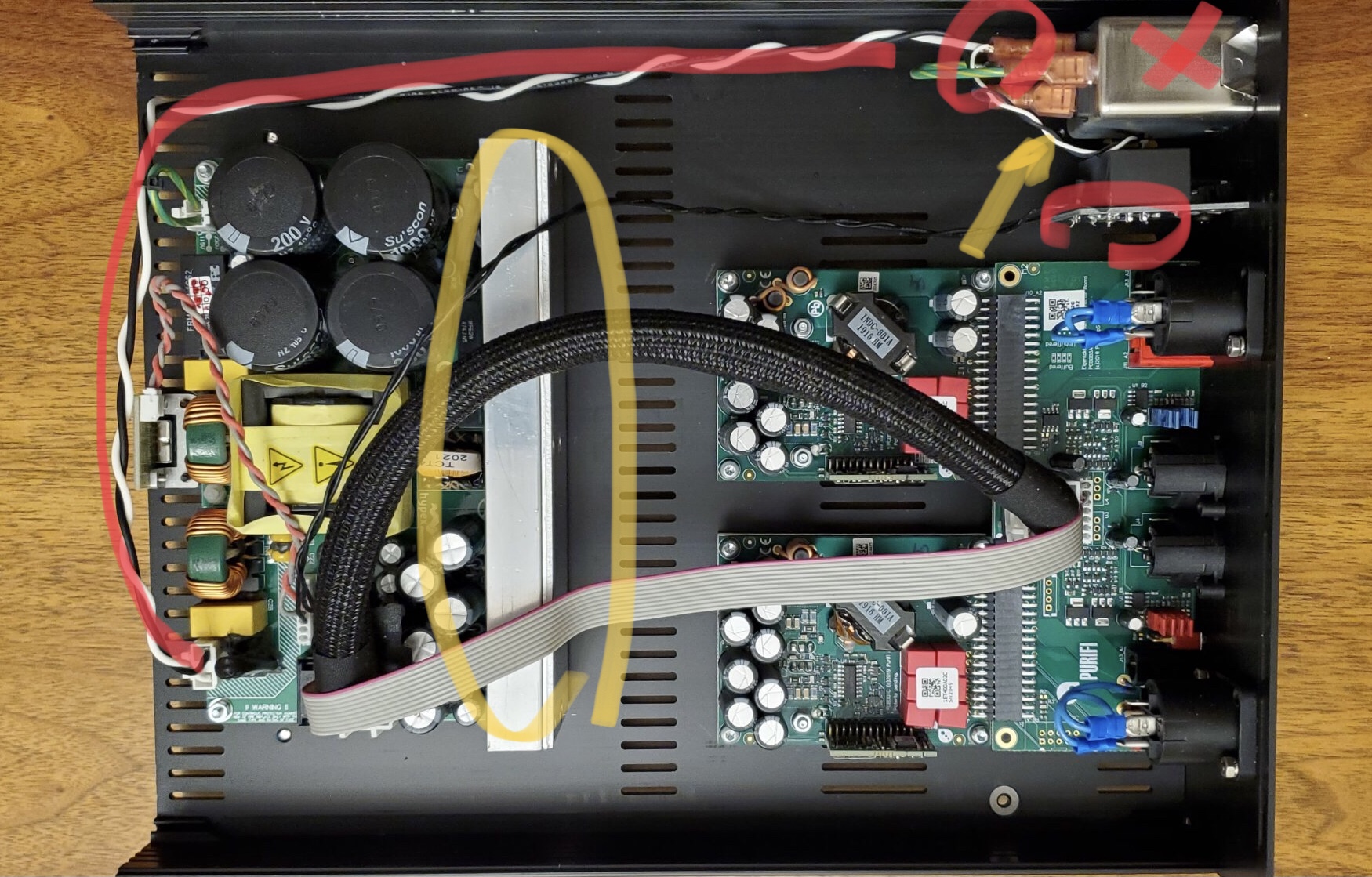
So, here the first pass. Here is my markup of the BEFORE pic that was posted in Amir’s teardown thread:
532E9E71-6232-48F1-966D-BCDD53FD2F8D.jpeg


First, I should mention that before opening this amp, I ran some quick checks and no major noise issues were identified. At this point, the main focus became improving any identified safety concerns. Please note my use of different colors is more for contrast than any other purpose. Starting with the Red X in the upper right, this is meant to note the lack of a case fuse. Some might say, the EMI filter is an issue too, but not as best as I can tell with my analyzer. So, will just be adding a 250V 15A fast blow fuse. The red circle to the left of the X is some slightly exposed AC wiring and will eliminate that. The yellow arrow points to the case ground that lacks a knurled washer and will add one of those.

Continuing with the AC wiring, there are several improvements planned. One is to shorten it by a bit more than half. This will be done by remounting the power supply so the heat sink is on the left. This also eliminates all the wiring running over the heat sink as identified by the yellow oval. Next will encase the AC wiring in nylon braid to double insulate most of it from the case. Finally will add some wire tires to tidy it up a bit too.

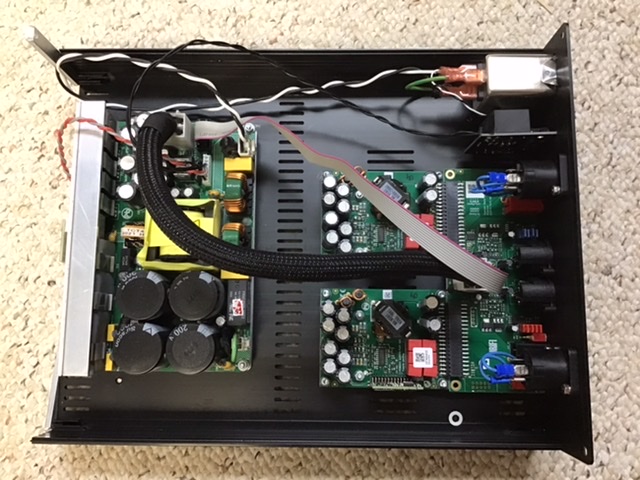
So here is a pic after I remounted the power supply:
DDE6EAD4-14ED-4C85-A484-D8F93587B3B5.jpeg


As you can see, this left a lot of excess AC wiring and now only the LED wire needs to go over the heatsink. Will add some heat shrink tubing for the LED wire to double insulate. At this point, I reran my tests and found a very marginal improvement in low frequency noise. This may improve more once I shorten the wires. Along with shortening the AC wiring, plan to solder the power wires to the input connectors. This will prevent them from falling off and causing potential loss of power or shorting.
 
Last edited:
Here is the pic with the updates...

65108446-CFE2-4480-8264-624F89CF9386.jpeg

Meant to take more pics along the way, but will add some closeups once I clean it up. The one that will be hard to see is the inline fuse as it is now encased in braided insulation. As even the larger cable clamps I have would mess up the ribbon cable, just tie wrapped it and the standby wiring to the power supply post.

Another quick analyzer test shows the same marginal improvement with low frequency noise for the new wiring. Will post them when I do a final test and get screen shots transferred from my workbench computer.
 
Last edited:
In the original orientation, does the heat sink act as a shield to reduce power supply noise from coupling into the amplifier boards? No idea, curious...
 
So apparently the big improvements should come when removing the IEC filter? Let's see.
 
In the original orientation, does the heat sink act as a shield to reduce power supply noise from coupling into the amplifier boards? No idea, curious...

Not that my analyzer detects, but the rewiring helped. Green is before and yellow is after rewiring.

1627252229377.png
 
So apparently the big improvements should come when removing the IEC filter? Let's see.

Tested this before and did not find any issue with this EMI filter. It just does not have a fuse. Rather than replace it, just added one inline.
 
More rework pics…

Flexseal on the trigger board exposed AC contacts:

B9553B98-5A68-43D9-A2A2-78D5A8BA5994.jpeg


Ground now has (internal) knurled washer…

E4CC3D50-A90E-4DDE-BFA7-27166176DBC9.jpeg


Tie wrap of control signal cables to keep the away from AC input wiring…

FD396984-3F0C-4DB8-B962-FDA1BF676C4B.jpeg
 
Last edited:
Tested this before and did not find any issue with this EMI filter. It just does not have a fuse. Rather than replace it, just added one inline.
Then I am puzzled why the VTV EVAL-1 does not measure as well as the reference design! o_O Any idea why?
 
Then I am puzzled why the VTV EVAL-1 does not measure as well as the reference design! o_O Any idea why?

Whose measurements? May just be limitation of my test rig. My NC500 tests as well as the Purifi for example. It is not near as quiet as Amir's AP.
 
Finally, here is my goto test....

VtV Purifi Eval-1.png


The low power performance is affected by an attenuator that I forgot to turn off in this automated test. Nice consistent performance for both channels before and after the reworks. Also am using the QA451 dummy load and it cannot be driven to this amp's full output. So is why the graph stops at 100 watts or so.
 
Last edited:
Not that my analyzer detects, but the rewiring helped. Green is before and yellow is after rewiring.

View attachment 143431

If it did anything, I'd expect it to reduce coupling at the SMPS frequency, well above the audio band. No worries, I was just curious. And reducing low-frequency line hash is undoubtedly much more important sound-wise.

Interesting you get 2HD and 3HD at virtually the same level, then no higher harmonics.
 
Then I am puzzled why the VTV EVAL-1 does not measure as well as the reference design! o_O Any idea why?
Below is from Amir's QA401 review. With Amir's APx 555 generator output, the QA401 "measured" THD was -105.6 dB, and THD+N was -99.0 dB These are the measurement limit of QA401's ADC.

Rick's measurements of the VTV Purifi were THD: -105.6 dB and THD+N: -97.2 dB. Therefore, the Purifi amp's performance is beyond what the QA401 could measure, and thus everything is all good.

index.php
 
Last edited:
Wow, flipping the PSU really helps the AC wiring. Amazing reduction in length.

How badly will the DC out get smashed onto the PSU when the lid goes on?
 
A shame the case isn't big enough to rotate the PS another 90 degrees and put the heat sink against the left side of the amp. Even shorter power lead, better for routing the ribbon control signal cables and a direct path for the LED wire as well.

Nice improvements Rick.
 
Wow, flipping the PSU really helps the AC wiring. Amazing reduction in length.

How badly will the DC out get smashed onto the PSU when the lid goes on?

That cable bundle is a bunch of thicker wires that are constrained by the length. They do push back very slightly when the case is buttoned up. That indicates to me that they are not getting smashed into the SMPS too badly. This one is going back to its owner today. Am still adding fuses to some of mine and, although tried before, will give some more scrutiny to see if the PSU cable position is making any significant difference. :cool:

EDIT: I wanted to add that the DC power cable position is a wash in this situation. Its routing is about the same regardless of the overall power supply orientation.
 
Last edited:
In the original orientation, does the heat sink act as a shield to reduce power supply noise from coupling into the amplifier boards? No idea, curious...

That was my thought also. I had brought it up in another thread about Hypex SMPS orientation.
 
@Rick Sykora : Why did you used a 15A fuse? I thought a 3A fuse would be more appropriate. What am I missing?

The Hypex power supply used already has a 12A slow blow fuse on its AC inputs. From Hypex data sheet...

1627294977149.png


Want the case fuse to blow if some wiring shorts and not otherwise hinder the power output of the SMPS. So went with a slightly higher rated fast blow fuse.
 
Last edited:
SMPS1200Axxx max in-rush current is 37 A.

Do not want nuisance blows, but want it to go fast if it shorts. The SMPS fuse is already a slow-blow one. Ideally could have measured but that stresses equipment and somebody else’s amp.

My understanding is that a 15A fuse blows at 15A. Surely you are not suggesting that the fuse be higher than the typical (US) house circuit breaker?
 
Last edited:
Back
Top Bottom