
• Welcome to ASR. There are many reviews of audio hardware and expert members to help answer your questions. Click here to have your audio equipment measured for free!

Topping Mini 300 Amplifier Review

Rate this amplifier:

  • 1. Poor (headless panther)

    Votes: 3 0.9%
  • 2. Not terrible (postman panther)

    Votes: 12 3.6%
  • 3. Fine (happy panther)

    Votes: 57 16.9%
  • 4. Great (golfing panther)

    Votes: 265 78.6%

  • Total voters
    337
Why do Chinese manufacturers like Topping, SMSL, Fosi Audio, etc., steadfastly refuse to release stereo power amplifiers (without volume controls)—offering only mono models instead?
Why are you asking this question in a topic of a stereo amplifier with a volume knob?
 
Why do Chinese manufacturers like Topping, SMSL, Fosi Audio, etc., steadfastly refuse to release stereo power amplifiers (without volume controls)—offering only mono models instead?
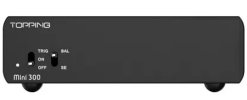
It may be they hesitate to put volume controls on mono amps, because of the difficulty of gain matching between channels.
 
Why are you asking this question in a topic of a stereo amplifier with a volume knob?
Precisely because I’d like to have one of that type, but without the volume control. Makes sense?
 

Attachments

  • tp.jpg
    tp.jpg
    14.6 KB · Views: 52
Why do Chinese manufacturers like Topping, SMSL, Fosi Audio, etc., steadfastly refuse to release stereo power amplifiers (without volume controls)—offering only mono models instead?
Is the knob such a big problem? I set the volume knob on my Mini 300 at max the day I got it and haven't touched it since then, works just fine. Of course I would have gotten it without the knob if I had the choice but having one wasn't a deal breaker.
 
Precisely because I’d like to have one of that type, but without the volume control. Makes sense?
Fair enough! Now I get where you're coming from. It was unclear to me

I'm curious why though. I assume that you probably place it in a chain of devices and control the volume from somewhere else?
 
Fair enough! Now I get where you're coming from. It was unclear to me

I'm curious why though. I assume that you probably place it in a chain of devices and control the volume from somewhere else?
Well, I do. But I just crank the Mini volume knob to max.
 
Precisely because I’d like to have one of that type, but without the volume control. Makes sense?
Interestingly, I hold the opposite point of view.

I've found that --- for every amp I've tested --- the stated input sensitivity has been somewhat on the optimistic side. That can be a problem when sources present signals of higher amplitude (e.g., 2 Vrms or more).

For example, when operated at maximum gain, the Topping Mini300 shows visible distortion (noise) on an oscilloscope trace when the amplitude of the input signal is greater than 1.15 Vrms (for 8 ohm and 16 ohm loads, 1.2 Vrms for 4 ohm loads), which is almost 5dB lower than the manufacturer-stated 1.3 Vrms input sensitivity. The noise can be avoided by turning down the gain knob (to about the 3:30 position) rather than leaving the amp at maximum gain. The Aiyima A07 and 3e Audio A7 face similar challenges. Having a gain (volume) knob provides a simple way to restrict the amplitude of the output signal so that the noise doesn't appear.

Also, many modern amps can push the drivers in my system beyond their rated limits. Setting the gain knob at a safe position and leaving it alone can avoid issues should someone inadvertently (or foolishly) crank the volume way up on a streamer.

That said, I tend to set my amps at maximum gain and use my DSP to attenuate the signal being sent to the amp so that it can never get to noisy or dangerous levels. But not everyone has a DSP.

I'd love to see amps that not only have a volume (gain) knob to control the amplitude of the output signal, but that also have a way to vary the amp's input sensitivity so that it can be tailored to match a source.
 
Last edited:
For example, when operated at maximum gain, the Topping Mini300 shows visible distortion (noise) on an oscilloscope trace when the amplitude of the input signal is greater than 1.15 Vrms (for 8 ohm and 16 ohm loads, 1.2 Vrms for 4 ohm loads)
Are you referring to RCA? Have you tested BAL?


Will the distortion shown on the oscilloscope affect sound quality, for example, by bleeding into the audio band?
 
Are you referring to RCA? Have you tested BAL?


Will the distortion shown on the oscilloscope affect sound quality, for example, by bleeding into the audio band?
I tested single ended (RCA) inputs. The input sensitivity of balanced connections is around 2x that of SE.

My DSP (a MiniDSP Flex Eight) doesn’t have balanced outputs so I haven’t tested them.

I can’t speak to how audible the noise might be. My testing apparatus is less sophisticated than what the manufacturers would use. IIRC, For the Mini300 at 1.3 Vrms input sensitivity, Topping specified 1% THD+N. That would indicate that the noise I can see is at a lower level than that, if Topping’s spec is accurate.

However, when presented with an input well above the input sensitivity (say, a 2Vrms signal into an amp rated for 1.3 Vrms) it’s usually not just noise but pretty severe clipping present, which would certainly be audible.
 
I’m having trouble understanding the issue. Virtually all manufacturers produce power amplifiers. Besides, many people use DACs with high-quality volume controls. Why add an extra component to the signal chain?
 
I can’t speak to how audible the noise might be. My testing apparatus is less sophisticated than what the manufacturers would use. IIRC, For the Mini300 at 1.3 Vrms input sensitivity, Topping specified 1% THD+N. That would indicate that the noise I can see is at a lower level than that, if Topping’s spec is accurate.
I've seen (and read) your analysis and I still think that the level of distortion at which manufacturers measure Pmax fully explains your findings. As you already mentioned, in the end you have to attenuate the signal to safely avoid this distortion and in the end it doesn't matter much if the attenuations is performed in one box or the other.

It's always been possible with traditional integrated amplifiers to drive the power stage into clipping if you don't mind the volume control sensibly.

Also, traditional power amplifiers didn't have volume control and in a way I can understand the desire to have that with modern gear. Switchable input sensitivity is very common anyway and usually all you need. It just doesn't look like there's a real market. Just because an amp has a volume control and more than one input it's not an integrated amp in my book. I'm well aware of traditionalists thinking otherwise, but well ... most people simply don't care.
 
If anyone is interested in the development of the sound of cheap class D amplifiers, here is a sound comparison of the current Topping Mini 300 and a twenty-year-old Panasonic AV receiver. According to reviews here, the Topping has excellent measured parameters, while the similar Panasonic turned out to be much worse. It's a blind test. I'll include the results in the video description later.

I am sorry, but you cannot compare the sound of any HiFi device using a YouTube video. It is not possible.

Just think about the number of devices in the signal chain here (7 or more, including your listening setup), as well as missing info about how the audio was processed and compressed. In addition, we dont know whether the test setup was properly assembled, level matching was good enough (description just says "levels matched at 1 kHz") or if the video producer inadvertently fumbled the recording settings or accidentally applied a different processing to either of them. It's all just a black box.

A YouTube video is useless to compare audible differences on this level.
 
Same thing, with a room temperature of about 20° degres Celsius, the enclosure is very warm, I estimate about 45°.
I am using the Mini 300 at my work station, used for editing, the Mini 300 is connected to JBL Control 1Gs, so 4ohms impedance. And I am listining at very low levels, the line of the volume knob barely points over the "M" of "Min". It's predecessor, an SMSL SA-36 which I used for ages just became slightly warm...
The SA-36 has a 25W output at 4R and 12V PSU. It's no surprise that it only became slightly warm, or that you have the volume close to minimum after replacing it with a much more powerful amp. Do you have any channel balance issues with the volume that low?
 
Not at all. I ordered 2 Mini 300 Amps, the second runs warm as well, connected to the same gear, but not that much. But I cannot measure to proof.
 
I'm running mine into an 8 ohm load. I wonder if that affects the idle power. Mine gets barely warm even after an hour or two.
 
I'm running mine into an 8 ohm load. I wonder if that affects the idle power. Mine gets barely warm even after an hour or two.
That would surprise me very much. There should be no voltage, and thus no current, across that 8 ohm speaker load when idle.
 
For those in the know :

How much does having a volume pot in the signal path actually affect the sound quality of this sort of amplifier?

Ta.
 
That would surprise me very much. There should be no voltage, and thus no current, across that 8 ohm speaker load when idle.
Yup, just the 600kHz that sneaks through the filter.
 
Back
Top Bottom
