• Welcome to ASR. There are many reviews of audio hardware and expert members to help answer your questions. Click here to have your audio equipment measured for free!

Topping Mini 300 Amplifier Review

Rate this amplifier:

  • 1. Poor (headless panther)

    Votes: 3 0.9%
  • 2. Not terrible (postman panther)

    Votes: 12 3.6%
  • 3. Fine (happy panther)

    Votes: 57 16.9%
  • 4. Great (golfing panther)

    Votes: 265 78.6%

  • Total voters
    337
Okay, so, I had my eyes set on the FIIO Level 1. Ordered one, it was a good amp, but the volume knob had an issue on the one I got. Contacted the seller, who contacted the FIIO dealer in my country and the dealer they work with said the showroom model they had, had the same issue with the volume knob and they claimed it was normal. I double checked with other users and they claimed their volume knob didn't have this issue so my trust in FIIO has fallen a bit and I sent the unit back as the volume knob annoyed me to hell. They way this was handled makes me very hesitant to buy another copy of a Level 1 unit.

This makes me look further and make possible concessions. Such as, maybe instead of trying to find an 'all in one' amp, getting a combo of two pieces of kit. With the downside of having more clutter on my desk, and also needing 2 mains outlets to hook it all up.. (considering the D50 III uses USB C as a power source, it doesn't seem to bad tbh).

I was thinking to get it here:
Mini 300

To get to the point, and my question is: Which of these two options would be best for my use case? (I am hooking up two floor standing speakers to the Mini 300).

Option 1: D50 III - seems like the best option, also more modern USB C connections

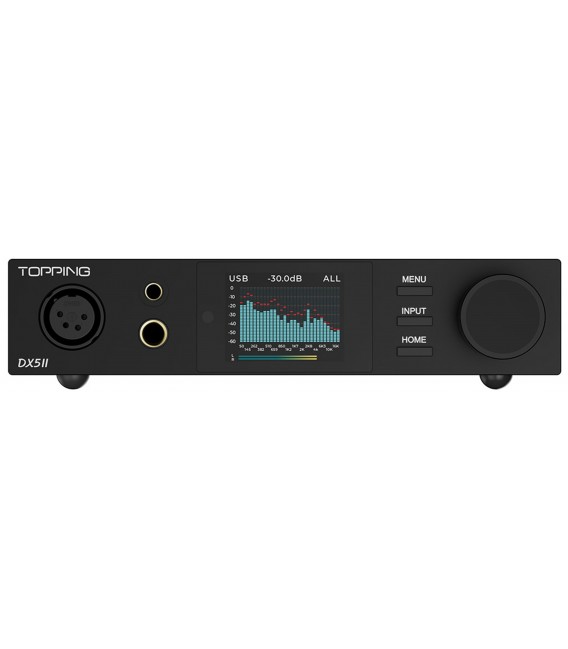
Option 2: DX5 II - more of a headphone DAC, but I read in the reviews in here it's also good as a DAC to then feed into a power amp

Do we really still need DAC's like this, or would it be just as good to hook up the Mini 300 directly to a PC from jack out to RCA in on the Mini 300 and then doing the equalizing on the PC?

ps I also looked at the 3e Audio A5 but it appears I can't source it in Europe anywhere, either not available or sold out and I don't like going to AliExpress for these type of things.
May I ask what problem you had with the volume control?
 
May I ask what problem you had with the volume control?
Yes, the issue with the volume control was that the knob had about 1mm of free movement before engaging. So if you moved the volume up, and then later down again you first had to move it down around 1mm before it would actually go down/engage. It felt like it was mechanical, there was a slight difference in rotational resistance. This made small adjustments in volume nearly impossible to make and since the volume knob is quite sensitive, this would mean I would constantly overshoot eg: either lower it by too much or raise it by too much depending on if you're lowering or raising the volume.

Also the Bluetooth connection would have audible pops and cracks, sometimes it would go silent for a tenth of a second. Enough to annoy. I didn't have these issues with any of my other Bluetooth devices.

Beyond that it's a solid amp. But since the distributor in my country claimed their showroom model had this issue as well, the seller sort of decided that it's normal. I don't think it's normal and other users didn't have this issue. I uploaded a video of it not too long ago but it was a 24-hour only link as I don't have any way of uploading videos online.

This link is available for 48 hours:
https://streamable.com/g4xflb (moving the knob with a light touch shows the free movement it has)

It might not seem like an issue, but it was quite annoying in reality :D The music in the background was playing from my other amp, so that's why moving the volume button doesn't alter the volume in the video.
 
ps I also looked at the 3e Audio A5 but it appears I can't source it in Europe anywhere, either not available or sold out and I don't like going to AliExpress for these type of things.
I've ordered from the 3e audio aliexpress store a couple of times (to the Uk) and never had a problem. If the intention is try it out and you want the option to return if you don't like it, then I agree best not to use Ali, but otherwise it'll be fine.

If you decide to get the mini 300 and you want a dac that matches its form factor then I'd go for the E50II. I've owned the D50III and it's a very nice DAC but it's a bit outdated functionality wise now, vs the newer topping stuff. Then if you decide later that you want headphones you can add the matching L50 headphone amp. All running balanced via trs interconnects. I have the DX5II and its great but probably overkill if you don't use headphones, and aesthetically not as pleasing to my eyes as stacking the mini 300 and the E50II together.
 
Audiophonics A5 waiting time is not so long
1787504181485.png
 
I've ordered from the 3e audio aliexpress store a couple of times (to the Uk) and never had a problem. If the intention is try it out and you want the option to return if you don't like it, then I agree best not to use Ali, but otherwise it'll be fine.

If you decide to get the mini 300 and you want a dac that matches its form factor then I'd go for the E50II. I've owned the D50III and it's a very nice DAC but it's a bit outdated functionality wise now, vs the newer topping stuff. Then if you decide later that you want headphones you can add the matching L50 headphone amp. All running balanced via trs interconnects. I have the DX5II and its great but probably overkill if you don't use headphones, and aesthetically not as pleasing to my eyes as stacking the mini 300 and the E50II together.
Thanks for the suggestions.

I ended up getting the Mini 300 with the DX5 II (over on Audiophonics.fr), because it allows PEQ on all outputs including Bluetooth and USB which will be the inputs I'm going to use. I also added a trigger cable and a new 25cm RCA set of cables because I only have 2 meter long RCA cables of questionable quality.

I'll update once I receive everything. Maybe in a couple of weeks, I'll get a UMIK1 mic and give REW a try.

Gosh, when I bought the FIIO Level 1 for 139 euros, I never expected to end up returning it and then paying over 400 euros a couple of weeks later for another amp and a DAC. Is this how easily things go south? :p
 
Here are some of the results of testing that I have done on the Topping Mini300 amplifier.

Background

I run tri-amped Klipsch LaScala speakers with 2 Bill Fitzmaurice-designed DIY horn-loaded subwoofers, configured as per this diagram:
Audio config.jpg

Since I wasn't sure how well tri-amping and DSP would work, I used inexpensive Aiyima A07 class D amplifiers in my initial configuration. Pleased with how my system performs, I have been looking at upgrading the amps. The Aiyima A07s are fine amps, but I was keen to try a 12V trigger (for convenience), PFFB, and better SINAD.

My speakers are very efficient (about 104 dB SPL @1W @1m). As such they do not require a lot of power but they do need clean signals.

I tried 3e Audio A7 amps and a 3e Audio/ALSOZONE PAM158 amplifier but neither worked out. A major problem that I had with the PAM158 was a hiss that was audible from my seating position, roughly 3m from the speakers. There was some hiss from the tweeters with the Aiyima A07 amp but only when I put my ear right up against the horn.

Attracted by the claims of exceptional THD+N, SNR, and a very low (<15UVrms) noise floor, I decided to give the Mini300 a try.

Testing

After spending an evening listening to the Mini300 in my system, where I verified that I could hear no hiss from the tweeter, even with my ear pressed against the horn, I took it to my workbench to run some tests.

This slide shows my testing setup and describes the methodology that I used.
Testing.jpg
The 1.3 Vrms input level was used because Topping specs that as the input sensitivity of the Mini300

What I was looking to find out

I wanted to determine:
  1. current requirements for the 12V trigger
  2. the maximum input signal amplitude that would be noise-free (and if that differed from the 1.3 Vrms input sensitivity)
  3. maximum gain settings before the onset of noise/clipping
  4. power into 4, 8, and 16 ohm loads
  5. channel balance (how much did the L and R channels differ in output when presented with the same input)
  6. how "clean" is the Mini300 output
12V trigger current consumption

I was keen to know how much current the Mini300's 12Vdc trigger required.

I had hoped to have three amps all controlled by a single 12V trigger for on/off (one amp for my tweeters, another for my midrange drivers, and the third for my woofers). Since the Mini300 has a trigger IN but not a trigger OUT, I was going to have to split the trigger from my source (a Bluesound Node) and send it to all three amps. That would only work if the cumulative current drawn by the 3 amps did not exceed the Bluesound Node TRIGGER OUT's 50 mA capacity.

I measured the current drawn by the Mini300's trigger at 7 mA. The Bluesound Node would certainly be able to support 3 Mini300 amps.

Maximum noise-free input signal amplitude

I have found that noise or clipping is often evident on oscilloscope traces even when amps are driven by a signal at their rated input sensitivity at high gain settings. I look to determine the highest noise-free input signal amplitude so that I can attenuate the signal going to the amp so as not to exceed that level.

I found that, at high gain and at the rated 1.3 Vrms input signal amplitude, the output of the Mini300 always showed noise. The noise wasn't always large, but it was clearly visible on the oscilloscope.
noise1.png


The noise would disappear if the gain was turned down, or if the magnitude of the input signal was decreased.

Since it would be convenient to "set and forget" the gain on the Mini300 (which is controlled by an unmarked volume knob), my preferred approach is to establish a maximum input signal amplitude and then set the gain (typically at MAX) and leave it there.
Input sensitivity.jpg
I will continue presenting my findings in another post in this thread.
 
found that, at high gain and at the rated 1.3 Vrms input signal amplitude, the output of the Mini300 always showed noise. The noise wasn't always large, but it was clearly visible on the oscilloscope.
Sure that's not the 500kHz carrier feeding through? I saw that on the scope.
 
Sure that's not the 500kHz carrier feeding through? I saw that on the scope.
I'm sure. I'll be discussing that in a subsequent post.

I measured a ~500mV signal at 600 kHz that was always present on the Mini300's output, even when no input signal was supplied. I suspect it's coming from the SMPS. I've asked Topping about it but not yet heard back from them.
 
I'm sure. I'll be discussing that in a subsequent post.

I measured a ~500mV signal at 600 kHz that was always present on the Mini300's output, even when no input signal was supplied. I suspect it's coming from the SMPS. I've asked Topping about it but not yet heard back from them.
Interesting. I'll be interested to see what Topping says, although my horns only need a few milliwatts. Luckily I'm old and can no longer hear 500kHz :D
 
Last edited:
Here are some of the results of testing that I have done on the Topping Mini300 amplifier.

Background

I run tri-amped Klipsch LaScala speakers with 2 Bill Fitzmaurice-designed DIY horn-loaded subwoofers, configured as per this diagram:
View attachment 554243
Since I wasn't sure how well tri-amping and DSP would work, I used inexpensive Aiyima A07 class D amplifiers in my initial configuration. Pleased with how my system performs, I have been looking at upgrading the amps. The Aiyima A07s are fine amps, but I was keen to try a 12V trigger (for convenience), PFFB, and better SINAD.

My speakers are very efficient (about 104 dB SPL @1W @1m). As such they do not require a lot of power but they do need clean signals.

I tried 3e Audio A7 amps and a 3e Audio/ALSOZONE PAM158 amplifier but neither worked out. A major problem that I had with the PAM158 was a hiss that was audible from my seating position, roughly 3m from the speakers. There was some hiss from the tweeters with the Aiyima A07 amp but only when I put my ear right up against the horn.

Attracted by the claims of exceptional THD+N, SNR, and a very low (<15UVrms) noise floor, I decided to give the Mini300 a try.

Testing

After spending an evening listening to the Mini300 in my system, where I verified that I could hear no hiss from the tweeter, even with my ear pressed against the horn, I took it to my workbench to run some tests.

This slide shows my testing setup and describes the methodology that I used.
View attachment 554245The 1.3 Vrms input level was used because Topping specs that as the input sensitivity of the Mini300

What I was looking to find out

I wanted to determine:
  1. current requirements for the 12V trigger
  2. the maximum input signal amplitude that would be noise-free (and if that differed from the 1.3 Vrms input sensitivity)
  3. maximum gain settings before the onset of noise/clipping
  4. power into 4, 8, and 16 ohm loads
  5. channel balance (how much did the L and R channels differ in output when presented with the same input)
  6. how "clean" is the Mini300 output
12V trigger current consumption

I was keen to know how much current the Mini300's 12Vdc trigger required.

I had hoped to have three amps all controlled by a single 12V trigger for on/off (one amp for my tweeters, another for my midrange drivers, and the third for my woofers). Since the Mini300 has a trigger IN but not a trigger OUT, I was going to have to split the trigger from my source (a Bluesound Node) and send it to all three amps. That would only work if the cumulative current drawn by the 3 amps did not exceed the Bluesound Node TRIGGER OUT's 50 mA capacity.

I measured the current drawn by the Mini300's trigger at 7 mA. The Bluesound Node would certainly be able to support 3 Mini300 amps.

Maximum noise-free input signal amplitude

I have found that noise or clipping is often evident on oscilloscope traces even when amps are driven by a signal at their rated input sensitivity at high gain settings. I look to determine the highest noise-free input signal amplitude so that I can attenuate the signal going to the amp so as not to exceed that level.

I found that, at high gain and at the rated 1.3 Vrms input signal amplitude, the output of the Mini300 always showed noise. The noise wasn't always large, but it was clearly visible on the oscilloscope.
View attachment 554252

The noise would disappear if the gain was turned down, or if the magnitude of the input signal was decreased.

Since it would be convenient to "set and forget" the gain on the Mini300 (which is controlled by an unmarked volume knob), my preferred approach is to establish a maximum input signal amplitude and then set the gain (typically at MAX) and leave it there.
View attachment 554253I will continue presenting my findings in another post in this thread.

NICE!
A question from a noob:
If I'm using a simple multimeter on the RCA cable to check the signal coming out of my source, say a PC running a 40hz signal, should I then make sure I should not go beyond 1.2V on the multimeter?

And what do you mean by 'high gain' in this context? Did the minidsp flex have a high gain setting? Just trying to relate back to my case using PC's integrated audio as source
 
NICE!
A question from a noob:
If I'm using a simple multimeter on the RCA cable to check the signal coming out of my source, say a PC running a 40hz signal, should I then make sure I should not go beyond 1.2V on the multimeter?
Be a little careful. You'll note the output voltage is over 50V then.
 
But the 50V is from the speaker out right? Not the signal from the source.
Correct. But your speaker may not appreciate it...for long.
 
Correct. But your speaker may not appreciate it...for long.
Understood.
No, Dave's post just got me curious as to my input voltage into the mini300. Not going to hook up my speakers anyway if I'm measuring with the multimeter.
 
Understood.
No, Dave's post just got me curious as to my input voltage into the mini300. Not going to hook up my speakers anyway if I'm measuring with the multimeter.
Then definitely load the Mini with a resistor (for example). Class D should have a load because of the output filter.
 
I'll continue presenting the results of my tests on the Mini300 in this post. Here's where you can find the results I presented already.

I wanted to determine:
  1. current requirements for the 12V trigger
  2. the maximum input signal amplitude that would be noise-free (and if that differed from the 1.3 Vrms input sensitivity)
  3. maximum gain settings before the onset of noise/clipping
  4. power into 4, 8, and 16 ohm loads
  5. channel balance (how much did the L and R channels differ in output when presented with the same input)
  6. how "clean" is the Mini300 output
The first two findings have already been discussed here.

Maximum gain settings before noise was visible

Previously, I found that a 1.3 Vrms input signal would always result in noise being visible on my oscilloscope when the Mini300 was set at maximum gain.
Dial settings.jpg

That noise would disappear if the input signal amplitude were reduced even if the amp was left at maximum gain. I found that a 1.2 Vrms signal was OK for 8 ohm and 16 ohm loads but that a slightly smaller amplitude (1.15 Vrms) was needed to avoid noise with a 4 ohm load. For simplicity, I've opted to treat 1.15 Vrms as my maximum input signal amplitude.
Max gain at 1_15.jpg

Power

At 1% THD+N, Topping rates the Mini300 as delivering 125 W/channel into 4 ohms and 65 W/channel into 8 ohms. The maximum power that I measured (into different loads) from the Mini300 -- using a 1.3 Vrms input signal amplitude -- were:
  • 129.6 W/channel into 4 ohms
  • 66.8 W/channel into 8 ohms
  • 33.6 W/channel into 16 ohms
But at those levels the output signal trace showed noise.

Power into diffetrent loads.jpg


I am unable to measure THD+N and have relied instead on when noise is visible on my oscilloscope trace. I expect that my threshold may be more stringent than 1% THD+N because my power ratings are lower.
Power summary.jpg

I would not hesitate to describe the Mini300 as a 50W/channel (into 8 ohms) amplifier.

Channel balance

The Mini300 exhibits very little variation in output between its Left and Right channels. Indeed, some of the variation shown on the following graphs may be due more to the difficulty in trying to accurately and repeatedly position the (unmarked) gain knob than to actual differences between the channels.
Balance into 4 ohms.jpg


Balance at 8 ohms.jpg


Balance into 16 ohms.jpg


In another post in this thread I will discuss how "clean" the Mini300 output is.
 
Last edited:
It will happen even when the only thing connected to the amp is a pair of speakers. I have tried a few different pairs of speaker cables, and a completely different outlet. I could try a different pair of speakers.

I just e-mailed Topping to find out what they think of this as it has always seemed to be inconsistent with the power on/off graph Amir posted in this review. I have seen a few people mention a similar thing to my own mini300 with theirs, but most of the accounts say that it's completely silent when it's powered on/off.

Got a response from Topping about this:

"Thank you for the detailed description, video link, and measurement reference. Please try disconnecting the MINI 300's input, connecting only the power supply and speakers, and turning the MINI 300's volume knob to its lowest setting. See if the distortion during power-on/off is related to the volume level. If it's still very noticeable, please record another video showing the adjustments made above for our reference. Thank you!"

They didn't come back saying it was normal, so it's possible there's an actual issue (the "measurement reference" was the on/off power graph from this review). I have responded with two new videos demonstrating what they have asked, so we'll see what they say to that in the next couple of days.
 
I'm sure. I'll be discussing that in a subsequent post.

I measured a ~500mV signal at 600 kHz that was always present on the Mini300's output, even when no input signal was supplied. I suspect it's coming from the SMPS. I've asked Topping about it but not yet heard back from them.
Amir doesn't measure wide band class D amplifiers output often, but here is the spectrum of the PA5, a predecessor of the Mini 300.
index.php


The output of a class D amplifier when it is idle is not a flat line at 0 V (at least for those that use AD modulation, which is the case for amplifiers based on the TI TPA 32XX chips). The idle output from the output bridge is a 50% duty cycle square wave, which is composed of the fundamental frequency (the switching frequency) and its odd harmonics, i.e. H1, H3, H5, ... They are, or should be, therefore effectively blocked by the output low pass filter.

The typical class D output filter is a 2nd order LC LPF with a cutoff frequency at ~50 kHz, about 1 decade below the switching frequency. They therefore attenuate the switching frequency by 40 dB (= 0.99 or 99% attenuation). For an amplifier with a rail (supply) voltage of 38 V, a residual of about 1% is expected*. Therefore an idle ripple of ~500 mV is normal, and is considered harmless.

Note: *For a 38 V square wave, the amplitude of the fundamental component is (4/π)×38 = 48 V. Therefore the ~500 mV residual is right at the ballpark.
 
Back
Top Bottom