• Welcome to ASR. There are many reviews of audio hardware and expert members to help answer your questions. Click here to have your audio equipment measured for free!

Topping MA4 Monitor Speaker Review

Rate this speaker:

  • 1. Poor (headless panther)

    Votes: 33 16.2%
  • 2. Not terrible (postman panther)

    Votes: 111 54.4%
  • 3. Fine (happy panther)

    Votes: 51 25.0%
  • 4. Great (golfing panther)

    Votes: 9 4.4%

  • Total voters
    204
I believe this speaker has a passive crossover, and not DSP. If you could take that back screw panel off, one could design a filter. Of course, many have PEQ so, like Amir, a fix is easy that way.

Topping should fix this.
 
In short: well-suited as a high-pass-filtered satellite speaker, but clearly too large for that purpose.
 
Sounds like it might be something rattling around inside leaking out of the port.
I don't know how you can conclude that from what I wrote. Me interfering with the port air flow doesn't mean there is something rattling in there.
 
100% THD means the sum of all distortion products has equal amplitude to the fundamental frequency.

As there are infinite ways to sum harmonics to a certain amplitude, there is not one "sound" that 100% THD has.

But you can play around with REW's Generator to get a feel for how sine tones sound with varying THD:
View attachment 569427

And for music, use https://distortaudio.org/
Thank you, that makes sense now!
 
@amirm, does the cabinet vibrate significanly at 420 Hz?
I didn't try to excite it at that single frequency. As capable as Klippel is, it is set in its way of only running sweeps. I guess I could have created a short loop....
 
I believe this speaker has a passive crossover, and not DSP. If you could take that back screw panel off, one could design a filter. Of course, many have PEQ so, like Amir, a fix is easy that way.

Topping should fix this.
The MA4 is bi-amped, therefore actively crossed over just like Genelec's non-GLM speakers.
 
He just means it has no DSP.
Maybe, but modifying an active analog crossover on a highly integrated PCBA ain't no easy feat. That requires board repair skills.

No comparison to modifying or replacing a passive crossover.
 
Seems like it could be OK with a sub, HP, and sitting very close. But for >$350/pair it's too much compromise. Nice work on the WG and in particular the verticals but I don't think I would recommend this to friends as-is.

I hope they follow up with more because these are solvable problems and they are taking a good technical approach, at least.
 
I don't know how you can conclude that from what I wrote. Me interfering with the port air flow doesn't mean there is something rattling in there.
I said might, not does.
 
Maybe, but modifying an active analog crossover on a highly integrated PCBA ain't no easy feat. That requires board repair skills.

No comparison to modifying or replacing a passive crossover.
Huh? Many passive crossovers are in PCBs. And replacing them is far more difficult than active ones due to power levels involved. Here, we are talking about an additional high pass filter which is trivial to do in active design than in passive.
 
Huh? Many passive crossovers are in PCBs. And replacing them is far more difficult than active ones due to power levels involved. Here, we are talking about an additional high pass filter which is trivial to do in active design than in passive.
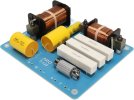
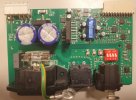
Hm I wonder which crossover would be easier to reverse engineer and modify:

610KPJzEwKL._AC_UF1000,1000_QL80_.jpg IMG_20220522_203229.jpg

Can you point out where the crossover even is in the second picture? :D
I sure can in the first :cool:
 
Last edited:
Hm I wonder which crossover would be easier to reverse engineer and modify:

View attachment 569447 View attachment 569449
Well, the answer is neither... I thought from the photos posted previously, it has active analog based opamp filters. More generally you have dsp, old school active filters with op amps, or really old school caps, inductors and resistors.

But modifying any of these, although doable, is way harder than just stacking an exernal dsp filter. You could argue that modifying a passive filter is technically easier. Yea, maybe. But way easier to just add external low level dsp and call it a day.
 
On second thought, forget it and buy something else.

My Edifier M60 work quite well on my desktop aside my computer screen. KEF LSX II LT quite well next to my TV screen.
 
610KPJzEwKL._AC_UF1000,1000_QL80_.jpg IMG_20220522_203229.jpg

Can you point out where the crossover even is in the second picture? :D
Why are you asking me? The topic was how hard would it be for Topping to modify. They wouldn't have to reverse engineer anything from a picture. If I had the PCB in front of me so i could trace the XLR, it would be very easy to figure it out.

I sure can in the first :cool:
Seeing is not the homework. Adding a high pass filter, is. That would require expensive, and large new parts. Not so with the active one.
 
The topic was how hard would it be for Topping to modify.
Was it?

I believe this speaker has a passive crossover, and not DSP. If you could take that back screw panel off, one could design a filter.

@dtaylo1066 noted that "Topping should fix it", but besides that and as I understood it, explored the possibility of designing a filter themselves.

And that is what I commented on.
 
Last edited:
This could likely be dramatically improved with an extra bass on the side, make it 3-way or 2.5-way
 
I expect Topping will use the feedback to improve their next offering in speakers. Iterative improvement has been a strong suit for them.
 
Back
Top Bottom