• Welcome to ASR. There are many reviews of audio hardware and expert members to help answer your questions. Click here to have your audio equipment measured for free!

Topping MA4 Monitor Speaker Review

Rate this speaker:

  • 1. Poor (headless panther)

    Votes: 33 16.2%
  • 2. Not terrible (postman panther)

    Votes: 111 54.4%
  • 3. Fine (happy panther)

    Votes: 51 25.0%
  • 4. Great (golfing panther)

    Votes: 9 4.4%

  • Total voters
    204
Maybe this is another entry in the computer desktop market with a listening distance of half a meter and an added sub?
My listening was at 1 meter or so. I don't think half a meter is realistic.
 
Voted “fine” as I suspect the use case for these speakers is in the nearfield at lower volumes. They should perform well in that application. However, there is a lot of competition in this space.
 
Last edited:
Disappointing for a brand like Topping. Will continue to use my 5010s on my desktop. Hard to beat.

Thanks fro the review, @amirm
 
I am sure they had their reasons but a small monitor that has more depth (288 mm) than height (255 mm) seems a very odd design choice.
I'd be curious to pop them open and have a look - my suspicion is that the vent is quite long and it's simpler and less expensive to manufacture if the vent is straight.
 
I wonder how the total THD spectrum would look like for a signal 420 Hz.
 
A bad tongue could say a typical Topping product, optimised for some score like Harman or SINAD but failing as a total in real use. ;)

Also at 190$ it is too close to the JBL 305/6 (soon MKIII generation will be on the market) or KALI LP6 V2 which in total are a less of a compromise.
T5V is also a strong showing:
Put one of Maiky's EQ's on mine if you want to be somewhere in the middle.

Going a bit smaller with the D3V still gives me plenty of output, but I will never listen to them loud.

Still waiting for cheap speakers that will have great voicing and good output, perhaps the JBL MKIII series will get us there. :D
 
My listening was at 1 meter or so. I don't think half a meter is realistic.
I did wonder at what distance your listening tests are done. 1 meter on all speakers, or varies with the speaker?
 
I did wonder at what distance your listening tests are done. 1 meter on all speakers, or varies with the speaker?
I have three setups:

1. Near-field. This is about 1 to 2 meters depending on the speaker size and capability. Speaker is put at the edge of a shelf so there is no desk bounce. Space is very large (open floor plan). Naturally almost all studio monitors get tested here (exceptions are likes of Genelec 3160A). And as of late, some of the smaller passive speakers and monitors.

2. Far field in my main audio system if the speaker is not very heavy or large. Roughly 50 pounds or less. Again, open floor plan. Listening is at about 3 to 4 meters.

3. Far field in our living room for large/tower speakers approaching 100 pounds or more. Again, very large open floor plan. Listening is again about 3 to 4 meters.
 
By the way why is it "smart" to add internal volume by adding depth to the enclosure?
Because in a small desk, especially in Asia, width is a premium. This is why almost all PC speakers are the size of the driver. If you don't make the cabinet deep, then you have very small volume. I don't know any desk that is NOT deep enough to contain this speaker by the time you figure out the space for keyboard and screen/laptop.
 
What happens if you block the port with foam?
I stuffed paper towels in there. While it nicely dealt with the distortion, the sound became quite flat. I liked my EQ much better, albeit with a bit more potential for distortion.

FYI, even if I just put my hand in the port the woofer rattle stops or reduces! So doesn't take much.
 
Such a shame about the distortion because the FR is so good for the price!
 
I stuffed paper towels in there. While it nicely dealt with the distortion, the sound became quite flat. I liked my EQ much better, albeit with a bit more potential for distortion.

FYI, even if I just put my hand in the port the woofer rattle stops or reduces! So doesn't take much.
Sounds like it might be something rattling around inside leaking out of the port. Doesn't speak to particularly good build quality.
 
@amirm, does the cabinet vibrate significanly at 420 Hz?
 
I thought that I instinctively understood what 100% distortion meant. Then I began overthinking it, and now I’ve no idea. 100% means complete and total, so silence would be 100% distortion, surely?

What does it actually sound like? Any layman’s explanation welcomed, thank you.
 
Kind of a bummer that the generally very smooth on and off axis performance is marred by a really subpar mid woofer. Not surprising though. Very difficult to get good bass out of a 4-5" driver given the amount of swept air that a cone of that size moves. If you want to do it right you have to get something like a Purifi 4.5" driver. Wouldn't give you real low end, but could give much better distortion numbers or 5 dB more output.

Of course, one Purifi 4.5" driver is ~$300 bucks.

Man, where is Usher to clone a Purifi when you need them...(er, sorry if you get the jab...)
 
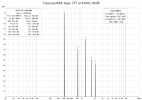
I wonder how the total THD spectrum would look like for a signal 420 Hz.
Like this:

Topping MA4 86dB.png

You'll have to imagine H6+
 
I thought that I instinctively understood what 100% distortion meant. Then I began overthinking it, and now I’ve no idea. 100% means complete and total, so silence would be 100% distortion, surely?

What does it actually sound like? Any layman’s explanation welcomed, thank you.
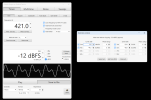
100% THD means the sum of all distortion products has equal amplitude to the fundamental frequency.

As there are infinite ways to sum harmonics to a certain amplitude, there is not one "sound" that 100% THD has.

But you can play around with REW's Generator to get a feel for how sine tones sound with varying THD:
Screenshot 2026-11-04 224533.png

And for music, use https://distortaudio.org/
 
These have a pref score of 6.0 while the JBL 306p and Kali LP-6 each are 5.2, so within their ability range these should sound meaningfully better.
That's the old LP-6. The newer one (IIRC) has a preference score of about 5.8-6. Not to mention lower distortion, etc.
 
These have a pref score of 6.0 while the JBL 306p and Kali LP-6 each are 5.2, so within their ability range these should sound meaningfully better.
5.2 vs 6.0 preference score is absolutely not meaningful.
 
Back
Top Bottom