This is a review, listening tests, EQ and detailed measurements of the Topping MA4 powered active monitor. It was sent to me by the company and costs US $189 each.

The MA4 compact and light. Company wisely extends the internal volume by deepening the speaker. Machined front panel exudes higher quality than otherwise ordinary wood cabinet.
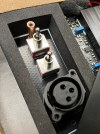
I like the simplicity of the back panel:

Topping is best known as producing state of the art audio electronics. Can they do it with speakers? Let's find out. FYI, company has a Klippel NFS scanner.
NOTE: company send me a sample more than a year ago but was not prepared to enter the market then and asked me to hold off. I *think* they sent me a sample recently and I am not sure if the one I am testing is that one, or the earlier one. There may be some minor production changes -- I don't know.
Topping MA4 Speaker Measurements
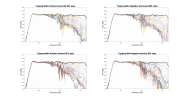
We can see company has put its top notch measurement system to good use in producing excellent tonality:

There is a tiny step down in treble response and some micro disturbance in the 500 to 2 kHz. Directivity is smooth though narrowing -- something I didn't expect given the waveguide.
Step down in treble energy impacts early window response even more:

But it is balanced by on-axis so predicted in-room response looks pretty good:

Near-field driver responses shows typical resonances:

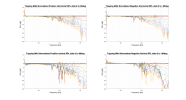
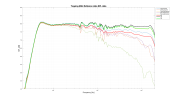
What was disappointing was power capability. I don't expect much from some a such small speaker with a 4 inch driver. But even at 81 dBSPL I could hear objectionable gurgling sound from the woofer which got worse naturally at 86 dBSPL:


We can see that bass distortion reaches 100% at 40 Hz.
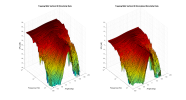
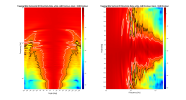
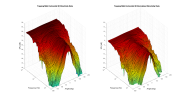
Given the waveguide, I expected a more constant directivity. But it is the opposite in the way it is proportionally beaming, albeit very smoothly:

Reminds me of Dr. Toole recalling the design of an Infinity speaker with similar goal and him saying it was difficult to pull off.
Vertical directivity is decently wide which is good:

We see resonances in waterfall graph:

Finally step response:

Topping MA4 Speaker Listening Tests and EQ
First impression was a surprisingly warm and balanced sound. OK, the measurements predicted them but psychologically one expects a small speaker to sound sharp/bright. Alas, it did not take long for really bad distortion to enter the picture. Yes, I play reasonably loud but lowering the level doesn't help much until you get way too low -- below my every day listening level. The fix thankfully was simple: a high pass filter:

I started with 50 Hz and that was good on some tracks but problem returned on others. At 60 Hz, most tracks were OK but not the Yello Till Tomorrow you see above. A synthetic rattling/gurgling sound was evident even though at first it seemed to be part of the song. Lower the volume, or plug the port and it went away. Upping the filter to 70 Hz allowed me to listen to pretty elevated levels without the distortion interfering.
With the above setting, we had a perfectly good speaker with track after track sounding very good to excellent.
Conclusions
I commend Topping for getting into speaker design with proper measurement system ($120K+ Klippel NFS). They seemed to have gotten the tonality and directivity right. But opted to push the speaker too low in frequency for its size and driver capability resulting in significant amount of objectionable distortion. Getting this balance right is what makes speaker design so challenging. By solving one vector but not the other, the MA4 leaves me somewhat disappointed. Fortunately the fix is simple with that high pass and I wish Topping would opt to provide this in the speaker itself -- perhaps by adding a high pass switch.
Personally I can't recommend Topping MA4 due to clearly audible distortion even at moderate levels. But you all may feel different given the reasonable cost and excellent tonality and the fact that you can fix that with a simple high pass filter.
----------
As always, questions, comments, recommendations, etc. are welcome.
Any donations are much appreciated using: https://www.audiosciencereview.com/forum/index.php?threads/how-to-support-audio-science-review.8150/
The MA4 compact and light. Company wisely extends the internal volume by deepening the speaker. Machined front panel exudes higher quality than otherwise ordinary wood cabinet.
I like the simplicity of the back panel:
Topping is best known as producing state of the art audio electronics. Can they do it with speakers? Let's find out. FYI, company has a Klippel NFS scanner.
NOTE: company send me a sample more than a year ago but was not prepared to enter the market then and asked me to hold off. I *think* they sent me a sample recently and I am not sure if the one I am testing is that one, or the earlier one. There may be some minor production changes -- I don't know.
Topping MA4 Speaker Measurements
We can see company has put its top notch measurement system to good use in producing excellent tonality:
There is a tiny step down in treble response and some micro disturbance in the 500 to 2 kHz. Directivity is smooth though narrowing -- something I didn't expect given the waveguide.
Step down in treble energy impacts early window response even more:
But it is balanced by on-axis so predicted in-room response looks pretty good:
Near-field driver responses shows typical resonances:
What was disappointing was power capability. I don't expect much from some a such small speaker with a 4 inch driver. But even at 81 dBSPL I could hear objectionable gurgling sound from the woofer which got worse naturally at 86 dBSPL:
We can see that bass distortion reaches 100% at 40 Hz.
Given the waveguide, I expected a more constant directivity. But it is the opposite in the way it is proportionally beaming, albeit very smoothly:
Reminds me of Dr. Toole recalling the design of an Infinity speaker with similar goal and him saying it was difficult to pull off.
Vertical directivity is decently wide which is good:
We see resonances in waterfall graph:
Finally step response:
Topping MA4 Speaker Listening Tests and EQ
First impression was a surprisingly warm and balanced sound. OK, the measurements predicted them but psychologically one expects a small speaker to sound sharp/bright. Alas, it did not take long for really bad distortion to enter the picture. Yes, I play reasonably loud but lowering the level doesn't help much until you get way too low -- below my every day listening level. The fix thankfully was simple: a high pass filter:
I started with 50 Hz and that was good on some tracks but problem returned on others. At 60 Hz, most tracks were OK but not the Yello Till Tomorrow you see above. A synthetic rattling/gurgling sound was evident even though at first it seemed to be part of the song. Lower the volume, or plug the port and it went away. Upping the filter to 70 Hz allowed me to listen to pretty elevated levels without the distortion interfering.
With the above setting, we had a perfectly good speaker with track after track sounding very good to excellent.
Conclusions
I commend Topping for getting into speaker design with proper measurement system ($120K+ Klippel NFS). They seemed to have gotten the tonality and directivity right. But opted to push the speaker too low in frequency for its size and driver capability resulting in significant amount of objectionable distortion. Getting this balance right is what makes speaker design so challenging. By solving one vector but not the other, the MA4 leaves me somewhat disappointed. Fortunately the fix is simple with that high pass and I wish Topping would opt to provide this in the speaker itself -- perhaps by adding a high pass switch.
Personally I can't recommend Topping MA4 due to clearly audible distortion even at moderate levels. But you all may feel different given the reasonable cost and excellent tonality and the fact that you can fix that with a simple high pass filter.
----------
As always, questions, comments, recommendations, etc. are welcome.
Any donations are much appreciated using: https://www.audiosciencereview.com/forum/index.php?threads/how-to-support-audio-science-review.8150/
Attachments
Last edited: