
• Welcome to ASR. There are many reviews of audio hardware and expert members to help answer your questions. Click here to have your audio equipment measured for free!

Topping LA90 Discrete Amplifier Review

Rate this stereo amplifier

  • 1. Poor (headless panther)

    Votes: 15 3.2%
  • 2. Not terrible (postman panther)

    Votes: 23 4.9%
  • 3. Fine (happy panther)

    Votes: 75 16.0%
  • 4. Great (golfing panther)

    Votes: 356 75.9%

  • Total voters
    469
2 of these or hypex ncx500?
nearly same price.
2 of these are 1.6k USD while an amp based on 2 x NCx500 + single power supply starts as low as 1.1k USD from Buckeye. Not really the same price point.

The LA90 Discrete bridged has lower noise and distortion, no questions there. And also has volume control (unusable in bridge mode - who would turn both volumes manually and match levels?), no remote though. Nice chassis, but ugly external PS.

The NCx500 still has excellent noise and distortion, but with tons more power (in this build it is limited by the 1200W PS, so "only" 600W per channel instead of the max 700W of the actual module limit, still it is almost double that of the LA 90 Discrete), runs into 2 ohms, smaller, wastes less energy as heat. Simple chassis but no external PS.

It is up to the customer to decide what is more important.
 
Last edited:
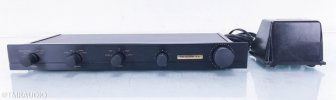
Topping is really a company that seems to care about quality. Not a fan of external power supplies though. I do not understand their need for small devices.
Why the need for external power supplies? Just ask PS Audio. ;-)
 

Attachments

  • 2K28fL7__48912.jpg
    2K28fL7__48912.jpg
    27 KB · Views: 489
This version is superior in every regard for the same money. I believe it will be replacing the IC based one soon if it has not already.
Is there an idle power consumption or heat difference?
 
The Absolute Sound's take on this. As usual, an absolutely useless review, but surprisingly the reviewer liked it.


I despise wall wart power supplies too.

I know for a fact I have more money than sense, and I'd choose the Benchmark if I needed a new amp. I'm also leery of the numerous comments I've read on the internet questioning Topping's product reliability. I don't know how legitimate these claims are, but if I read this many complaints about Benchmark I wouldn't have purchased their products either.
 
I wish we could know the distortion vs. freq. in reactive loads @ 5Watt.

Pretty please? :)

//
 
The Absolute Sound's take on this. As usual, an absolutely useless review, but surprisingly the reviewer liked it.


I despise wall wart power supplies too.

I know for a fact I have more money than sense, and I'd choose the Benchmark if I needed a new amp. I'm also leery of the numerous comments I've read on the internet questioning Topping's product reliability. I don't know how legitimate these claims are, but if I read this many complaints about Benchmark I wouldn't have purchased their products either.
If you can afford it , I’d go Benchmark too . I have both brands
 
Now I need to choose whether I want to sell my old IC unit, or just buy a second one for cheap and go dual mono bridged..
 
Why so much hate for this not “lasting long”? Does Topping have a high rate of failures for power amps that I’m not aware of?
 
What's the practical value of absolutely pristine hygiene in a power amp like this?
I don't know the answer to your question, but if this trend continues and we keep getting amps with this kind of performance (hypex, purifi, benchmark...), in the future amps will become even more as dacs are now, one less issue for us to bother about, and hopefully prices will come down and available power up. A good thing overall.
 
Most two ways these days are 80-87dB.
And most are 4 Ohm nowadays. You’ll get plenty of power that way.

Let’s also downvote any speaker with a lower than 94 dB efficiency then! Those are just basement stuff as well ;) Speaker with less than 12” woofer: children’s toy! Less than 300l internal volume: wannabes! No horns: are you kidding me :facepalm: :cool:
 
Last edited:
Does Topping have a high rate of failures for power amps that I’m not aware of?
They certainly do with the PA5.

Anyway, my thoughts echo @restorer-john. What's the point of an amp with ultra-low distortion that can't actually drive anything with typical modern sensitivities to reasonable loudness? Like, it's great that they've managed to reduce distortion this much, but... It already wasn't particularly audible even in cheap amps, and this has basically no power on tap without bridging it.
 
2 of these are 1.6k USD while a 2 x NCx500 + single power supply starts as low as 1.1k USD from Buckeye. Not really the same price point.

The LA90 Discrete bridged has lower noise and distortion, no questions there. And also has volume control, no remote though. Nice chassis, but ugly external PS.

The NCx500 still has excellent noise and distortion, but with tons of power more (in this build limited by the 1200W PS, so "only" 600W per channel instead of the max 700W of the actual module limit, still almost double the LA 90 Discrete), runs into 2 ohms, smaller, wastes less energy as heat. Simple chassis but no external PS.

It is up to the customer to decide what is more important.
I see you now have the ncx500.
how does it compare to the nc502 you have.
have you found passive speakers which make use of the ncx500 improvements, or are you still looking?
 
I see you now have the ncx500.
how does it compare to the nc502 you have.
have you found passive speakers which make use of the ncx500 improvements, or are you still looking?
I have orderd the NCx500, noone has it yet. My speakers are 2.7 ohms large and 10" woofers, power is always good here.
 
Iirc and I’m in no way an expert in such things. Separating the Power Supply module prevents negative EMI effects from the processing and output stage side. Enabling less noise and higher SINAD scores. Additional benefits are reduced heat load and reduced cost to replace a bad or failed power supply. Power bricks suck. But they have benefits too.

Change the case of the brick. Tell ultra high end seperation of power supply and amplifier stage. Sell 1000$ more expensive. ;)
 
This amp is not class D, so most likely it is class A/B. What is its idle (no signal) steady-state power consumption?
The power supply is rated at 64 V x 4 A = 256 W, yet in the bridged configuration it produced 279 W on the bench. For how long?

Robust all-aluminum enclosure with passive cooling​

I would be very concerned about heat dissipation and its negative impact on durability of this amp. The side heat sink fins are horizontal, which prevents good air convection. Also, heat sinks are small, about 8 x 15 cm each (see case dimensions at the above link).
Optimistically assuming a 65% efficiency, with the 256 W rated PS about 90 W is lost as heat. At the rated mono output of 220 W into 8 Ohms, about 118 W. The aluminum case may help a bit, but it does not appear to be vented.
 
There exists RCA male to balanced out cables. Construction must be done correctly; Bruno Putzeys wrote some words on the importance of this aspect which have been copied here in some obscure thread.

Edit. I found Mr Putzeys paper. It is a 13 page document in pdf format. While quite tedious reading, well, so be it.
I know, I made up many in my time, but there was something about the previous model which basically hobbled it when used from single ended sources, hence my wondering if this model might be better..
 
Back
Top Bottom