• Welcome to ASR. There are many reviews of audio hardware and expert members to help answer your questions. Click here to have your audio equipment measured for free!

Topping E2x2 Audio Interface Review

Rate this audio interface

  • 1. Poor (headless panther)

    Votes: 11 3.5%
  • 2. Not terrible (postman panther)

    Votes: 28 9.0%
  • 3. Fine (happy panther)

    Votes: 142 45.7%
  • 4. Great (golfing panther)

    Votes: 130 41.8%

  • Total voters
    311
Topping quickly replied!


Thank you for contacting TOPPING support. We are happy to assist.
When you set Output 1+2 to Input 1+2 in the TOPPING Professional Control Center, this routing is not a pure analog direct-through path. The input signal is first converted into a digital signal by the ADC, then enters the device’s internal digital mixing/routing section, and is finally output through the DAC to the corresponding analog outputs.

Best Regards,
ADKq_NZmjUlPAkNpOsDr8ZTsyxs1hp7yzPHyjekgsS2a83LNgrEO4pruEOfIm6U41GZhWkldb6ehTj8I32wHmC9KjoZAsCwt4jafe-gtO-3ed6Kbzp1QUdzpcQcTuuIR2QU=s0-d-e1-ft
service
[email protected]
I sent them another (follow-up) question:

"So, is there any way to have a pure analog connection between input and output or is it impossible with current hardware?"
 
Last edited:
Another super quick reply from Topping (I really respect these guys' professionalism already):

Hi,

The current hardware design does not support this type of transmission. However, please rest assured that our amplifier circuits are very clean.


Best Regards,

ADKq_NZmjUlPAkNpOsDr8ZTsyxs1hp7yzPHyjekgsS2a83LNgrEO4pruEOfIm6U41GZhWkldb6ehTj8I32wHmC9KjoZAsCwt4jafe-gtO-3ed6Kbzp1QUdzpcQcTuuIR2QU=s0-d-e1-ft
service
[email protected]
 
To be fair, their AD/DA conversion on the way of the signal is still super clean and transparent.
I am not sure if anyone could easily hear a difference in blind A/B testing between pure analog paths and via ADC/DACs at 24/36/48-bit 96+ KHz when high quality converters are used...
This is a hilarious paradox of the vinyl resurgence... While many chase pure, "AAA" (All-Analog) signal paths, the reality is that the vast majority of records pressed since the late 1970s (when studios adopted digital delays and PCM recorders) have passed through AD/DA converters at some stage of production.
The "analog" purity of modern records is frequently compromised long before the needle ever drops...
 
Last edited:
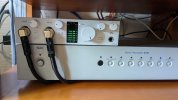
Just for information. I encountered distortions when listening to music from any source connected to the preamplifier. The source of the distortions turned out to be the Topping E2x2 audio interface, which is connected to Tape1 (input and output) of the NAD S100. I try to digitize vinyl with it, and use it for room correction (REW). If it is turned off with the button on the back, then there is distortion, if turned on - there is no . So now it is constantly on and performs the function of a level indicator (when not used for its intended purpose)

50.11.jpeg
 
Just for information. I encountered distortions when listening to music from any source connected to the preamplifier. The source of the distortions turned out to be the Topping E2x2 audio interface, which is connected to Tape1 (input and output) of the NAD S100. I try to digitize vinyl with it, and use it for room correction (REW). If it is turned off with the button on the back, then there is distortion, if turned on - there is no . So now it is constantly on and performs the function of a level indicator (when not used for its intended purpose)

View attachment 541278
I would to recommend to toggle on the "instrument" button when using unbalanced connection/source - turn down the gain before doing it.
 
I would to recommend to toggle on the "instrument" button when using unbalanced connection/source - turn down the gain before doing it.
Thanks for your answer. I soldered the input cable as shown in the picture. The distortion appears when the E2x2 is completely turned off with the button on the back. Therefore, switching to Inst mode does not matter.
 

Attachments

  • 153128.jpg
    153128.jpg
    17.5 KB · Views: 81
I have extremely poor SNR performance of E2x2 in loopback mode, rear OUT1L connected to front IN1L with 6.35" TRS balanced cable, and measured with REW.
And yes, I replaced my TRS cable with another one just to make sure its not the cable.
Bought Topping USB Isolator, now much better.
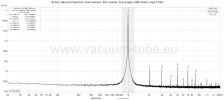
S/N 107.6 dB, REW graph attached.
PS. In Linux pavucontrol -> Configuration -> E2x2 -> Profile -> Off.
 

Attachments

  • 96.png
    96.png
    208.7 KB · Views: 92
I can't believe I read thru all these 33 pages! :oops:
ToppingE2x2OTG.png

Some long discussions with [Claude] -and fact-checks- has finally made me feel better about my purchase of the E2x2OTG.
Confirmed, from Topping's own official documentation and diagram [above]:
  • Three ports total: Power (DC5V input), USB-C ("for computer"), OTG ("for phone/tablet")
  • Main USB-C port: USB2.0 High Speed, supports 24-bit/44.1kHz–192kHz
  • OTG port: USB2.0 Full Speed, locked to 48kHz regardless of what's connected
  • Topping's own labeling explicitly restricts the OTG port to phone/tablet use — no mention of PC/Mac anywhere in their materials
  • Topping recommends a specific (OTG-compliant) cable for that port when live-streaming
Regarding how Topping E2x2OTG handles USB DFP (host role) or UFP (peripheral role) could not be resolved and [CLAUDE]' final suggestion was
Bottom line: retract the earlier statement. "Hard-wired to always present as UFP, doesn't negotiate" was my own inference, not sourced, and this new documentation suggests the real behavior is more deliberately configurable than that.
If you want the actual mechanism nailed down, that's a question for Topping support directly, ...
Until I receive my E2x2OTG, I am sticking with the above [CLAUDE] summary.
 
Last edited:
Bought Topping USB Isolator, now much better.
S/N 107.6 dB, REW graph attached.
PS. In Linux pavucontrol -> Configuration -> E2x2 -> Profile -> Off.
Topping HS02? Yeah I bought one just to protect my laptop in precarious situations...added bonus was I noticed it increased SNR on the Topping and some other interfaces I have; really context/topology dependant though, what was connected etc...but it can make a difference OK. Also made a huge difference to my high voltage differential probe (usb powered)...good purchase for sthg that feels a bit snake-oily lol...actually now that i think of it i still haven't tested if every pin is really isolated...I have a few usb-c 24 pin breakout boards, must do that.

btw the line outputs are by far the weakest part of this interface...which is a real shame, it's top notch otherwise imo...even the di is great.
 
just wondering, has anyone tried aggregating two or more of these on a Mac? If so any issues? Possibly with drift etc.?

Given these are cheaper than a good DI, I'd nearly buy another one just to have more DI inputs...
 
just wondering, has anyone tried aggregating two or more of these on a Mac? If so any issues? Possibly with drift etc.?
Not working reliably with Mac mini M4, even with 1 pc of e2x2 only. See my posts on this thread.
 
This is a review and detailed measurements of the Topping Professional E2x2 audio interface (ADC, DAC, Headphone Amp). It was sent to me by the company and costs US $159.
View attachment 322548
As the British would say, the E2x2 definitely "looks the part" as far as fitting in the general offering of interfaces in the market. And that extends to control app which seems a lot fancier than I expected from a company just getting into this market:
View attachment 322550
The company must have staffed up on the software side of things. You can power the unit exclusively via USB-C if your host supports its level of power (mine did), or with auxiliary USB-C power:
View attachment 322551

Note an interesting feature that if you use TRS in line In, you get a different gain than when using XLR. One is used for microphone and the other for line in/instrument.

We have three subsystems to test so let's get on with it.

Topping E2x2 DAC Measurements
Treating the unit strictly as a DAC, we have this for our dashboard:
View attachment 322552
I am so used to chart topping measurements from Topping DACs that this seems decisively less performant:
View attachment 322553
We do beat the spec so that is good.

Noise performance is better:
View attachment 322554
As is multitone:
View attachment 322555

Linearity is near perfect:
View attachment 322556

As is jitter:
View attachment 322557

IMD noise and distortion is along the same lines as the dashboard SINAD:
View attachment 322558

One filter is provided:
View attachment 322559

Wideband THD+N again is similar to what we saw in dashboard:
View attachment 322560

Topping E2x2 ADC Measurements
The E2x2 starts to show the strength of the brand in this department:
View attachment 322561
View attachment 322562

Noise performance is nice:
View attachment 322563

As is frequency response:
View attachment 322564

Measuring the IMD level was a bit tricky in that the gain impacted that initial hump. This measurement is also not ideal as it shows the generator level on X axis, not the output:

View attachment 322565

Still what is there seems pretty nice especially if you use the right gain structure. Testing against measured level, I had an older THD sweep which I resurrected:
View attachment 322566

As you see, it matched the reference pretty well.

Performance is essentially frequency independent:
View attachment 322567

Topping E2x2 Headphone Amplifier Measurement
Let's see if Topping brought its "A game" in this department:
View attachment 322568

Seems to be the case seeing how this is USB powered. Many competitors just have a checklist headphone amp with low power and high noise and distortion. Not here. We have good bit of power in high gain mode and excellent noise and distortion in low gain. Same is true of 32 ohm:
View attachment 322569

I was impressed by the noise level as represented in our 50 mv test:
View attachment 322570

Many stand-alone headphone amps struggle to achieve this level of quietness:
View attachment 322571

Conclusions
Topping gives us a "good" DAC in E2x2. But then surprises us with very good performance of its ADC and excellent response of the headphone amplifier. I suspect the cost constraints here kept it from delivering better DAC performance. For some reason I thought if Topping entered the interface market, they would top of the chart performance with costs to go with it. Thinking about it, they may have been wise to go after the entry level market first. This way, they pick up customers who are not wedded to long established brands.

I am impressed by the completeness of the product especially when considering the control app and such. You would think the company has been in market for many years.

I am going to recommend the Topping E2x2 audio interface as an entry level product.

E2x2 Specifications@24bits/96kitz)

1. Microphone Inputs:


Equivalent Input Noise@A-wt,150 Ohm | -130.5dBu
THD+N@A-wt | -110dB (0.0003%)
Dynamic Range @A-wt | 115dB
SNR | 115dB
Crosstalk@1kHz | -140dB
Frequency Response | 20Hz-40kHz (#0.2dB)
Maximum Input Level | 8.6dBu
Input Impedance | 1.5k Ohms
Available Gain | 58dB + 20dB (20dB digital gain)
Phantom Power | 48V
Phantom Power | XLR connector of the combo socket:

2. Line Inputs:

THD+N@A-wt | -107dB0.00045%)
Dynamic Range @A-wt | 115dB
SNR @A-wt | 115dB
Crosstalk@1kHz | -140dB
Frequency Response | 20Hz-40kHz (#0.1dB)
Maximum Input Level | 23.9dBu
Input Impedance | 6k Ohms
Available Gain | 58B + 20dB (20dB digital gain)
Connector Type | TRS connector of the combo socket:
Tip (Hot), Ring (Cold) & Sleeve (Shield)

3. Instrument Inputs:

THD+N@A-wt | -108dB (0.0004%)
Dynamic Range @A-wt | 115dB
SNR @A-wt | 115dB
Crosstalk@1kHz | -140dB
Frequency Response | 20Hz-40kHz (#0.3dB)
Maximum Input Level | 14.8dBu
Input Impedance | 1M Ohms
Available Gain | 58dB + 20dB (20dB digital gain)
Connector Type | TS connector of the combo socket:
Tip (Hot) & Sleeve (Shield)

4. Line Outputs:

THD+N@A-wt | -100dB (0.001%)
Dynamic Range @A-wt | 115dB
Analogue Dynamic Range@A-wt, -40B attenuation | 127dB
SNR @A-wt | 115dB
Crosstalk@1kHz | -128dB
Frequency Response | 20Hz-40kHz (#0.3dB)
Maximum Input Level | 14dBu
Noise @A-wt | 1.8uVrms
Output Impedance | 100 Ohms
Connector Type | 6.35mm TRS balanced jack:
Tip (Hot), Ring (Cold) & Sleeve (Shield)

5. Headphone Outputs:

THD+N @A-wt | -100dB (0.001%)
Dynamic Range @A-wt | 115dB
Analogue Dynamic Range @A-wt, -40dB attenuation | 132dB
SNR @A-wt | 115dB
Crosstalk@1kHz | -120dB
Frequency Response | 20Hz-40kHz (£0.3dB)
Maximum Input Level | OdBu@ Gain=L, 17dBu@ Gain=H
Noise @A-wt | 1 uVrms
Output Impedance | 1 Ohms
Connector Type | 6.35mm stereo headphone jack:
Tip(Left), Ring (Right) & Sleeve (Shield)
6.35mm stereo headphone jack | 580mWx2@320 THD+N<1%
380mW x 2@64Q THD+N<1%
198mW x 2 @1500 THD+N<1%
105mW x 2@3000 THD+N<1%
55mW x 2@6000 THD+N<1%

*Note: The above data is the result of the test in TOPPING laboratory.


----------
As always, questions, comments, recommendations, etc. are welcome. Click here if you have some audio gear you want me to test.

Any donations are much appreciated using: https://www.audiosciencereview.com/forum/index.php?threads/how-to-support-audio-science-review.8150/

Hi this is my first comment on this site, I know your comment is 3 years old but I’d greatly appreciate your help. I’m just getting into making beats in MPC (on my Microsoft laptop) and I need an audio interface. I’m trying to decide between the Topping E2x2 or the Focusrite Scarlett 2i2 4th Gen, which do you believe is better? I hear alot of good things about the E2x2’s headphone performance which is important for me but I’m a bit scared because I also keep hearing that it has software/driver instability issues. Anyways I look forward to your response and Thank You ahead of time.
 
Hi this is my first comment on this site, I know your comment is 3 years old but I’d greatly appreciate your help. I’m just getting into making beats in MPC (on my Microsoft laptop) and I need an audio interface. I’m trying to decide between the Topping E2x2 or the Focusrite Scarlett 2i2 4th Gen, which do you believe is better? I hear alot of good things about the E2x2’s headphone performance which is important for me but I’m a bit scared because I also keep hearing that it has software/driver instability issues. Anyways I look forward to your response and Thank You ahead of time.
I've had horrible experiences with Focusrite interfaces on Windows in the past. Bluescreens and instability. Heck, I even sent Windows kernel crashdumps to their support that showed exactly where it crashed in their drivers and they replied with: "have you tried updating Windows and the driver?" They also claimed to they had fixed my issue in one update, but it still was not stable ...

Been using a Topping E2x2 OTG for about a year now without any issues, though.
 
Hi this is my first comment on this site, I know your comment is 3 years old but I’d greatly appreciate your help. I’m just getting into making beats in MPC (on my Microsoft laptop) and I need an audio interface. I’m trying to decide between the Topping E2x2 or the Focusrite Scarlett 2i2 4th Gen, which do you believe is better? I hear alot of good things about the E2x2’s headphone performance which is important for me but I’m a bit scared because I also keep hearing that it has software/driver instability issues. Anyways I look forward to your response and Thank You ahead of time.
I am a former user of Scarlett 2i2 (2nd gen), and currently am using E2x2 OTG. Just go with Topping. But get the OTG, it has an optical SPDIF out, you never know when you might need it. I need it and am using it regularly. Well worth the price difference over the non-OTG.
 
I've had horrible experiences with Focusrite interfaces on Windows in the past. Bluescreens and instability. Heck, I even sent Windows kernel crashdumps to their support that showed exactly where it crashed in their drivers and they replied with: "have you tried updating Windows and the driver?" They also claimed to they had fixed my issue in one update, but it still was not stable ...

Been using a Topping E2x2 OTG for about a year now without any issues, though.
Add me to the list of those who are happy owners of the E2x2 (mine='OTG' version):
Not just with the hardware and its performance; but what amazed me the most is that the "Topping Professional Control Center" software app works in Windows11 without any bugs, crashes and/or weirdness, that I was *NOT originally expecting.;)
 
Last edited:
Just curious... does the Topping E2x2 driver support recording in 32 bit float? I guess I'm not sure if it's necessary for that to be in the driver...
 
Topping E2x2 driver support recording in 32 bit float?
My notes from some time ago have this entry I had copied from elsewhere(?), for the Topping E2x2:
Its ES9010Q2M-based AD/DA path is fixed at 24-bit.
Float-conversion can be done during recording via a DAW but it would not provide true advantage or protection.
 
It turns out that the Focusrite hardware is24 bit as well, so this isn't a strike against the E2x2.

I'm assuming the Topping ASIO driver is solid. I've found ASIO is a must for multitrack recording, overdubbing, etc.
 
Back
Top Bottom