The Capstan
Active Member
- Joined
- May 4, 2020
- Messages
- 153
- Likes
- 146
If the glitch generates downstream to the DAC chip, that’s possible…so perhaps it couldn't because of some hardware problems?

If the glitch generates downstream to the DAC chip, that’s possible…so perhaps it couldn't because of some hardware problems?
Audirvana allows you to mute the DAC when a sample rate change occurs and even set a delay before reactivating the output. Although the delay clearly works, once the muting period has elapsed, the DX1 II still produces a pop when the output is reactivated.If the glitch generates downstream to the DAC chip, that’s possible…
That's interesting, it seems it is the mute circuitry in the DX1 that creates the issue...Audirvana allows you to mute the DAC when a sample rate change occurs and even set a delay before reactivating the output. Although the delay clearly works, once the muting period has elapsed, the DX1 II still produces a pop when the output is reactivated.
This makes me wonder whether the issue might be related to the analogue output circuitry rather than something occurring purely in the digital domain.
Audirvana allows you to mute the DAC when a sample rate change occurs and even set a delay before reactivating the output. Although the delay clearly works, once the muting period has elapsed, the DX1 II still produces a pop when the output is reactivated.
This makes me wonder whether the issue might be related to the analogue output circuitry rather than something occurring purely in the digital domain.
Yes, that's what a modern DAC usually does.My SMSL DL200 only changes sample rate when it detects an incoming signal with the new sample rate.
I’m not sure I understand what you mean. Most modern DACs are able to handle sample-rate changes without producing audible pops or clicks. Depending on the implementation, this can involve sending digital zeros during the transition, muting the analogue output stage, or a combination of both. The analogue muting itself may be implemented using relays or solid-state switching circuits.If the DX1 II works the same way, it would make sense that the software mute does nothing to fix the issue...
No. It also has output muting keysThe device apparently lacks any hardware-based output muting
It could be a software mute. After turning off the DX1 II, the mute function is inactive, and the device emits a constant hum on RCA output.No. It also has output muting keys
It could be a software controlled feature in ESS DAC chip, but also there are many hardware mute keys and of course one between RCA output.It could be a software mute
If there is a muting chip, it is either malfunctioning or being controlled incorrectly via software. In any case, Topping has failed to fix the issue even after numerous firmware updates.It could be a software controlled feature in ESS DAC chip, but also there are many hardware mute keys and of course one between RCA output.
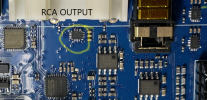
SGM3710What type of solid state relays are these ?
Reviving the thread as I too am looking for help with the same part. My Topping E30 stopped producing sound and I have narrowed down the issue to this chip. I spent quite a bit of time trying to identify the part, but with no success. This included browsing on Mouser, filtering by function and...www.diyaudio.com
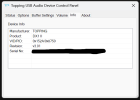
In earlier firmware versions, the hardware revision was displayed in the Topping Home app. It has disappeared in newer firmware versions.O jaké hardwarové verzi přesně mluvíte a kde bych ji mohl sehnat?
Je v ovladačích uvedeno číslo revize?
View attachment 561781
You can look closer at this chip at photo upper. The question remains what is wrong with MCU controlling those mute keys or problem in something deeper.If there is a muting chip, it is either malfunctioning or being controlled incorrectly via software. In any case, Topping has failed to fix the issue even after numerous firmware updates.
My unit also produces pops and clicks through the optical input when the sample rate changes — even with something as ordinary as switching from 44.1 to 48 kHz. So I’m not sure this can simply be dismissed as one faulty unit.So besides Jannox' (likely a faulty unit)
But that rather misses the point. What is the purpose of having a DAC capable of handling multiple sample rates and formats if it only operates without audible artefacts when it is fed a constant sample rate?One member has stated that these issues NEVER arise so long as you feed it a constant sample rate, even when using the RCA SE line level outputs.
My unit also produces pops and clicks through the optical input when the sample rate changes — even with something as ordinary as switching from 44.1 to 48 kHz. So I’m not sure this can simply be dismissed as one faulty unit.
If you use the DX1 II as a preamplifier with RCA outputs, the volume of the clicking sound depends on the input sensitivity of the power amplifier. With sensitive amplifiers, it is quite loud and unpleasant, though it won't blow out the speakers. I have two other DACs, both of which operate completely silently in the same setup.It is still unclear to me if we are talking about tiny clicks and pops on sample rate switch, which are completely normal and ubiquitous on DACs, or if we're talking about impulses that are so loud that they could blow up headphones and speaker drivers...
You can listen to it yourself. I sent these videos to Topping a few months ago. I’ve even posted them here before. The firmware update didn't change anything.It is still unclear to me if we are talking about tiny clicks and pops on sample rate switch, which are completely normal and ubiquitous on DACs, or if we're talking about impulses that are so loud that they could blow up headphones and speaker drivers...
I doubt the pops and clicks are loud enough to cause any damage, but if you’re used to making playlists with tracks in different formats and sample rates, they definitely become annoying after a while.It is still unclear to me if we are talking about tiny clicks and pops on sample rate switch, which are completely normal and ubiquitous on DACs, or if we're talking about impulses that are so loud that they could blow up headphones and speaker drivers...