• Welcome to ASR. There are many reviews of audio hardware and expert members to help answer your questions. Click here to have your audio equipment measured for free!

Topping DX1 II DAC & HP Amp Review (NTTY)

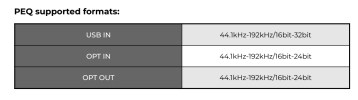
Appreciate the multiplatform approach, PEQ accessible from Mac, Windows and Linux. Prefer not having to replace everything else if/when swapping platform. It will keep my desk clean too, moving the Mac under my desk where it is ment to be

Keep in mind that PEQ only works from digital inputs
 

Attachments

  • Capture+_2026-06-21-10-32-53.png
    Capture+_2026-06-21-10-32-53.png
    38.8 KB · Views: 163
Did I miss the power vs. distortion graphs at different impedances? I couldn't find them
You did not, I have a problem with my 32ohms load which I will not fix soon, but I can run some tests at 300ohms although I lost the necessary cables for that, so I bought others and waiting to receive them. I’ll update the review when I can.
 
Last edited:
Keep in mind that PEQ only works from digital inputs
Thanks,

Am aware, will only be using digital sources for this one as with everything else in the pipeline. Would have been nice with more than 3 profiles in the memory though....

The perk with this one is that it fits my usage scenario perfectly featurewise. Everything I need, hardly anything I won't. From a techncial/sound perspective I'll have to wait until I get it. Might be, thanks to ASR, I'll be fine with just the 3 profiles too, if I get the IEM's right straight away. Not worried by HD650.
It’s quite easy to load extra EQ profiles if you have it connected to a computer.
 
It’s quite easy to load extra EQ profiles if you have it connected to a computer.
Yeah, will do that. As far as I can establish, Topping Tune (1.15) facilitate installation of profiles and filters ++ from the Mac only. The more clever solution would be for Topping Tune to let the users link up to the publically available lists of profiles for various head gear. Don't have the hardware yet, thus my perspective is purely theoretical/pragmatic research for now.

The Pico DSPi console's integration with the AutoEQ headphone db would be a good one to learn from I gather. Big fan of what Weeb Labs achieved with that project, but I couldn't find a suitable and likeable enclosure for Pico 2 (I never shop via Amazon)...


Following the discussions around DX5 II and even more so DX1 II, what strikes me as a challenge for Topping is a certain limitation in intuitivity both in terms of software/firmware and connectivety forcing users to mess about more than a bit to take advantage of feasible features/capabilities. Sorting that out would serve both Topping and their customers very well.

Glory to technically brilliant engineers, programmers and designers who are able to translate complex technology to a intuitive and brilliant UX and understandable language. Like Wee Labs :)
 
Fixed: Under USB input, the clock did not switch when the sample rate changed.
That indicated no testing with different sample rates before releasing the first firmware.
 
That indicated no testing with different sample rates before releasing the first firmware.
It’s Topping, it’s what they do. I say this as an owner of a DX5II. I bought it six months after it came out on purpose and it still took another three months for them to have firmware and software withe better than alpha quality PEQ. If you can deal with that you get some good performance bargains. If you can’t you should buy something else and likely pay significantly more.

Cha Bu Duo​

 
I've been testing a theory of mine this afternoon about playback from the digital output of a CD Player.

So, I pulled out the SMSL PL200T which has a very stable internal clock, and that can be synced from an external clock too. I added the Leo Bodnar LBE-1421 which is a clock generator (GPS Disciplined Oscillator) reaching ceasium accuracy onboard satellites.

First, as I suspected, with a CD player (or transport in this case) that has a very precise internal clock, I suffered 0 glitch (during 6 hours of testing and listening), while I had issues with other CD Players.

The Topping offers 2 undocumented options for the clock (d-1 and d-2 from the main menu), and I had to test.
For that, I used my usual pitch error test, which is a sine at 19'997.00Hz and I measured the output of the Topping, after conversion to analog, from rear balanced output.
  • When d-1 is selected
    • If PL200T uses its internal clock: Pitch is 19’996.94Hz, ie deviation of -3ppm
    • If PL200T uses Leo Bodnar clock: Pitch is 19997.02Hz, ie deviation of +1ppm
  • When d-2 is selected:
    • If PL200T uses its internal clock: Pitch is 19’996.79Hz, ie deviation of -10.5ppm
    • If PL200T uses Leo Bodnar clock: Pitch is 19996.79Hz, ie deviation of -10.5ppm
This tells me that (maybe), and as opposed to what I said in the review, option d-2 relies on its internal clock, while option d-1 (tries to) synchronise to the digital input.

Indeed, when I test CD players, their internal clock imprecision transitions via the SPDIF which embeds the clock. So the receiver has to synchronize to that input using a PLL to align the incoming signal to its internal clock (that's the DAC working in slave mode). Most of the time, I get the same results from CD Players, from their analog output, or from an external DAC, meaning that their clock imprecision indeed transitions through SPDIF. You can find a lot more information about that in my review of the SMSL G1 Clock Generator.

So, from all the above, option d-1 (clock slave mode) should make things better, at least at the input, and my guess is that you should chose option d-2 (clock master mode) when using the output. Someone from Topping could confirm that.

 
Last edited:
I've been testing a theory of mine this afternoon about playback from the digital output of a CD Player.

So, I pulled out the SMSL PL200T which has a very stable internal clock, and that can be synced from an external clock too. I added the Leo Bodnar LBE-1421 which is a clock generator (GPS Disciplined Oscillator) reaching ceasium accuracy onboard satellites.

First, as I suspected, with a CD player (or transport in this case) that has a very precise internal clock, I suffered 0 glitch (during 6 hours of testing and listening), while I had issues with other CD Players.

The Topping offers 2 undocumented options for the clock (d-1 and d-2 from the main menu), and I had to test.
For that, I used my usual pitch error test, which is a sine at 19'997.00Hz and I measured the output of the Topping, after conversion to analog, from rear balanced output.
  • When d-1 is selected
    • If PL200T uses its internal clock: Pitch is 19’996.94Hz, ie deviation of -3ppm
    • If PL200T uses Leo Bodnar clock: Pitch is 19997.02Hz, ie deviation of +1ppm
  • When d-2 is selected:
    • If PL200T uses its internal clock: Pitch is 19’996.79Hz, ie deviation of -10.5ppm
    • If PL200T uses Leo Bodnar clock: Pitch is 19996.79Hz, ie deviation of -10.5ppm
This tells me that, and as opposed to what I said in the review, option d-2 relies on its internal clock, while option d-1 (tries to) synchronise to the digital input.

Indeed, when I test CD players, their internal clock imprecision transitions via the SPDIF which embeds the clock. So the receiver has to synchronize to that input using a PLL to align the incoming signal to its internal clock (that's the DAC working in slave mode). Most of the time, I get the same results from CD Players, from their analog output, or from an external DAC, meaning that their clock imprecision indeed transitions through SPDIF. You can find a lot more information about that in my review of the SMSL G1 Clock Generator.

So, from all the above, option d-1 (clock slave mode) should make things better, at least at the input, and my guess is that you should chose option d-2 (clock master mode) when using the output. Someone from Topping could confirm that.
I have sound dropouts on both D1 and D2 settings. The problem is the same on various CD and DVD players at 44.1kHz.
 
I think it will go well only if the clock of the CD player is better than 2ppm, which is rare. That’s why I doubt any of the two settings act as clock slave, with a PLL, else there’d be no glitches at all.
Of course we won’t be all equal, as it probably will be dependent on your own Topping, all Xtals won’t have the same performances, making things better or worse.
Let’s hope Topping can fix that via a future firmware.
 
People hi :D

I don't understand at all why Topping doesn't use the 'same program' as the TOPPING D50 III because it seems to work correctly?
Are we still going to have a 'long history' of firmware like for the TOPPING DX5 II?
This is once again VERY disappointing on the part of topping... :(
 
"Hi,

Thank you for your timely follow-up and feedback. The user you mentioned is also continuing to follow up with us. We have also forwarded the test results to our engineers, and I will contact you again if there are any updates. ^.^"

The are following this topic
 
Topping knows the problems, I sent them videos with sound dropouts when playing CDs and loud clicking on the RCA output.


Topping knows the problems, I sent them videos with sound dropouts when playing CDs and loud clicking on the RCA output.


I say the more the merrier. Let em know things need fixing
 
Topping knows the problems, I sent them videos with sound dropouts when playing CDs and loud clicking on the RCA output.


Ouch! That sound kills my brain. I just canceled my preorder until I'm sure Topping can fix this through a firmware update. Let's hope it isn't a hardware problem.
 
People hi :D

I don't understand at all why Topping doesn't use the 'same program' as the TOPPING D50 III because it seems to work correctly?
Are we still going to have a 'long history' of firmware like for the TOPPING DX5 II?
This is once again VERY disappointing on the part of topping... :(
Perhaps not?

By the looks of it, the likes of Topping and Fosi puts a lot of effort into developing new and better products, and sometimes one gets hick-ups as a consequence. Same thing with bicycles, cars, hairdryers, games, MacOS, Windows, Linux, robocleaners and what not. Kicking off production of new hardware even if the production process is the same may be a source of production inconsistencies.

They don't like that more than we do, and if there is something one SHOULD be aware of, it's the potential risk in being early adapters. If the risk is unbearable to someone they should not purchase products before they believe the production ++ has settled in.

As mentioned before I have one of these in the air as we speak, but I am aware it makes me an early adapter, thus the risk is on me - warranties as in terms and conditions valid. As far as software goes, pretty sure the firmware will be sorted out eventually, and Topping Tune is first generation - this kind of functionality within this price range is pretty cool, and following generations will be better.
 
By the looks of it, the likes of Topping and Fosi puts a lot of effort into developing new and better products,
More like throwing shit at the wall and seeing what sticks. SMSL is the worst offender of this, they discontinue few months old devices.
 
  • Like
Reactions: MCH
Back
Top Bottom