• Welcome to ASR. There are many reviews of audio hardware and expert members to help answer your questions. Click here to have your audio equipment measured for free!

Topping B100 Amplifier Review

Rate this amplifier:

  • 1. Poor (headless panther)

    Votes: 31 6.4%
  • 2. Not terrible (postman panther)

    Votes: 26 5.4%
  • 3. Fine (happy panther)

    Votes: 85 17.5%
  • 4. Great (golfing panther)

    Votes: 343 70.7%

  • Total voters
    485
More you have a high sinad system ( read more transparent, as it relates to sinad mostly)
No, it doesn't. You'll note SINAD is just one of many measurements carried out here. All have to have good results for transparency.
 
Human brain is much more sensitive than any current measuring equipment.
I'll give you that the human brain is certainly more imaginative than any measurement devices. Blind studies tend to dampen or eliminate those profound differences many claim to hear. A book I've often recommended is Dr. Cordelia Fines "A Mind of its Own". it explains how our brain distorts and deceives us. Its not directly about audio but our brain does not turn into a scientific measuring device because one utters the word " audiophile".

But, I also believe that if appearance, brand name, impressive advertising verbiage, cost, audio reviews and so on help increase your perception of superior sound quality, then have at it! Just don't expect others to come to the same conclusion.
 
I would prefer a -80dB THD+N amp (or 80dB SINAD for those who use it the other way) which never clips and immune to anything upstream over a -120dB THD+N one which is constantly at the edge of clipping and requires certain conditions to perform.

I would also prefer one that's load agnostic down to 2Ω, providing constant voltage, just in case.
Needless to say about power vs freq, specially down low.

After a gazillion of blind tests with vastly different spec amps (and some training/habit to recognize clipping) , distortion is the last thing I worry about any more.
I would choose a lower noise one (CD spec is more then enough) if I had 100dB sens horns or some weird gain-staging though, but that's it.

Lowest noise ones, that's IEM territory.

Amps like B100 are a nice exercise though, can't deny that.
 
  • Like
Reactions: NTK
I've installed my newly bought used B100's as amplifiers to my TAD TD-4002 compression drivers in TH-4001 horns. Not stressing the B100's during normal listening levels :D

My old horn amplifier, the Purifi based 1ET400 amps are now driving my midrange / midbass the TAD 1201H's, and the two DIY bridged Class-A Amp Camp amplifiers have the pleasure of distorting the hell out of the Fostex T500 mk2 tweeters. When I get access to B200 or LA90 D I will move the B100's onto the tweeters just to reduce the heat production from the 2x 15w Amp Camp amplifiers.
 
Overload recovery is an ignored trait. Also stability in recovery from clipping. A friend designed and marketed a 40 watt amp. Several thought the specs were incorrect. Played average efficiency speakers loud and they never heard clipping.
 
  • Like
Reactions: EJ3
Works geat in low gain and fed directly by high output dac with in built volume control. For most listening cases low gain with xlr input is ok in small to medium room for bookshelf speakers. For bass duties subwoofer can be used. It's on warmer side of neutral and has insane realism specially when you feed directly by a dac with in built volume control.
 
It's on warmer side of neutral and has insane realism specially when you feed directly by a dac with in built volume control.
How many degrees warmer, and what physical, verifiable parameter corresponds to "realism"?
 
Use a pair of B100’s in low gain. Using their running mate, E70 Velvet. Same chassis.
Would not work as configured in most systems. But my speakers are a real 105dB efficient.
The five volt maximum output is overkill.
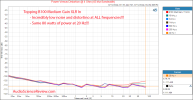
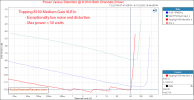
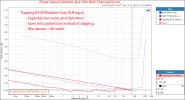
Think the tests for SINAD do not show off the real strength of the B100. If tests were run at 50mW instead of 5 watts the incredible low noise, distortion, and high linearity at low power would be very evident.
Not sure why 5 watts was selected as the power output for a single number benchmark. At five watts many speakers are already distorting. Covering up any electronics misbehavior.
At 50mW, or even at 100mW the noise generated by some amplifiers may be audible. Look at the tests here on ASR. Many stop at 200mW. Extrapolating, the SN goes way down. Assuming it is linear.
I figured out a while back the B100 is the best commercial amplifier ever for high efficiency loudspeakers.
In low gain mode it allows a dac with digital attenuation to operate in the optimal range of attenuation. I had never padded mine down to below -30dB even for purposefully low volumes. Never turned up higher than -10dB for house rattling levels.
 
If tests were run at 50mW instead of 5 watts the incredible low noise, distortion, and high linearity at low power would be very evident.
But the tests *were* run at 50mW:

Topping B100 Monoblock amplifier balanced power into 4 ohm load vs frequency measurement.pngTopping B100 Monoblock amplifier balanced power into 8 ohm load measurement.pngTopping B100 Monoblock amplifier balanced power into 4 ohm load measurement.png

At five watts many speakers are already distorting.
At five watts, the average loudspeaker with 4Ω impedance and 86dB sensitivity will output 90dB SPL.

Judging by Amir's latest five speaker reviews, 90dB is not a problem for most speakers.
 
Last edited:
The distortion vs output for the B100 are run to low levels. The amps to compare to are not. Even on Toppings website this is true.
The five watts comment is because this is the output level where SINAD is measured. I do not read the speaker reviews. But speaker distortion climbs with output. Many speakers are loud at 5 watts. Speaker distortion is usually in percent. Amplifier, wirh a power resistor loading are three to four decimal points lower.
Last 86 dB speakers I owned were B&W 801 Matrix II. Been a while.
 
The distortion vs output for the B100 are run to low levels. The amps to compare to are not.
Amir runs (mostly) the same tests for each Amp.

With his data, you can very much compare the B100's SINAD at 50mW to other Amps, at seven frequencies between 20Hz and 15kHz.
 
So you mean all good measuring amps, dac and speakers sound identical?
DACs and Amps Yes. Not speakers though. And amps have to be operating within limits (not clipping)

But then you have already been told this, multiple times.
 
DACs and Amps Yes. Not speakers though. And amps have to be operating within limits (not clipping)

But then you have already been told this, multiple times.
And how did reach that so called cut off limit beyond which all dac and amps sound same ?
 
Because research of audibility thresholds are performed and the results published.
For example,
Keith
 
So you mean all good measuring amps, dac and speakers sound identical?
Amps and DACs yes. If you disagree, feel free to provide objective, verifiable evidence.
 
And how did reach that so called cut off limit beyond which all dac and amps sound same ?


And you've also asked that before - and been given exactly the same answer @Purité Audio audio gave you. By yours truly and in this exact thread:


So frankly - it looks like you are just trolling now.
 
Because research of audibility thresholds are performed and the results published.
For example,
Keith
Please tell where that threshold value of sinad mentioned in the above post beyond which all dac sound same. I find limits of human hearing but not the sinad limits of equipments. I
 
Amps and DACs yes. If you disagree, feel free to provide objective, verifiable evidence.
Exactly what I am asking. What is that "objective" limit of sinad beyond which "it starts not mattering". Which "objective" Test fixed that limit? Or the limit was fixed "subjectively" by some golden ears. This is not trolling imo, because if beyond certain limits objectivity itself doesn't matter then there is no point of ranking equipments based on sinad isn't it ? Also there is no point of brands like topping to break their own past records. Why brands keep improving distortion figures beyond a certain point if it's not audible?
 
Back
Top Bottom