• Welcome to ASR. There are many reviews of audio hardware and expert members to help answer your questions. Click here to have your audio equipment measured for free!

The Perfect CD Sample Rate Converter (Shannon Interpolation)

That's the problem, your posts do sound like that ;) You also don't have to be an actual data specialist to ask: "Please translate this text as faithfully and direct as you can from German to English".
Sorry. I wont use ai in future for communication. I am 31, no kids, too much time. But shannon64 was designed to advance DSP technology and delight the community.

Again
Sorry
 
No worries :) BTW, I never said you should not use AI for communication. Just use it responsibly :cool:

Since you are willing to share the knowledge, I would recommend uploading the code to github/bitbucket with whatever licence you deem fit for purpose. Then anyone can enjoy it.
 
I am not on github.
But i can Imagine you have the networks and authority for distributing shannon64
 
I am not on github.
But i can Imagine you have the networks and authority for distributing shannon64
You just need a signup. They have the network, authority not needed :)
 
You just need a signup. They have the network, authority not needed :)
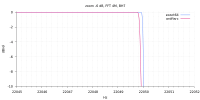
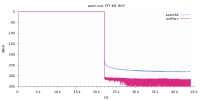
ffmpeg -i INPUT -af "aformat=dblp,ardftsrc=88200:quality=$((4*1024*1024)):bandwidth=.99999:phase=0"

Its a copy from a Hydrogen Audio member
He was testing Ardftsrc with 99.99999 pass band against Shannon64
 

Attachments

  • IMG_3298.png
    IMG_3298.png
    7 KB · Views: 96
  • IMG_3299.png
    IMG_3299.png
    8.9 KB · Views: 87
ffmpeg -i INPUT -af "aformat=dblp,ardftsrc=88200:quality=$((4*1024*1024)):bandwidth=.99999:phase=0"

Its a copy from a Hydrogen Audio member
He was testing Ardftsrc with 99.99999 pass band against Shannon64
Not Bad for AI
 
@pjug is asking about PGGB specifically. AFAICT from their page they also use Shannon interpolation without windowing:
Isn't PGGB slow, though? It sounds like @JulianW may have a faster implementation. It would be interesting to compare speed and see if there is any difference in delta wave. If anyone has PGGB.
 
Isn't PGGB slow, though? It sounds like @JulianW may have a faster implementation. It would be interesting to compare speed and see if there is any difference in delta wave. If anyone has PGGB.
PGGB has a selectable number of taps, so it can’t really be doing exactly the same thing like shannon64
 
PGGB has a selectable number of taps, so it can’t really be doing exactly the same thing like shannon64
That is not what the documentation says. While. You can enable additional filtering, by default it’s off and the algo is, as far as I can see, equal to yours.
 
Is there a size limit for the music tracks? The program is crashing when I put a long track (15'40''). After some days of use, I am persuaded the upsampled tracks using your upsampler are more transparent than my usual 44.1>176.4 hz SoX upsampling option (inside JRiver). The inteligibility and narutalness of the harpsichord is a true telltale for me, but there are more signs.
 
Last edited:
In theory, feeding the DAC 88.2 kHz instead of 44.1 kHz can make its job easier. The difficult first interpolation stage has already been performed offline, so the DAC no longer has to transition from the 44.1 kHz audio band to its first image over such a narrow frequency range. At 88.2 kHz, the first image is much farther away, giving the DAC a much wider guard band and therefore a less demanding filtering problem.


This does not guarantee a better analog output — it depends on the DAC’s internal architecture — but it potentially moves the most demanding interpolation step from the DAC into a controlled offline process.
This is why I advocate for high resolution music. For the electronics that's required of the digital domain.
 
ExactEQ uses the original RBJ formulas

There are no arbitrary caps on filter count, gain or Q, and frequencies go right up to the Nyquist limit for the selected sample rate.

You can even enter 1234.5678937373737 Hz or a Q of 16363737.747474747, as long as the filter is mathematically valid and the calculation fits the available resources.

It supports 44.1, 48, 88.2, 96, 176.4 and 192 kHz. (Stereo, Mono , Double Mono)

The GUI is clean and straightforward, with preset imports from TXT, JSON and CSV.

Compatible RBJ presets from Squiglink or oratory1990 use the same frequency, gain and Q values, so there's no need to translate them into a different filter design.


and of course correct rounding too

Of course with Accurate BLT warping at Nyqvist
 
I solemnly declare
There is no more accurate RBJ Cookbook EQ than my ExactEQ
(for 64-bit float output)
 
The First who succeeds in disproving this (verified against an independent reference) will receive €100 from me by bank transfer
 
Back
Top Bottom