• Welcome to ASR. There are many reviews of audio hardware and expert members to help answer your questions. Click here to have your audio equipment measured for free!

Surge Protector Japan / Home Desktop

I hope this doesn't come across as rude, but I might suggest that if you're scared of your load center and don't really know how surge protection devices work then maybe your feeling that you absolutely need one for your new computer/audio setup might not be correct.

If you really want proper surge protection, consult an electrician to see an SPD can be installed into your load center. I mean, you did just spend quite a lot on all that gear, but now you absolutely can't make the outlay for an electrician to intstall an SPD?
 
Japan is 100v country. I did notice that 200v section when looking in the fuse box. I honestly have no clue what that’s about nor would I even touch it. Things here are reliable though. I have lived in this building for 12 years. Never lost power once - not for 1 min or 1 hour. We had some lightning a few days ago which came with a typhoon but it’s not a norm here.

Myself, personally, it’s not something I would be able to do (cable shortening and plug swap). I have a sneaking suspicion that if I ask around to electricians, being Japanese, most are going to decline the request out of some disrespect to the manufacturer if they agree. That would solve my problem though, so I will put some time into seeing if I can find someone.
Be bold!
Putting plugs on power cords is routine over here and surprisingly entrusted to morons (pretty much).

100V? That's going to need a fat mains cable to power just a good PC! I wonder if the 200V label on your fuse box means you have 2 phases like in the US?

I'm enjoying hearing about practical details of Japan. My wife has been there, and thought it was great (apart from some misogyny in Tokyo, as a 5'10" skinny UK blond, but she had great respect and politeness in the countryside) but I never have been. I'm sure it would be brilliant. Again, I digress.... Sorry!
 
100V? That's going to need a fat mains cable to power just a good PC!
Nah. Even if the PC is consuming 1kW (unlikely), that's only 10A at 100V. Not a big deal.
I wonder if the 200V label on your fuse box means you have 2 phases like in the US?
U.S. doesn't have 2-phase power. Residential is single-phase, commercial is 3-phase.
 
Nah. Even if the PC is consuming 1kW (unlikely), that's only 10A at 100V. Not a big deal.

U.S. doesn't have 2-phase power. Residential is single-phase, commercial is 3-phase.
So 10A on a 15A breaker means one PC not say, two? Might as well use AA batteries!

In the US, at least where I lived:
  • Split-Phase Power: Homes receive 240V from a utility transformer with a center tap that creates a neutral wire, splitting the service into two 120V lines (L1 and L2).
  • Standard Outlets: Standard 3-prong outlets (NEMA 5-15) connect to one 120V line, neutral, and a ground wire.
  • Large Appliances: Heavy-duty machines bridge across both 120V lines (L1 and L2) to run on 240
Sounds live 2 phase and neutral to me. Except it depends on wiring if phases, so you may only get 207V max. I made no mention of phase angle.
 
1788482070869.png

Split-Phase Power: Homes receive 240V from a utility transformer with a center tap that creates a neutral wire, splitting the service into two 120V lines (L1 and L2).
Yes, hence it's called split phase, with the phase of L1 and L2 180 degrees from each other.

Sounds live 2 phase and neutral to me. Except it depends on wiring if phases, so you may only get 207V max. I made no mention of phase angle.
Hence this statement is contradicting the one before. Because there is only one 240V phase and the angle is 180 degree, and you will always get the full voltage by connecting across both of the split-phases.
 
a little off topic, but I wasn't able to convince Gemini that surge protection isn't worthwhile, even after feeding it arguments made in this thread. haha
 
Hey @somethingsup , I completely understand the concern regarding your electronics.
It's not a small investment, and not an insignificant task to replace components when something happens.

I suggest consulting a local electrician - you can find friendly contractors with reasonable rates on Jimoty or Kurashi no Market.
Setting aside the issue of the efficacy of surge protectors (which the other members here have addressed much more competently than I could), the main issue here is that standard 2-prong Japanese outlets lack the ground (Earth) pin.
This means that, even if a surge protector did try to shunt the surge to ground as intended, there would be nowhere for that to go.
This is why the only products that claim protection (again, setting aside if that is useful) have 3-prong plugs.

You likely have the most common type of Earthed outlet in your kitchen, which combines a 2-pronged receptacle with a ground wire screw terminal:
4901087193295.jpg.webp

These are required for refrigerators and microwaves, and thus almost always found in kitchens, sometimes in bathrooms, but unfortunately rarely in a location where they would be useful for audio equipment.
Luckily, an electrician can change an existing 2-prong outlet into one of these without too much difficulty, and at a reasonable cost, by running a ground wire from another location.

Armed with that, you can add any 3-pronged power strip of reasonably robust construction (usually they are called "OA Taps"), run the ground wire to the screw terminal, and you'll be good to go. This will give you the maximum amount of protection achievable within the Japanese electrical system.

Also, as a bonus: the 200V circuits in your circuit breaker are used to power 200V outlets like the one below on the right side of the image:
k21i-poles0104.jpg

These supply double the voltage (200V) and are typically used to power larger air conditioning units, induction cooktops, and more recently, connected outside to power EV chargers.
These must be 3-pronged Earthed plugs, so if you have one nearby the electrician should be able to pull ground from there as well.

Hope this is helpful!
 
Apologies for the consecutive replies.
Zooming in on the photo of your circuit breaker, the 200V circuit is indeed labeled "induction cooktop" so that is guaranteed to be Earthed and an electrician could pull ground from there.

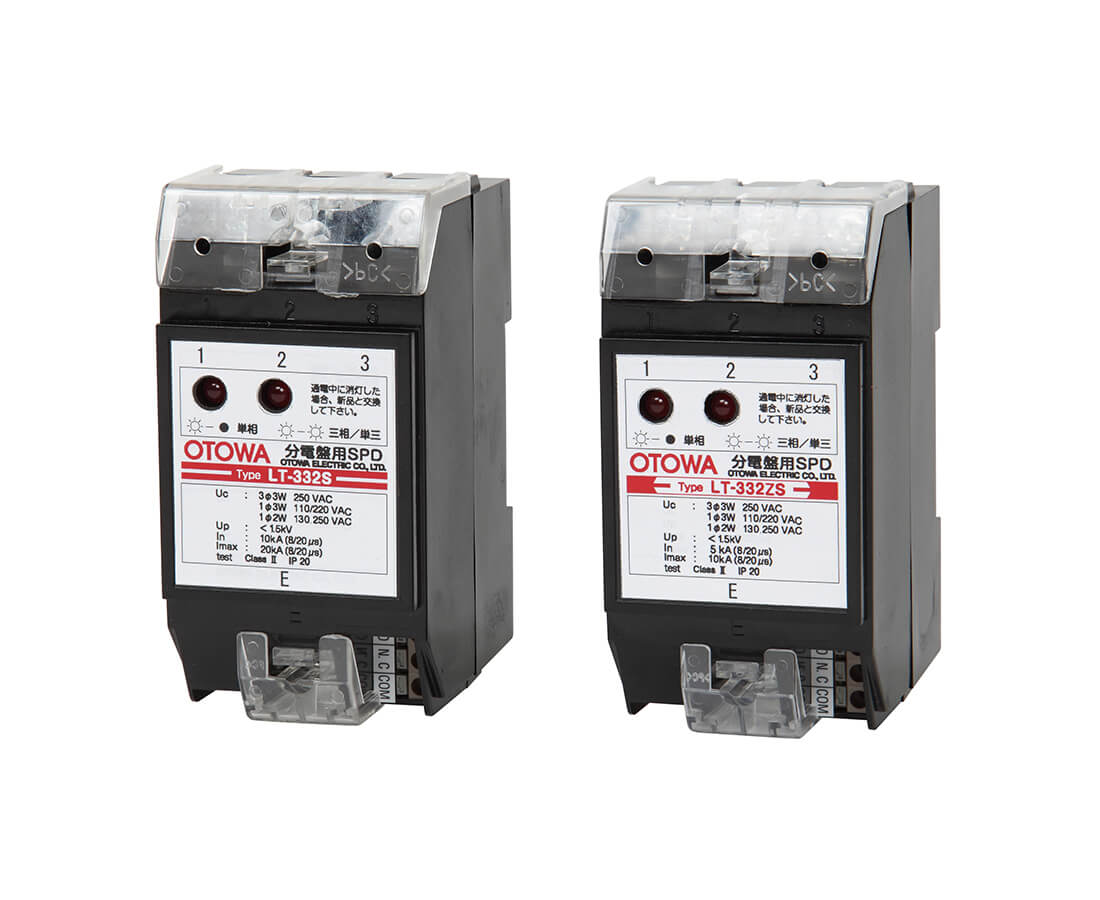
Also, as others suggested above in the thread, you could install an SPD box inside your existing circuit breaker for protection without needing to change any outlets:

products_main04-1.jpg

A search online shows that installation of the SPD would be between 20,000 and 40,000 yen including parts - not too bad for whole-house protection.

Finally, your homeowner's or renter's insurance should cover damage caused by lightning strikes or surges; I had a surge that fried a relay in my home theater receiver and was able to get it replaced with the insurance payout. Check the details on your policy just in case.

Best of luck and let us know how it goes!
 
Apologies for the consecutive replies.
Zooming in on the photo of your circuit breaker, the 200V circuit is indeed labeled "induction cooktop" so that is guaranteed to be Earthed and an electrician could pull ground from there.

Also, as others suggested above in the thread, you could install an SPD box inside your existing circuit breaker for protection without needing to change any outlets:

View attachment 556375
A search online shows that installation of the SPD would be between 20,000 and 40,000 yen including parts - not too bad for whole-house protection.

Finally, your homeowner's or renter's insurance should cover damage caused by lightning strikes or surges; I had a surge that fried a relay in my home theater receiver and was able to get it replaced with the insurance payout. Check the details on your policy just in case.

Best of luck and let us know how it goes!
No worries. I appreciate your enthusiasm and responses.The only issue with all of it is that I live in a rental apartment, so it would be illegal and definitely being evicted, security deposits kept (or worse) for doing any of this without having to go through hours of phone calls with the rental company and then building owner, who will most likely come to a quick “fuck no” when asking for permission.
 
No worries. I appreciate your enthusiasm and responses.The only issue with all of it is that I live in a rental apartment, so it would be illegal and definitely being evicted, security deposits kept (or worse) for doing any of this without having to go through hours of phone calls with the rental company and then building owner, who will most likely come to a quick “fuck no” when asking for permission.


Some fun watch about why 2-pin outlets prevail in Japan.
 
I want to thank everyone who has contributed their thoughts and ideas, whether for or against surge protectors.

I want the best solution, but also the path of least resistance. The reason I didn’t want to travel down the “whole home solution” or even the “one room solution” path of rewiring or adding to fuse boxes, electricians, etc is simple - it is a literal pain in the f_cking ass to do this with a rental apartment. It would take hours of calls back and forth, along with paperwork, office visits, long detailed explanations as to what I want to do and why it’s necessary, and in the end, I would have to convince the rental agency that holds my lease and they would have to then convince the building owner(s). I would put the chance of getting a “yes” at about 30-40% max.

Never mind the fact that whether it’s ¥20k-¥30k-¥40k or more to do it, I'm going to need to oh that again upon moving out because nobody else is going to want a room with 200v outlets. And I will have to repeat much of the same calls and paperwork and approvals on the way out. My time and sanity has much more value to me than that. If there comes the day where I buy an apartment or build a house, then yes, I would have the whole place wired how I need it or at the very least, the one room that I turn into a music room or home office.

That being said, modifying the room in question is off the table. Japan isn’t the US/UK/AU/EU/etc so it’s just a no-go for me, sorry.

I am also not against “no surge protectors”, but when the overwhelming majority of people, forums, articles, websites, manufacturers, etc all seem to point to the benefits of having one, it’s kind of hard to roll the dice on going naked. Is something does happen, what do I get as a consolation prize? “Sorry bro. I’ve never heard of that happening before.” ?

I feel like I am somewhere in the middle. Do I want some big fancy ¥150,000 device that promises everything under the sun? No, even if true.

Do I want a ¥1000 plastic piece of shit that’s a glorified power strip? No, not really.

I’m not concerned about lightning striking my building or of waking up tomorrow to notice that somehow 125,000v of electricity somehow was dumped from the local power grid and through every outlet in my apartment (it’s an exaggeration, I know).

Perhaps any little fluctuations would be perfectly with my listed gear. Or perhaps not and upon complaining, they all ask why I didn’t use a surge protector as recommended, and then sorry, claim denied.

This was my rationale for wanting a surge protector. I know it’s not impenetrable armor.

Since none of the outlets in my home office room have grounding screws, and only accept 2 prong plugs, I have limited options:

1. Electrician route - No (see above).

2. Use a surge protector with 2-prong plug. The only type I see are plastic power strip looking type.

3. Use a surge protector with a 3-prong plug and plug adapter (3p to 2p). Quality adapters here include the green grounding wire to attach, but it won’t matter if I never attach it or ignore it is permanently attached because there’s nothing to connect it to on the outlet.

In this case, even if it’s a respected unit, like the Tripp Lite Isobar 6 (for example), it will instantly show a red light error because not grounded. It will work offering basic level of surge protection, but not to the full ability. Although with this specific model, the benefit I see would be with it’s noise reduction since I will have not only powered speakers and a sub going into it, but a noisy computer and monitor, as well.

4. Using no surge protector at all. Whatever happens, happens, I guess. But if something does happen, who do I have to blame? Myself or Cables72936 on Audio Science Review?

5. Ah yes, almost forgot. I can buy whichever brand and model, have a shop shorten the cable and swap the plug. But besides voiding the warranty instantly, and equally screwing my self if I ever needed to make a claim, the plug I end up with will either be 2p with no ground (thia limiting the protection I receive from a 3p unit) or a 2p with ground wire that goes unattached and still limiting the protection i receive.

I would love to keep my money and not get anything, but that seems about as likely or a choice for me as going with an electrician.

Perhaps the Tripp Lite 6 or 6 Ultra (not sure if basically the same) is a solution with a 3p to 2p adapter. It will offer basic bumps in the road fluctuation protection, will help with the noise of computer and audio mixed together, and if nothing else, it’s an expensive power strip.

Sorry for the thesis. I don’t expect anyone to read it all the way through. I’m still up for thoughts or to tell me how stupid I am. Appreciate you all.
 
Hey @somethingsup , not gonna tell you you're stupid, so no worries there. And I did read through your entire post ;)
Also, from the style of writing in your posts I assume you are an expat, so for what it's worth from one 30-year veteran expat, I feel your pain and frustration with what must seem like a catch-22 style situation - things have gotten better in my time here, but Japan is still a place where the simplest things can become very complicated quickly.

I myself was a long-time lurker here on ASR, only posting since I saw a unique opportunity to try and help someone out in similar circumstances to what I have experienced in the past.
I think that, if you spend more time here on ASR reading various posts from the extremely knowledgeable membership here, you may be able to learn a lot (as I have) about what is real vs. perceived in this hobby that we all share. You may even come to learn that "problems" that we have been led to believe are clear as day and a no-brainer to attempt to solve (such as protection from surges and "noisy power") are, in fact, often solutions in search of a problem that does not actually exist.

With that in mind, my advice to you (in the most objective terms possible) is to purchase a power strip from a reputable manufacturer such as Panasonic, which is guaranteed to meet all relevant standards and regulations on product safety, and connect it to a standard outlet. This will give you no more and no less protection than any other native Japanese resident, and that seems to be doing well for the vast majority of them on a daily basis.
As a renter, you are likely forced to carry renter's insurance (likely on a 2-year renewal term policy) - check your insurance company's information and you will see that lightning damage to appliances and electronics is covered up to the coverage limit of your policy (that limit can be increased by you if necessary without needing permission from your rental agency, building management, or landlord - it covers your property, not the building, so you set the terms).
In the extremely unlikely event of damage due to a lightning strike, you will be made whole from insurance; again, this is the method by which 99% of native residents protect themselves from financial liability in such events.
The manufacturer of your equipment doesn't handle these claims, insurance does, and I've never heard of such claims being denied (in my own experience and from others).

I know that's not necessarily the "feel good" answer (who doesn't want to buy a seemingly solidly-built piece of power delivery kit to go along with speakers and computers - after all, how could just plugging them in the wall or a "cheap" power strip be OK?), but it's the most honest one I can offer.
Most of us on this forum have been there at some point in our journey - convinced that there must be some sort of special sauce needed to make our equipment perform at it's best (look at the previous reviews of power conditioners on this site for countless stories of members that can't believe such a product exists if there isn't a need for it).

No one will call you stupid for making a purchase decision based on emotion or what "feels right" - we just try to do our best to give the information so that you can go in with your eyes open.

Wish you the best of luck with your decision, and enjoy the new system!

P.S. I ran 2x Genelec 8341 and 2x Genelec 7360 along with a PC and monitor on a single Panasonic power strip for 5+ years and never had an issue, FWIW
 
I wonder in your case may be it is easier to use an online UPS (i.e. double conversion uninterruptable power supply). The double conversion should rectify (or at least protect you from) all sorts of incoming problems of the main AC. The capacity demand (a Mac Mini, display, power loudspeakers) shouldn't be too high. Yes, they are expensive, but that is in proportion to the hardware your are getting inside the units. You may also need to hide it somewhere sound proof as they may generate audible noise.
 
I wonder in your case may be it is easier to use an online UPS (i.e. double conversion uninterruptable power supply). The double conversion should rectify (or at least protect you from) all sorts of incoming problems of the main AC. The capacity demand (a Mac Mini, display, power loudspeakers) shouldn't be too high. Yes, they are expensive, but that is in proportion to the hardware your are getting inside the units. You may also need to hide it somewhere sound proof as they may generate audible noise.
Honestly, the solution i am looking for would be the easiest one that works.

There are dozens upon dozens of people across Mac forums all complaining that their Apple Studio Display is buzzing, whining, etc through their speakers- seems like a ground loop.

I asked a Japanese guy who deals with power and the like, and his way of explaining is like end of the world, if I don’t use a Tripp Lite 8 ultra which has independent banks and noise removal this and that, Im going to have a ton of headaches on my shoulders since I am plugging a monitor and computer into the same power tap or surge protector. The switching power of the monitor and computer and giving off noise, injecting it into the speakers and sub. On and on.

I’m pretty much burnt out on it. Not you or anyone here. Whenever I think to ask this guy or that guy because they manufacture power amps or have experience with audio and power, it always seems like an answer like, “If I were you, I’d first have an electrician gut your entire apartment and rewire it from scratch, then have a construction crew come in a build a custom listening booth within your home office, and then bring in a sound engineer to acoustically treat the booth.” And then I’m sitting there asking myself, “Just because I want to add a pair of speakers and a sub to a computer? Really?”
 
There are dozens upon dozens of people across Mac forums all complaining that their Apple Studio Display is buzzing, whining, etc through their speakers- seems like a ground loop.
Yes, a ground loop - but surge protection will (almost certainly) do nothing for that. SImplest way to solve it is use a USB to Toslink converter, and connect into the audio system optically. Second simplest is a competent fully power isolated USB isolator. Third simplest is a balanced output dac into balanced input amp - which will have the benefit of rejecting all common mode (ground loop) noise - not just that from the PC.

The switching power of the monitor and computer and giving off noise, injecting it into the speakers and sub. On and on.
See point one.


I’m pretty much burnt out on it.
Then spend £20 to £50 on USB to TOSLINK - get noise free audio (or at least zero noise from the computer), and then forget about the whole thing.
 
Last edited:
Then spend £20 to £50 on USB to TOSLINK - get noise free audio (or at least zero noise from the computer), and then forget about the whole thing.
Hmm… now that’s interesting. Thank you.

I suppose there is always a chance I won’t even have any ground loop - I could get lucky. And then if I do, ditch the USB-C connection from Mac Mini to KEF speakers, and use the toslink converter and cable. I don’t lose anything audio-wise (quality), but the one issue I saw was it by-passes something with volume control.

As for the power vs surge protector, it leaves me either to go with AJ_Tokyo’s advice of using any standard surge protector I can get an an electronics store (better than nothing) or if I wanted to forego surge protection, just get a power tap to run everything into.
 
Why not just get a UPS?

I bought one recently since we get a lot more short power outages than in the past. Like the lights will flicker so short that you barely notice it, but it's enough to turn off my all my PCs and IT equipment.

Most UPS have built-in surge protection as well. In any case, it's one more device between your precious equipment and the grid that could hopefully die first if something happens.
 
I really don’t want to chance not using any protector whatsoever, so unless I magically discover the correct word combination which unlocks the golden chest of surge protectors in Japan, it seems finding a solid unit that’s middle of the road and geared toward audio will remain a mystery, and I’ll have to use the generic plastic models from Elecom or Sanwa. They still offer 12500V of protection and are rated at 125V・15A・1500W. This is the standard generic protectors found in any electronic store here. I was just really hoping I could find one a bit more robust, im the same range of the Furman SS-6B. But it’s been impossible.
I live in Europe, I have SPD in the General Panel of the house, but even so, I decided to make another panel dedicated to the audio system, now I'm in the assembly stage.
In addition to all this protection, I decided to add a PDU with protection for the audio rack, I know I'm paranoid but it's better to sleep peacefully than to worry about the audio system.

I suspect that in Japan you must find something similar.
And yes, an SPD is a sacrificial piece, it discharges the overload to the ground very quickly in the event of a lightning strike for example, but the SPD will be destroyed, all this to protect your electrical equipment in the house.

IMG_20260906_133516_842~2.jpg
TG Audio Line.jpg
PDU 18 S..jpg
 
Why not just get a UPS?

I bought one recently since we get a lot more short power outages than in the past. Like the lights will flicker so short that you barely notice it, but it's enough to turn off my all my PCs and IT equipment.

Most UPS have built-in surge protection as well. In any case, it's one more device between your precious equipment and the grid that could hopefully die first if something happens.
The short answer is because every UPS I’ve seen here has a 3p power cable plug, which I can’t use here as our outlets are 2p. It means the unit requires that ground pin to function properly, and offer the full protection. Using a plug adapter and leaving the green ground wire dangling (or removing it) will allow the cable to be plugged into the wall outlet, but it’s still not grounded and this will only offer bare minimum coverage.
 
Back
Top Bottom