
• Welcome to ASR. There are many reviews of audio hardware and expert members to help answer your questions. Click here to have your audio equipment measured for free!

Stand-mounted vs. Floorstanding

You probably need a 3ms or more delay for your mains. The least expensive solution would be to replace your DAC with a MiniDSP 2x4 HD.


OK, love the forum again :)
This is awesome, thank you!
Switchable between USB (windows 10) and a Toslink (tv) which is exactly what I need, but it looks like I’m giving up some DAC quality relative to my 2 new DACs (khadas & modi 3)

I generally keep the crossover between 60-80 and the gain low. With movies, there’s no issue but music exhibits a delay which has me reaching for the off button now.
 
Back to this point on delay for the mains. Does it apply when both go via miniDSP (balanced)? With a Rhytmik sub what would be a good starting point if a delay is likely needed?
 
Yeah, so perhaps Dirac just plays each sub individually and EQs that response. Which may very well not produce a flat sum. Perhaps that behaviour is what the bass module is designed to correct. I haven't yet used Dirac personally so not too familiar with it. MSO seems to EQ each sub individually *to produce* a flat sum at the listening position, which is more complex than EQing them as a mono channel or EQing them individually.

I don't know exactly how Dirac does it, but when I'm mannualy EQ-ing multisub setup I do it in 1st iteration per individual sub (FR and phase), then I measure all sub response and based on that I make some overall adjustement that I apply to all subs to make all sub response as flat as possible.
 
Back to this point on delay for the mains. Does it apply when both go via miniDSP (balanced)? With a Rhytmik sub what would be a good starting point if a delay is likely needed?

Mains delay is not something that you should guess-adjust, you need to adjust it based on measurment. Typically it is in the range of 10-15ms but that really depends on DSP board in the sub.
 
Back to this point on delay for the mains. Does it apply when both go via miniDSP (balanced)?

To answer your question: assuming your sub has DSP processing (as most modern active subs do) that DSP processing will cause sub signal to be delayed relative to mains which are typically passive. But then, your mains can also be active with some DSP processing as well and chances are their delay would be different than sub delay. It is a good idea to have both, mains and subs connected via miniDSP as in that scenario you can not only fix delay difference but you can also implement a high-pass filter on mains.
 
Last edited:
ME Geithain made cardioid speakers before D&D and makes them fully cardioid...........

I am impressed, oh and look - they make subwoofers too.

https://www.me-geithain.de/en/aktiv-subwoofer.html
The active bass series serve as complement for the lower octave of our active studio monitors and as central bass unit in stereo reproduction. Furthermore, the subwoofers can be operated with suitable AV receivers to also allow optimal cooperation with our passive high-end loudspeakers. All subwoofer have cardioid radiation characteristics for minimisation of rearward roomreflections. This construction principle significantly simplifies the positioning of the bass loudspeakers in the listening room.

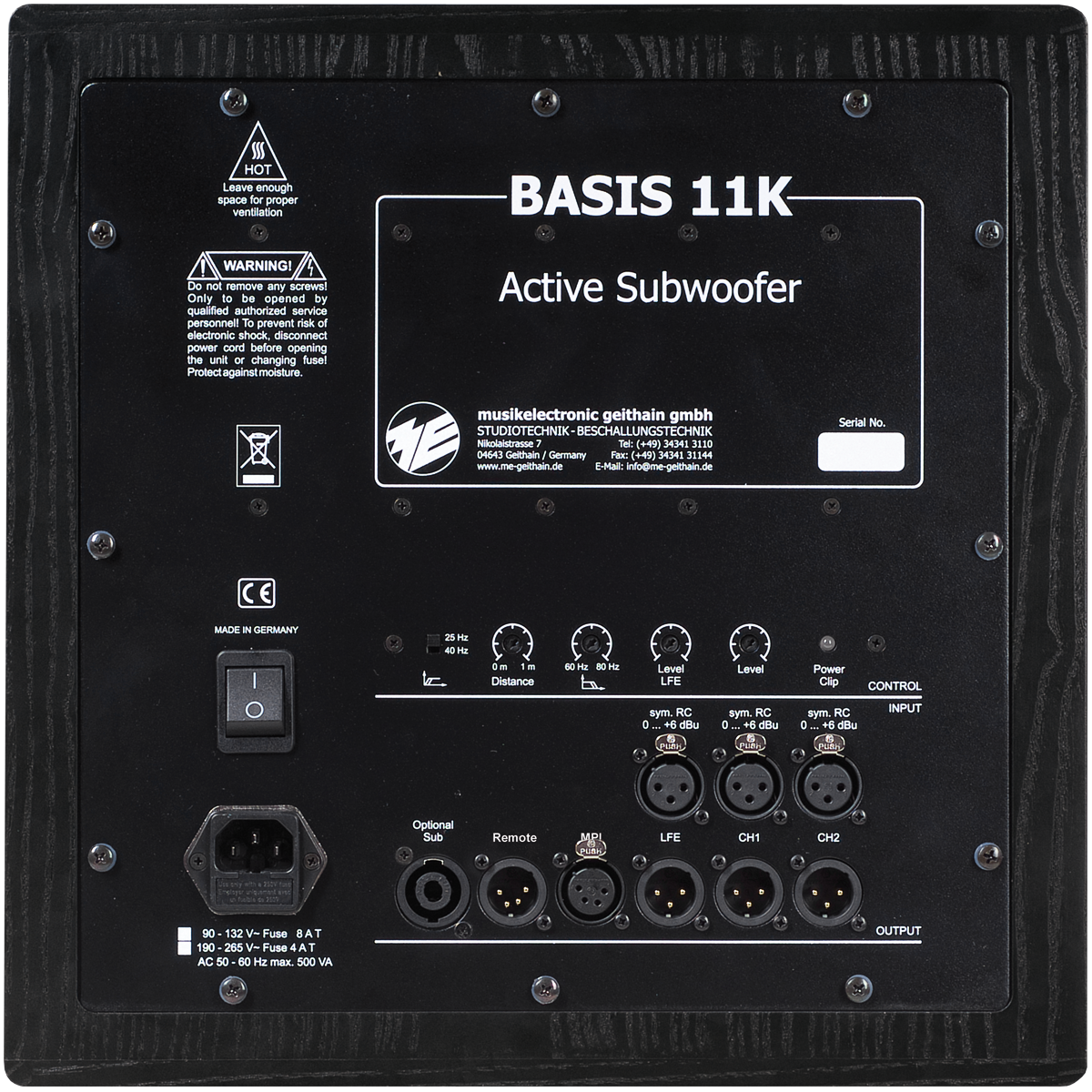
Looks to be balanced connections, a sound recording studio standard.


https://www.me-geithain.de/en/rl-901k2.html
B11K-Back_V3.png


And this looks to be how they wire them with their own monitors.

https://www.me-geithain.de/en/basis-11k.html
BASIS-Blockschaltbild-eng_V1.png
 
A single sub will never work well. 2 subs should be placed in opposite corners which will significantly cancel modes, not either side of the main speakers.
I invite you over for a listen, after the pandemic of course.

I'm going to play side 2 of The Dave Brubeck Quartet LP by Columbia Records "Time Further Out".

The drum track (first song on side 2) and following hand clapping track are going to make a believer out of you.

Then will play ELP's "Lucky Man", just the song not whole LP, followed up by playing both sides of Pink Floyd's Dark Side of the Moon, a master recording version.

The Goodbye Yellow Brick Road LP by E.J. might have a few worthy tracks, but bring some of your own stuff and put it though the paces.

You will be forced to reconsider your use of "never", never say never. ;)
 
I am impressed, oh and look - they make subwoofers too.

https://www.me-geithain.de/en/aktiv-subwoofer.html


Looks to be balanced connections, a sound recording studio standard.


https://www.me-geithain.de/en/rl-901k2.html
B11K-Back_V3.png


And this looks to be how they wire them with their own monitors.

https://www.me-geithain.de/en/basis-11k.html
BASIS-Blockschaltbild-eng_V1.png
Sadly, the price is around 2900€ for the 11". The 14" is interesting because it uses the same back (as opposed to side) slots as the RL901K and it looks like the exact same woofer too (both 40 cm and with ribs).
Really, a shame this brand isn't a bit cheaper and distributed through Thomann.

That SpeakON output is also quite rare.
 
OK, love the forum again :)
This is awesome, thank you!
Switchable between USB (windows 10) and a Toslink (tv) which is exactly what I need, but it looks like I’m giving up some DAC quality relative to my 2 new DACs (khadas & modi 3)

I generally keep the crossover between 60-80 and the gain low. With movies, there’s no issue but music exhibits a delay which has me reaching for the off button now.

If your room is rectangular and the short wall is the front wall, try moving the sub(s) to the side wall(s) with a placement where it(they) are about 3' (or whatever it takes) closer to the listening position. This has the same effect as delaying the mains.
 
This has the same effect as delaying the mains.

Changing sub position will have small impact on phase but not nearly enough to compensate for timing difference between passive mains and active sub(s). It may hep to match phase in the scenario where both mains and sub(s) are passive but even then it is impossible to match phase between them without measurement.
 
If your room is rectangular and the short wall is the front wall, try moving the sub(s) to the side wall(s) with a placement where it(they) are about 3' (or whatever it takes) closer to the listening position. This has the same effect as delaying the mains.

Let me be more clear here: subs are 10-15ms delayed from mains due to DSP processing in sub. Whatever you do you simply cannot move sub response forward in time, not even with Borg technology which leaves you with the only option to delay the mains for equal ammount of time.

You still have to adjust the phase of mains and sub at XO point and there moving the sub might help, although you don't really move the sub to adjust the phase but to find optimal frequency response.
 
On thinking about it more I think summed is probably not the optimal way to do things. If you have multiple subs you want different EQ for each so that you can take advantage of their different locations, for example a cut or boost of an individual sub may be more efficient at a particular frequency due to its interaction with the room at that spot.
There's no doubt the multi-sub optimizer approach is the best overall, but that isn't a choice with either at this point. If you have to choose between simply EQing each sub as flat as you can and hoping their summation is good, and leaving each sub alone and EQing the summation, the latter is likely going to give the best results.

This paper seems to indicate that crossovers up to 120hz are almost always fine, and 50% of the critical listeners/musicians in the study couldn't even localize it as high as 227hz.
There have been quite a few studies and tests on this subject and results are largely too inconclusive to put a number on it--it seems listener, sub location and program material dependent. That particular study is often brought up (usually by people with small speakers ;)) and even within it there are red flags to this line of thinking. In the initial listening tests with one piece of program material, many listeners were able to locate the subs down to 60 Hz. So they just didn't use that material for the formal test. So better hope your music or movies don't contain material like that....

The ability of a larger speaker to be crossed over to the subs at 80 Hz or even below can be a huge advantage in my opinion.
 
There's no doubt the multi-sub optimizer approach is the best overall, but that isn't a choice with either at this point. If you have to choose between simply EQing each sub as flat as you can and hoping their summation is good, and leaving each sub alone and EQing the summation, the latter is likely going to give the best results.


There have been quite a few studies and tests on this subject and results are largely too inconclusive to put a number on it--it seems listener, sub location and program material dependent. That particular study is often brought up (usually by people with small speakers ;)) and even within it there are red flags to this line of thinking. In the initial listening tests with one piece of program material, many listeners were able to locate the subs down to 60 Hz. So they just didn't use that material for the formal test. So better hope your music or movies don't contain material like that....

The ability of a larger speaker to be crossed over to the subs at 80 Hz or even below can be a huge advantage in my opinion.

Agreed, of the two current automatic approaches, Audysseys seems best.

I cross everything at 100hz right now but that's largely because my Magnepans cause terrible comb filtering. Replacing them with Genelecs soon hopefully.

I feel like the worries about bass directionality aren't even an issue if you can sometimes tell. I have a sub in a corner now and I can't ever recall getting an impression that bass was only coming from there. But that's really the worst case, isn't it? If you have two subs in front back midwall placement, or 4 in the corners, then I'd argue that even if you can localize some effects it doesn't matter.

After all "oh yeah I heard the bass come from in front and back on that one note" is hardly the end of the world to me especially when I'm listening in surround.

It's only going to be really jarring if you have a single lone sub in a very different location from your mains.
 
Agreed, of the two current automatic approaches, Audysseys seems best.

I cross everything at 100hz right now but that's largely because my Magnepans cause terrible comb filtering. Replacing them with Genelecs soon hopefully.

I feel like the worries about bass directionality aren't even an issue if you can sometimes tell. I have a sub in a corner now and I can't ever recall getting an impression that bass was only coming from there. But that's really the worst case, isn't it? If you have two subs in front back midwall placement, or 4 in the corners, then I'd argue that even if you can localize some effects it doesn't matter.

After all "oh yeah I heard the bass come from in front and back on that one note" is hardly the end of the world to me especially when I'm listening in surround.

Here's a simple experiment you can try to check if you can hear the sub location. Stand in the midle of the room while sub is playing 100Hz tone, close your eyes and rotate your body several times so you loose sense of in-room orientation, then stop and try to locate the sub. I'm going to put my money on the bet you won't guess it. ;)

It's only going to be really jarring if you have a single lone sub in a very different location from your mains.

It's going to be much better than you think, just get the response and timing right.
 
Here's a simple experiment you can try to check if you can hear the sub location. Stand in the midle of the room while sub is playing 100Hz tone, close your eyes and rotate your body several times so you loose sense of in-room orientation, then stop and try to locate the sub. I'm going to put my money on the bet you won't guess it. ;)
Then try that with a sharp timpani strike with the sub set for a 100 Hz crossover. I'll bet you will.
 
Then try that with a sharp timpani strike with the sub set for a 100 Hz crossover. I'll bet you will.

I tried with many various sounds. Sub LP was set to 120Hz with 24db/oct., no mains. You'd loose money.
 
You may be an outlier assuming your "various sounds" included any sharp, dynamic material. I wouldn't loose money with most people.
 
Let me be more clear here: subs are 10-15ms delayed from mains due to DSP processing in sub. Whatever you do you simply cannot move sub response forward in time, not even with Borg technology which leaves you with the only option to delay the mains for equal ammount of time.

You still have to adjust the phase of mains and sub at XO point and there moving the sub might help, although you don't really move the sub to adjust the phase but to find optimal frequency response.

Typical DSP processing is 2ms add 1ms for the large driver to accelerate. Rythmik 18" subs have measured around here with a 3.2ms delay. I asked SVS and they said the SB-3000 has a 6ms delay. I did a lot of research on this.
 
Typical DSP processing is 2ms add 1ms for the large driver to accelerate. Rythmik 18" subs have measured around here with a 3.2ms delay. I asked SVS and they said the SB-3000 has a 6ms delay. I did a lot of research on this.

Ok, let's say it's 5 ms. How exactly do you think you can shift sub response 5ms to the future by moving it around the room?
 
Btw, any filter sub's DSP would be running will also introduce delay, so total delay is processing delay + filter delay.
 
Back
Top Bottom