• Welcome to ASR. There are many reviews of audio hardware and expert members to help answer your questions. Click here to have your audio equipment measured for free!

SOVOX Minimax3 Monitor Review

Rate this monitor:

  • 1. Poor (headless panther)

    Votes: 2 1.6%
  • 2. Not terrible (postman panther)

    Votes: 64 52.5%
  • 3. Fine (happy panther)

    Votes: 47 38.5%
  • 4. Great (golfing panther)

    Votes: 9 7.4%

  • Total voters
    122
I'm guessing the designers elected against these best practices you've listed specifically because it would result in a very same-y product in a very, very competitive and crowded field. You've got dozens of pro-audio brands selling the larger enclosure design, some with similar/better spins and similar/lower prices than the Minimax3; you've also got many consumer options (Kanto, Audioengine) with aesthetics, lower prices, and DTC sales.

If you're an unknown brand, your product needs to strongly differentiate in this segment.


I think the iLoud MTM (not a 3-way, btw) is a very apt comparison given the (seemingly) primary value proposition of enclosure width. It has the same price direct-to-consumer, same bass extension, DSP, and is slightly wider. The Minimax3 then distinguishes via co-ax and no port, which are very prominently advertised on its product page.

My bad. Yes this is "Appolito" configuration for the Iloud. What makes them very interesting is that these speakers come with a measurement microphone and the ARC calibration system... At this price point, they have little competition.

 
My bad. Yes this is "Appolito" configuration for the Iloud. What makes them very interesting is that these speakers come with a measurement microphone and the ARC calibration system... At this price point, they have little competition.
I have seen a complaint (here, even on this site) from someone saying that they could not find a pair of desktop speakers narrow enough for their application. The European's, Australians, American's among us (that would include me), don't realize that there are:

billions of other people around the world that just flat do not have the space for a larger set-up than this.

I have been in many places where that is a fact of life.

It is why I have a pair of D3V's, they go louder then I'd ever get to play them while in South East Asia.
I would gladly pay a bit more if I didn't have to fiddle with EQ myself, but I am still shocked how good they sound on my desk.

See the following post for my PEQ, seems off topic to show directly here:


Very happy to see more speakers reviewed!
If the next version has better directivity I'll gladly spend some more time on EQ.

10Khz I wouldn't touch without auditioning the speakers, the dip at 1kHz might very be intentional but doesn't show up in Erin's measurements.
Was going to try an EQ on both but I am no longer able to acces the raw Spinorama data so I simply posted what I already had. :)
 
Last edited:
The reference z-axis is wrt to the speaker baffle angle in my measurements. I don't recall the angle... maybe 4 degrees? Whatever it was, the klippel measurement process is accounting for it in my measurements.
So you didn't physically tilt the speaker and instead, changed the reference vector? If so, that generates different results. Having the driver vertical vs tilted back changes the reflection angle. Klippel NFS can't filter out reflections inside its scan so that is likely what we are seeing.
 
Would that difference in diffraction be limited to 900-1700Hz though, with no effect above or below that?
That cut is small even in relation to the wavelength an entire decade higher than the region of interest, so its impact on diffraction might be within measurement uncertainty even on the Klippel.

Erin's measurement is smoother than mine so doesn't show that detail.
Indeed does the 3dB step size coupled with Klippel's unfortunate color scheme make it hard to hunt for any detail in Erin's plots. Smooth gradient plots with contour lines would be much nicer to both look into detail while simultaneously glancing at the overall behavior of the speaker.

Klippel NFS can't filter out reflections inside its scan so that is likely what we are seeing.
How large is the speaker platform compared to the speaker itself? Would you have a picture of that at hand? Super small speakers like this could warrant a pole mount (if that isn't already in place) to reduce interference effects. Small speakers (typically) don't have as much directivity control as larger ones, so reflections will be of larger magnitude as well. What's Klippel's official suggestion on DUT mounting inside the NFS?
 
So you didn't physically tilt the speaker and instead, changed the reference vector? If so, that generates different results. Having the driver vertical vs tilted back changes the reflection angle. Klippel NFS can't filter out reflections inside its scan so that is likely what we are seeing.

Correct. I could have flipped it and measured it straight up and down but chose what I felt was the lesser of two evils.
 
Here's a sneak peek at our nearly finalized M0503, featuring a 5-inch woofer, a 3-inch coaxial midrange/tweeter with aramid fiber cones, a wooden cabinet, and an aluminum front baffle.
We're considering black, white, and natural wood finishes. For the wood version, we're still debating between a black or silver aluminum front baffle.
We'd love to hear what the community thinks. Which would you prefer?
1793638295981.jpeg
1793638321825.jpeg
1793638344427.jpeg
 
Here's a sneak peek at our nearly finalized M0503, featuring a 5-inch woofer, a 3-inch coaxial midrange/tweeter with aramid fiber cones, a wooden cabinet, and an aluminum front baffle.
We're considering black, white, and natural wood finishes. For the wood version, we're still debating between a black or silver aluminum front baffle.
We'd love to hear what the community thinks. Which would you prefer?
View attachment 568945View attachment 568947View attachment 568948

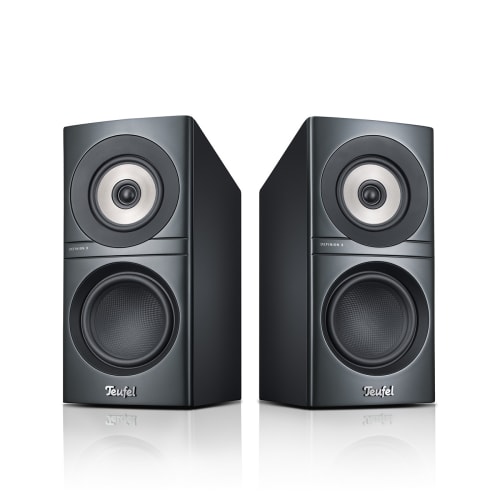
Looks like the Teufel Definition 3S
I would like to see a full black version (satin)
PS : my humble opinion > avoid any yellow woofers


Attachments

  • Capture+_2026-11-02-18-07-54.png
    Capture+_2026-11-02-18-07-54.png
    467.1 KB · Views: 25
Here's a sneak peek at our nearly finalized M0503, featuring a 5-inch woofer, a 3-inch coaxial midrange/tweeter with aramid fiber cones, a wooden cabinet, and an aluminum front baffle.
We're considering black, white, and natural wood finishes. For the wood version, we're still debating between a black or silver aluminum front baffle.
We'd love to hear what the community thinks. Which would you prefer?
View attachment 568945View attachment 568947View attachment 568948

Pay careful attention to the inside cutout for the coaxial speaker. You may need to chamfer it. See Troels' great post here:
 
Pay careful attention to the inside cutout for the coaxial speaker. You may need to chamfer it. See Troels' great post here:
I'd be surprised if that makes much of a difference for a 'normal' baffle thickness, but it doesn't add too much extra cost to manufacturing, so might as well go fancy with it. Just leave some pegs for the screws to bite into, like what I did on my Bordeaux project :)

lDhCRVD.jpg
 
Pay careful attention to the inside cutout for the coaxial speaker. You may need to chamfer it. See Troels' great post here:
Thanks for pointing this out! That's a great reminder, especially with our coaxial design. We'll take a closer look at the rear cutout and make sure to account for this before finalizing the enclosure. Really appreciate you sharing Troels' article!!!
 
I'd be surprised if that makes much of a difference for a 'normal' baffle thickness, but it doesn't add too much extra cost to manufacturing, so might as well go fancy with it. Just leave some pegs for the screws to bite into, like what I did on my Bordeaux project :)

lDhCRVD.jpg
Thanks for the suggestion! It looks like the image in your Bordeaux project post isn't showing up on my end. Would you mind sharing it again?
1793646482855.png
 
I'd be surprised if that makes much of a difference for a 'normal' baffle thickness, but it doesn't add too much extra cost to manufacturing, so might as well go fancy with it. Just leave some pegs for the screws to bite into, like what I did on my Bordeaux project :)

lDhCRVD.jpg

It's especially important with smaller drivers which have a smaller cutout diameter and a higher relative baffle thickness compared to basket size. IOW, it matters more than you think; especially for small drivers. I've measured this literally over 100 times building speakers and pods over the last 15 years. I didn't realize it was an issue until I read Troels' site back around 2010 or so. Before then there was no telling how many speakers I could have improved by simply adding a chamfer to the rear of the driver cutout.
 
I think it is great that Sovox Audio supported testing your new speaker by ASR!

I think some of your employee profiles might register as "Audio Company." It does not affect also being a "Forum Donor" or contributing to all ASR topics.
 
Here's a sneak peek at our nearly finalized M0503, featuring a 5-inch woofer, a 3-inch coaxial midrange/tweeter with aramid fiber cones, a wooden cabinet, and an aluminum front baffle.
We're considering black, white, and natural wood finishes. For the wood version, we're still debating between a black or silver aluminum front baffle.
We'd love to hear what the community thinks. Which would you prefer?
View attachment 568945View attachment 568947View attachment 568948
If you would ask my wife: all black ...
 
PS : my humble opinion > avoid any yellow woofers
Additionally: avoid any orangoid surrounding too (see Palmer thread) to avoid unnecessary discussions.
 
Looks like the Teufel Definition 3S
I would like to see a full black version (satin)
PS : my humble opinion > avoid any yellow woofers

I would prefer silver.
As to yellow woofers: I am in 100% agreement with @daniboun!
 
Why is the horizontal directivity slightly wonky on the negative and positive sides? The speaker looks absolutely symmetrical. Maybe I'm missing something here.

I love the aluminium extrusion design and integrated invisible PR. Really awesome little desktop speaker. Probably could be improved with generous side roundovers but this would likely be much more expensive to machine.

At £250 per speaker I personally think the value is there. The people comparing these to similarly priced but much larger speakers are completely missing the point in my opinion. A speaker should be compared to another of similar size and value. Of course an 8" woofer in a 15L enclosure produces more bass than a 3" woofer in a much smaller enclosure, this shouldn't really be shocking to anyone.
 
  • Like
Reactions: EJ3
Back
Top Bottom