• Welcome to ASR. There are many reviews of audio hardware and expert members to help answer your questions. Click here to have your audio equipment measured for free!

SOVOX Minimax3 Monitor Review

Rate this monitor:

  • 1. Poor (headless panther)

    Votes: 2 1.6%
  • 2. Not terrible (postman panther)

    Votes: 64 52.5%
  • 3. Fine (happy panther)

    Votes: 47 38.5%
  • 4. Great (golfing panther)

    Votes: 9 7.4%

  • Total voters
    122
I realize most people would probably consider my choice as being in a different market niche altogether, but if I had between $600-700 to spend on a stereo system, rather than bite on this I'd go for the Ascend Acoustics CBM-170SE2 and the Fosi BT20A, and maybe run it off whatever DAC I had lying around even if it was just the DAC in my phone.

Thanks for the nice review, Amir.
 
Would that difference in diffraction be limited to 900-1700Hz though, with no effect above or below that?


That much is clear from the directivity above 2kHz shifting slightly in the GIF.


That'd be my guess as well.

Curious if @Gary_SOVOX or @Fisher_Sovox Audio have a comment on this.
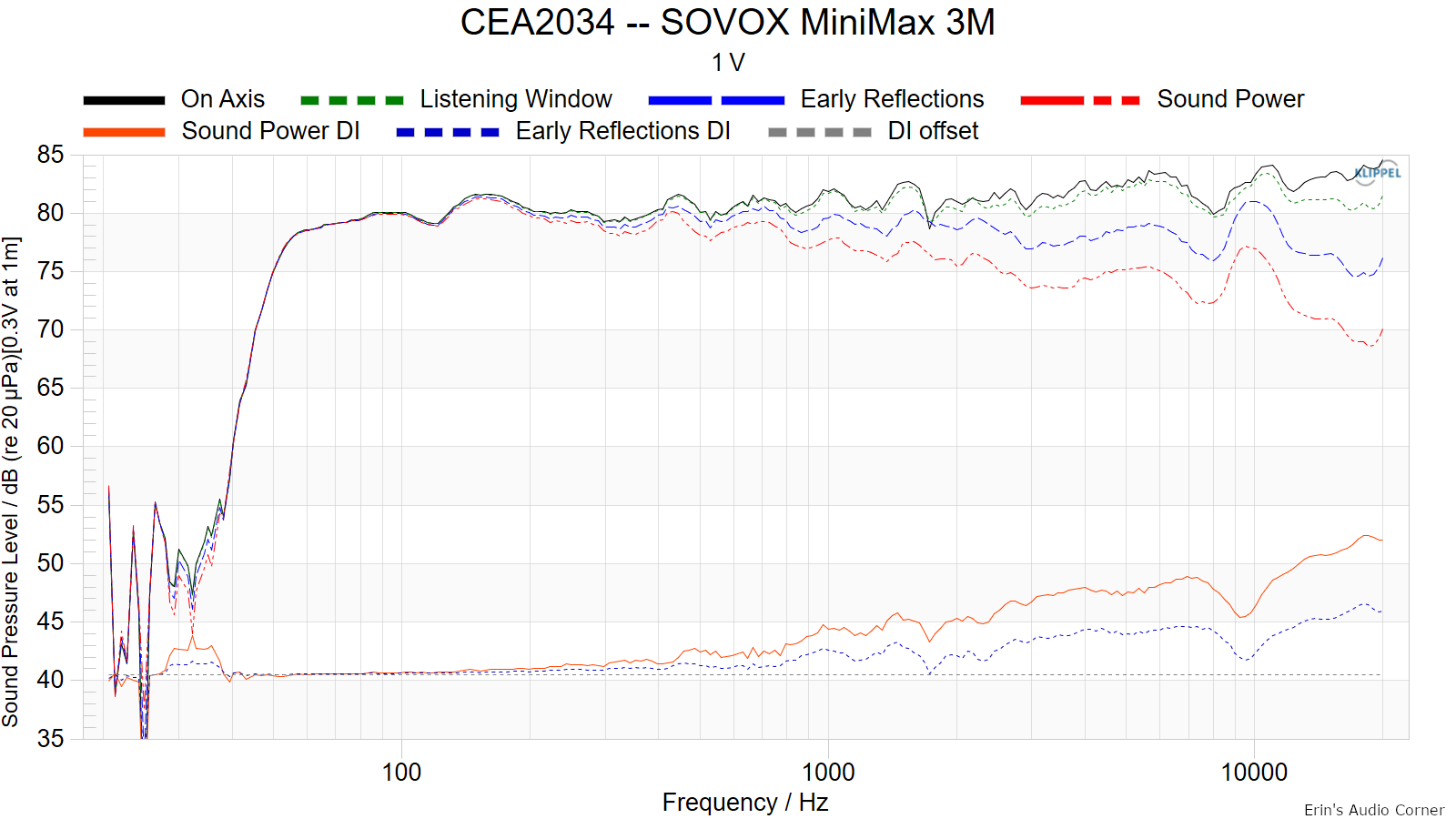
Here is a comparison of Amir's measurements and Erin's (source: link to Erin's review). Look at the region of 1 - 1.8 kHz in Amir's measurements, which was where the asymmetry showed up. The sound power and early reflection curves showed some problems with Amir's review sample, which were absent in Erin's. I suspect there are some quality issues with Amir's sample. (I hope the couple of dB difference in the test levels is not the cause.)

index.php

CEA2034-SOVOX-MiniMax-3M.png
 
Look at the region of 1 - 1.8 kHz in Amir's measurements, which was where the asymmetry showed up. The sound power and early reflection curves showed some problems with Amir's review sample, which were absent in Erin's. I suspect there are some quality issues with Amir's sample. (I hope the couple of dB difference in the test levels is not the cause.)
There is indeed a major acoustic event there. However, you wouldn't know that from that comparison. Erin's measurement is smoother than mine so doesn't show that detail.
 
(I hope the couple of dB difference in the test levels is not the cause.
That's an artifact. For powered speakers, Klippel NFS doesn't know the gain so produces wrong results unless you manually tune that (which I did but not sure of Erin's).
 
Hi @Gary_SOVOX and @Fisher_Sovox Audio,
many thanks for joining the thread and explaining your design choices. We can all learn from each other here at ASR, and I appreciate your candour. As a reformed oboeist, I love to hear that a music graduate is involved in sound reproduction: a perfect fit.

Good luck on your endeavours.
Thank you fordiebianco!
 
This is a very tiny speaker, perhaps a good target is as a computer desktop speaker. There the listening distance might be half a meter. The coaxial design has value at a close listening distance.
Who is the intended customer, what is the channel and retail positioning?

It would be interesting to see the resonances.

They spent money on the passive radiator, it would have been better I think to ship a pair with a subwoofer. The aluminum enclosure is likely expensive. Do Chinese customers especially value a "unibody aviation-grade aluminum" enclosure in their buying decision? Back in the day of CRT monitors there was an argument for metal shielding between the speakers and the CRT. Not a concern today.

The whole design, analog in, DSP, price, then all the rest of the product decisions are puzzling.

I guess with a small speaker, they economize on shipping volume.
Thanks for the thoughtful questions. You’ve described the target exactly: the MiniMax3 is a desktop speaker for near-field listening, sitting beside a large monitor at around half a meter, which is precisely where a coax earns its keep. Our current market focus is North America and Europe, through our own DTC store, Amazon, and distributors, and the intended customer is someone who wants a compact pair that sounds right up close and looks good on a modern desk.

On the passive radiator: a sub is a valid route, but a lot of desktop users don’t have room for, or simply don’t want, a sub under the desk, so we wanted the pair to stand on its own. A passive radiator system is effectively a fourth-order alignment, much like a vented box but not exactly (the suspension differs), and getting the tuning right in an enclosure this small took us a fair amount of work.

On the aluminum: it isn’t about shielding. Part of it is stiffness, with butyl damping on the inner walls to keep the panel resonances you mentioned under control, and part of it is simply design. A desktop speaker sits right in front of you all day, so we think how it looks and feels matters too. And while the speaker is small, the metal makes it heavy, so the shipping savings are smaller than you might expect.
 
Would that difference in diffraction be limited to 900-1700Hz though, with no effect above or below that?


That much is clear from the directivity above 2kHz shifting slightly in the GIF.


That'd be my guess as well.

Curious if @Gary_SOVOX or @Fisher_Sovox Audio have a comment on this.
Thanks for the ping static. I don’t think the cutout is the main cause. The cabinet geometry is identical on every unit, so if the cutout were shaping the pattern around the crossover, our own measurements of the MiniMax3 would show the same asymmetry, and they don’t. The cutout is also small relative to the wavelengths at 1–2 kHz, sits well below the coax, and is angled toward the floor, so its effect on the horizontal plane should be minor.

Since the midrange and tweeter share the same axis in a coax, the horizontal pattern through the crossover should in principle be symmetric. My best guess is a slight offset in the reference axis during the measurement, which would also fit the small shift you noticed above 2 kHz in the GIF. We can’t rule out some sample variation around the crossover on this particular unit either. For comparison, take a look at our own horizontal directivity measurement on website. Thanks for your attention!
 
Would that difference in diffraction be limited to 900-1700Hz though, with no effect above or below that?


That much is clear from the directivity above 2kHz shifting slightly in the GIF.


That'd be my guess as well.

Curious if @Gary_SOVOX or @Fisher_Sovox Audio have a comment on this.
As for the slight asymmetry, we don't think the angled cut on the right side of the cabinet is the main cause, since it's located near the bottom of the cabinet, close down to the woofer, and faces downward. We wouldn't expect it to significantly affect the coaxial driver's directivity.

We think it's more likely related to slight variations in driver alignment during assembly or differences in measurement conditions with this particular sample.

We haven't observed similar behavior in our previous internal measurements, and we've already started testing units from our recent production batches to see if the same issue appears.
Fisher
Sovox
 
This is a very tiny speaker, perhaps a good target is as a computer desktop speaker. There the listening distance might be half a meter. The coaxial design has value at a close listening distance.
Who is the intended customer, what is the channel and retail positioning?

It would be interesting to see the resonances.

They spent money on the passive radiator, it would have been better I think to ship a pair with a subwoofer. The aluminum enclosure is likely expensive. Do Chinese customers especially value a "unibody aviation-grade aluminum" enclosure in their buying decision? Back in the day of CRT monitors there was an argument for metal shielding between the speakers and the CRT. Not a concern today.

The whole design, analog in, DSP, price, then all the rest of the product decisions are puzzling.

I guess with a small speaker, they economize on shipping volume.

You’ve made some really good observations, and these are exactly some of the trade-offs we faced with the MiniMax3. Our original goal was to create a compact desktop nearfield monitor, bringing a three-way coaxial design to the 3-inch speaker market while getting as much performance as possible from such a small enclosure.

But as you pointed out, that came at a cost. The passive radiator system was particularly challenging to develop, and while it pushed our engineering team to learn a lot, placing it underneath the aluminum cabinet also brought additional challenges with desk reflections, resonances, and tuning. As for the aluminum enclosure, we added internal damping to control resonances, but aesthetics were also part of the decision. We wanted something that sounded good and looked good on a desk. We also thought it could work well as height speakers in smaller home Dolby Atmos setups.

Regarding pricing, our original target was actually $500 per pair. But this was our first step from professional audio manufacturing into the consumer market. Despite our engineering experience, we underestimated some of the development and manufacturing costs, and didn't have enough market feedback early on. Looking back, we've learned that a technically interesting design isn't always the most sensible choice for a particular price point.

The MiniMax3 has taught us a lot, and feedback from this community is helping us understand what really matters to customers. For future products, we hope to focus more of our budget on sound performance while keeping prices more reasonable. Really appreciate you taking the time to share your thoughts!

Fisher
SOVOX
 
a specific reason to lean toward the MA1207P series rather than a TPA325X ?
These are completely different microchips with different approaches to conversion. Due to their advantages, the MA12070 microchips run much cooler than even their direct analog, the TPA3116. Not to mention the much more powerful TPA3255. In PMP2 mode they also have much lower distortion without PFFB. Therefore, they don't particularly need PFFB. Therefore, for use in small packages, the MA12070 microchips are unrivaled.
 
Thanks for the suggestion, the JAB6 is a very capable module and a great option for DIY builds. For the M series we went a step further: the amplifiers are our own in-house PFFB design, with GaN output devices. We are getting closer to global launch. Regarding PFFB, an active design where each driver gets its own amplifier channel and the impedance curves aren’t steep, PFFB doesn’t make a big difference though.

Thanks for the feedback
You mean a discrete GaN transistor or a GaN chip amp ?
 
Some interesting things going on in this spinorama.
1793525417225.png


Flattening the LW and bumping up the bass a bit gets us here:
1793525453894.png


A closer look at the listening window:
1793525142857.jpeg

Curious what people are going to come up for EQ and what kind of voicing/PEQ options you have with the current DSP implementation.

#SOVOX Minimax3 LW EQ Ype
Preamp: -1.5 dB
Filter 1: ON PK Fc 50.00 Hz Gain 1.5 dB Q 0.500
Filter 2: ON PK Fc 735.00 Hz Gain -1.0 dB Q 7.500
Filter 3: ON PK Fc 1040.00 Hz Gain 1.5 dB Q 5.000
Filter 4: ON PK Fc 1530.00 Hz Gain -2.5 dB Q 6.000
Filter 5: ON PK Fc 5825.00 Hz Gain -1.5 dB Q 3.000

I would expect filter 1, 4 and 5 to be the most audible, where filter 1 also impacts the overal tonality.
I prefer a bit more bass, especially in speakers that don't go as low and I have to cut the gain anyways.

Really appreciate the community interactions @Fisher_Sovox Audio and @Gary_SOVOX.
Thank you so much!

Edit: Took another look after I had my coffee, this should be correct now.
 

Attachments

Last edited:
You’ve made some really good observations, and these are exactly some of the trade-offs we faced with the MiniMax3. Our original goal was to create a compact desktop nearfield monitor, bringing a three-way coaxial design to the 3-inch speaker market while getting as much performance as possible from such a small enclosure.

But as you pointed out, that came at a cost. The passive radiator system was particularly challenging to develop, and while it pushed our engineering team to learn a lot, placing it underneath the aluminum cabinet also brought additional challenges with desk reflections, resonances, and tuning. As for the aluminum enclosure, we added internal damping to control resonances, but aesthetics were also part of the decision. We wanted something that sounded good and looked good on a desk. We also thought it could work well as height speakers in smaller home Dolby Atmos setups.

Regarding pricing, our original target was actually $500 per pair. But this was our first step from professional audio manufacturing into the consumer market. Despite our engineering experience, we underestimated some of the development and manufacturing costs, and didn't have enough market feedback early on. Looking back, we've learned that a technically interesting design isn't always the most sensible choice for a particular price point.

The MiniMax3 has taught us a lot, and feedback from this community is helping us understand what really matters to customers. For future products, we hope to focus more of our budget on sound performance while keeping prices more reasonable. Really appreciate you taking the time to share your thoughts!

Fisher
SOVOX
I'm a former product manager. I think you have done some things well, the premium woven carbon fiber cone look, coaxial, industrial design. The desktop/laptop speaker space is crowded and competitive. I would suggest, beyond what I have said, move the knob and display to the front - they are expensive parts which no one sees on the back. With a display, consider adding a real time spectrum, like the RME ADI-2. I would say your greatest opportunities would be digital-in only, reducing costs, and positioning the speaker as a complement to aluminum case laptops, which tend to run premium. If you want to innovate, figure out how to do room EQ at the desktop listener position more elegantly than a UMIC. Maybe through a gaming headset microphone? Prior art as now suggested on ASR. KEF does a great job at small coaxials which can be used on desktops.
 
Last edited:
It's definitely overbuilt and overpriced for what it is. Don't get me wrong, the price is justified by the materials, drivers, it looks premium, a lot of drivers, nice enclosure. It's not a rip-off. But when assessing the result, is it worth it? I'd rather take a 7 times cheaper Edifier MR4. It measures about the same, a little better in some respects, a little worse in others. The directivity of the coaxial (combined with the enclosure, I guess) is quite messy.

What I think would have been a much better choice is a version of this with a 5 inch woofer, a larger enclosure, a way to correct the dispersion (waveguide for the little coaxial, which would fit in a wider box, maybe rounded edges, I don't know what works). A 3.5 inch I think isn't enough even for desktop and if let's say it is, definitely not at this price point. This thing has potential as something like a KEF R3 Concerto, but smaller, somewhere in the middle point between R3 and this. The aluminium enclosure would give it a premium feel and also the advantage of thinner walls (and overall dimensions). You have to do at least 90dB to be taken seriously and not be considered a toy. Toys are fun, too (I have a MR4 pair, too), but at a completely different price point.
 
I'm a former product manager. I think you have done some things well, the premium woven carbon fiber cone look, coaxial, industrial design. The desktop/laptop speaker space is crowded and competitive. I would suggest, beyond what I have said, move the knob and display to the front - they are expensive parts which no one sees on the back. With a display, consider adding a real time spectrum, like the RME ADI-2. I would say your greatest opportunities would be digital-in only, reducing costs, and positioning the speaker as a complement to aluminum case laptops, which tend to run premium. If you want to innovate, figure out how to do room EQ at the desktop listener position more elegantly than a UMIC. Maybe through a gaming headset microphone? Prior art as now suggested on ASR. KEF does a great job at small coaxials which can be used on desktops.

You forgot to include an important feature of desktop/studio monitors:
  • Front-facing 1000 lumen LED that you can't turn off.
 
Thanks for the thoughtful questions. You’ve described the target exactly: the MiniMax3 is a desktop speaker for near-field listening, sitting beside a large monitor at around half a meter, which is precisely where a coax earns its keep. Our current market focus is North America and Europe, through our own DTC store, Amazon, and distributors, and the intended customer is someone who wants a compact pair that sounds right up close and looks good on a modern desk.

On the passive radiator: a sub is a valid route, but a lot of desktop users don’t have room for, or simply don’t want, a sub under the desk, so we wanted the pair to stand on its own. A passive radiator system is effectively a fourth-order alignment, much like a vented box but not exactly (the suspension differs), and getting the tuning right in an enclosure this small took us a fair amount of work.

On the aluminum: it isn’t about shielding. Part of it is stiffness, with butyl damping on the inner walls to keep the panel resonances you mentioned under control, and part of it is simply design. A desktop speaker sits right in front of you all day, so we think how it looks and feels matters too. And while the speaker is small, the metal makes it heavy, so the shipping savings are smaller than you might expect.
A sub of any reasonable stature (for it to actually be a SUB) is a bit of a pain when it is where your feet are under a desk.
That is my current desk setup (and I like it, as I have made the adjustments that accommodate me, which are probably not what others would do.
 
While I like its approach being a very compact 3-way desktop loudspeaker it costs almost double than for example the ADAM Audio D3V which doesn't measure worse and plays even deeper and a bit louder, EAC had measured both in the past:

View attachment 568388


My son and his girlfriend are both music producers. He's at the front end assisting artists with song writing and recording using a pair of Adam A7x speakers that he bought recently for A$800, about US$550. She is making use of my 12 year old Adam A7 for finishing off the process at the mixing and mastering stages. Both very happy with the Adams.
 
And oh, as i noted, I measured the speaker by tilting it down so that its face is 90 degrees to the microphone. I don't know if Erin has done that.

The reference z-axis is wrt to the speaker baffle angle in my measurements. I don't recall the angle... maybe 4 degrees? Whatever it was, the klippel measurement process is accounting for it in my measurements.


The ~1kHz measurements in yours looks to be a measurement artifact. I've run into this before with other speakers; I think . But sometimes it was a legitimate issue with the speaker's panel vibrating. No way to know for sure without diving into it. Not worth the effort on your part since my measurements already exist.


Edit: Yep, 4 degrees.

1793571152916.png
 
What I think would have been a much better choice is a version of this with a 5 inch woofer, a larger enclosure, a way to correct the dispersion (waveguide for the little coaxial, which would fit in a wider box, maybe rounded edges, I don't know what works).
I'm guessing the designers elected against these best practices you've listed specifically because it would result in a very same-y product in a very, very competitive and crowded field. You've got dozens of pro-audio brands selling the larger enclosure design, some with similar/better spins and similar/lower prices than the Minimax3; you've also got many consumer options (Kanto, Audioengine) with aesthetics, lower prices, and DTC sales.

If you're an unknown brand, your product needs to strongly differentiate in this segment.

Given the price, if you are looking for 3-way desktop speakers, the IK Multimedia iLoud MTM MKII seem to me to be much higher-performing.
I think the iLoud MTM (not a 3-way, btw) is a very apt comparison given the (seemingly) primary value proposition of enclosure width. It has the same price direct-to-consumer, same bass extension, DSP, and is slightly wider. The Minimax3 then distinguishes via co-ax and no port, which are very prominently advertised on its product page.
 
Back
Top Bottom