This is a review, listening tests/EQ and detailed measurements of SOVOX Minimax3 3-way coaxial speaker with passive radiator. It was donated to me by the company and costs US $325 each.

This is one stout metal enclosure with so much stuffed in it. It has an integrated stand as you see and at the bottom, there is a down firing passive radiator. The top driver is coaxial midrange+tweeter.
Back side impressed me with rather clear menus on the small display:

I tested the unit in "Free standing" setting.
I like that despite being so small, the power supply is built-in and we have XLR inputs indicating it is truly a "monitor" as opposed to "PC Speaker."
Note: I tilted the speaker back fare enough for measurements so that the front was 90 degrees to reference plane of the measurement system.
SOLVOX MINIMAX³ Monitor Speaker Measurements
As usual we start with our anechoic family of frequency response measurements as computed by Klippel NFS:

Macro level view shows rather flat response from 50 Hz all the way to nearly 20 kHz. There are however, many micro deviations with some bunching up between 1 and 2 kHz. Directivity is variable which naturally hurts early window response and predicted in-room:


Slope is rather flat as well indicating likely bright sounding. But note that the last two graphs are statistical in nature and apply to far field listening.
Directivity as noted is somewhat uneven:


But coaxial nature gives you somewhat similar vertical and horizontal response.
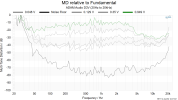
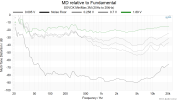
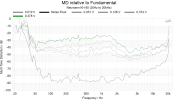
The highest level distortion I could dare to run was 91 dBSPL:


Step response for fans of that:

SOVOX Minimax3 Speaker Listening Tests and EQ
First impression was rather bland here. Not because the Minimax3 is bad but rather, its max performance right below the bar at which my reference tracks shine. Cranking up the volume I wanted would cause the red clipping light to come on. At lower levels, bass was too faint, taking away dynamics.
Looking at the response, I initially just dialed a high shelf above 1 kHz to bring the highs down. This gave me a much needed warmth in exchange for some air and detail. I liked it better but wanted to see if a machine generated one would do better. So I asked ChatGPT Pro to create 4 PEQ filters with only one decimal place. It created this:
Preamp: −5.0 dB
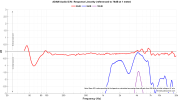
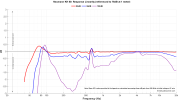
Its pre/post graph (zoomed) looks like this:

I wish it had taken down the peak around 1.5 kHz but maybe it stopped because I told it only 4 filters. What it produced was inverse of mine in the way it boosted the lows. It also made small, localized corrections. The result was better than mine, with more subjective detail than my crude single filter.
With this filter in place, the threshold of performance went up high enough that now I could enjoy some of my tracks. There was just enough bass to have a somewhat even spectrum.
Wanting to know what a size up speaker would do, I swapped in the Neumann KH80 DSP ($595). The transformation was massive with the Neumann getting substantially louder, with fuller bass and wider spatial image.
Conclusions
From engineering point of view, there is a ton here stuffed in a low cost, but not cheap package. We have DSP, 3-way, coaxial design with passive radiator, built-in stand and power supply. I am left though thinking if fewer components but at higher level would have done better. As is, the minimax3 really needs a subwoofer to be usable. Fortunately with some EQ, you can pull its performance high enough that it becomes good enough by itself.
Anyway, it is nice to test such an unusual speaker.
-----------
As always, questions, comments, recommendations, etc. are welcome.
Any donations are much appreciated using: https://www.audiosciencereview.com/forum/index.php?threads/how-to-support-audio-science-review.8150/
This is one stout metal enclosure with so much stuffed in it. It has an integrated stand as you see and at the bottom, there is a down firing passive radiator. The top driver is coaxial midrange+tweeter.
Back side impressed me with rather clear menus on the small display:
I tested the unit in "Free standing" setting.
I like that despite being so small, the power supply is built-in and we have XLR inputs indicating it is truly a "monitor" as opposed to "PC Speaker."
Note: I tilted the speaker back fare enough for measurements so that the front was 90 degrees to reference plane of the measurement system.
SOLVOX MINIMAX³ Monitor Speaker Measurements
As usual we start with our anechoic family of frequency response measurements as computed by Klippel NFS:
Macro level view shows rather flat response from 50 Hz all the way to nearly 20 kHz. There are however, many micro deviations with some bunching up between 1 and 2 kHz. Directivity is variable which naturally hurts early window response and predicted in-room:
Slope is rather flat as well indicating likely bright sounding. But note that the last two graphs are statistical in nature and apply to far field listening.
Directivity as noted is somewhat uneven:
But coaxial nature gives you somewhat similar vertical and horizontal response.
The highest level distortion I could dare to run was 91 dBSPL:
Step response for fans of that:
SOVOX Minimax3 Speaker Listening Tests and EQ
First impression was rather bland here. Not because the Minimax3 is bad but rather, its max performance right below the bar at which my reference tracks shine. Cranking up the volume I wanted would cause the red clipping light to come on. At lower levels, bass was too faint, taking away dynamics.
Looking at the response, I initially just dialed a high shelf above 1 kHz to bring the highs down. This gave me a much needed warmth in exchange for some air and detail. I liked it better but wanted to see if a machine generated one would do better. So I asked ChatGPT Pro to create 4 PEQ filters with only one decimal place. It created this:
| Filter | Type | Frequency (Hz) | Gain (dB) | Q |
|---|---|---|---|---|
| 1 | Peaking | 259.0 | +1.1 | 0.8 |
| 2 | Peaking | 1088.0 | +2.6 | 4.7 |
| 3 | Peaking | 7925.0 | −1.0 | 0.5 |
| 4 | Peaking | 9810.0 | +2.5 | 3.5 |
Its pre/post graph (zoomed) looks like this:
I wish it had taken down the peak around 1.5 kHz but maybe it stopped because I told it only 4 filters. What it produced was inverse of mine in the way it boosted the lows. It also made small, localized corrections. The result was better than mine, with more subjective detail than my crude single filter.
With this filter in place, the threshold of performance went up high enough that now I could enjoy some of my tracks. There was just enough bass to have a somewhat even spectrum.
Wanting to know what a size up speaker would do, I swapped in the Neumann KH80 DSP ($595). The transformation was massive with the Neumann getting substantially louder, with fuller bass and wider spatial image.
Conclusions
From engineering point of view, there is a ton here stuffed in a low cost, but not cheap package. We have DSP, 3-way, coaxial design with passive radiator, built-in stand and power supply. I am left though thinking if fewer components but at higher level would have done better. As is, the minimax3 really needs a subwoofer to be usable. Fortunately with some EQ, you can pull its performance high enough that it becomes good enough by itself.
Anyway, it is nice to test such an unusual speaker.
-----------
As always, questions, comments, recommendations, etc. are welcome.
Any donations are much appreciated using: https://www.audiosciencereview.com/forum/index.php?threads/how-to-support-audio-science-review.8150/
Attachments
Last edited:


 That was a cool speaker.