
• Welcome to ASR. There are many reviews of audio hardware and expert members to help answer your questions. Click here to have your audio equipment measured for free!

Some subjective thoughts about Hiby MSEB

TuneInSoul

Member
Joined
Sep 20, 2018
Messages
81
Likes
8
Because English is not my first language,I hope you can understand it.
To me, low means frequency under 150hz, mid means 150hz to 5khz, high means 5khz to 10khz,
extreme high means 10khz above.
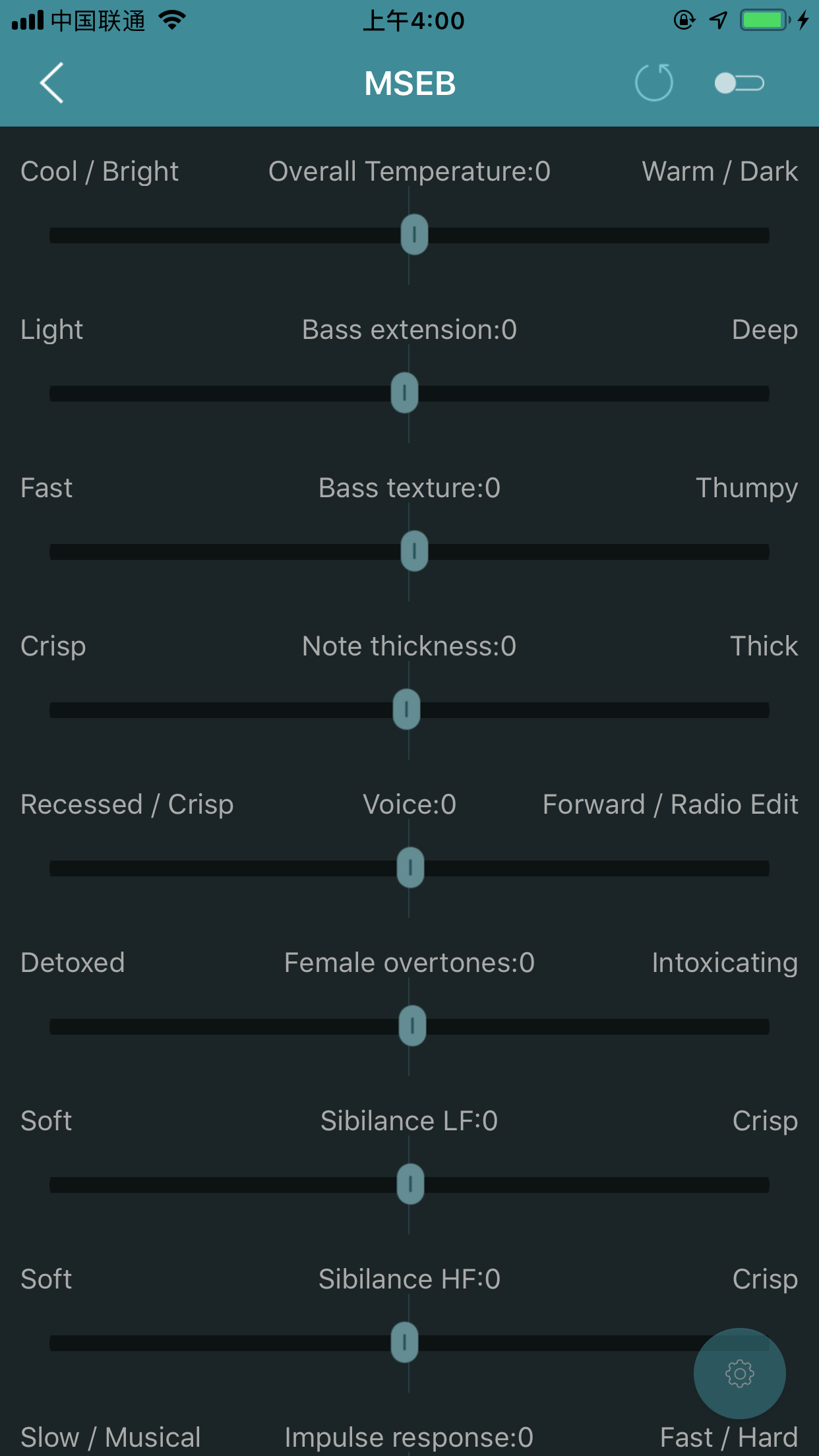
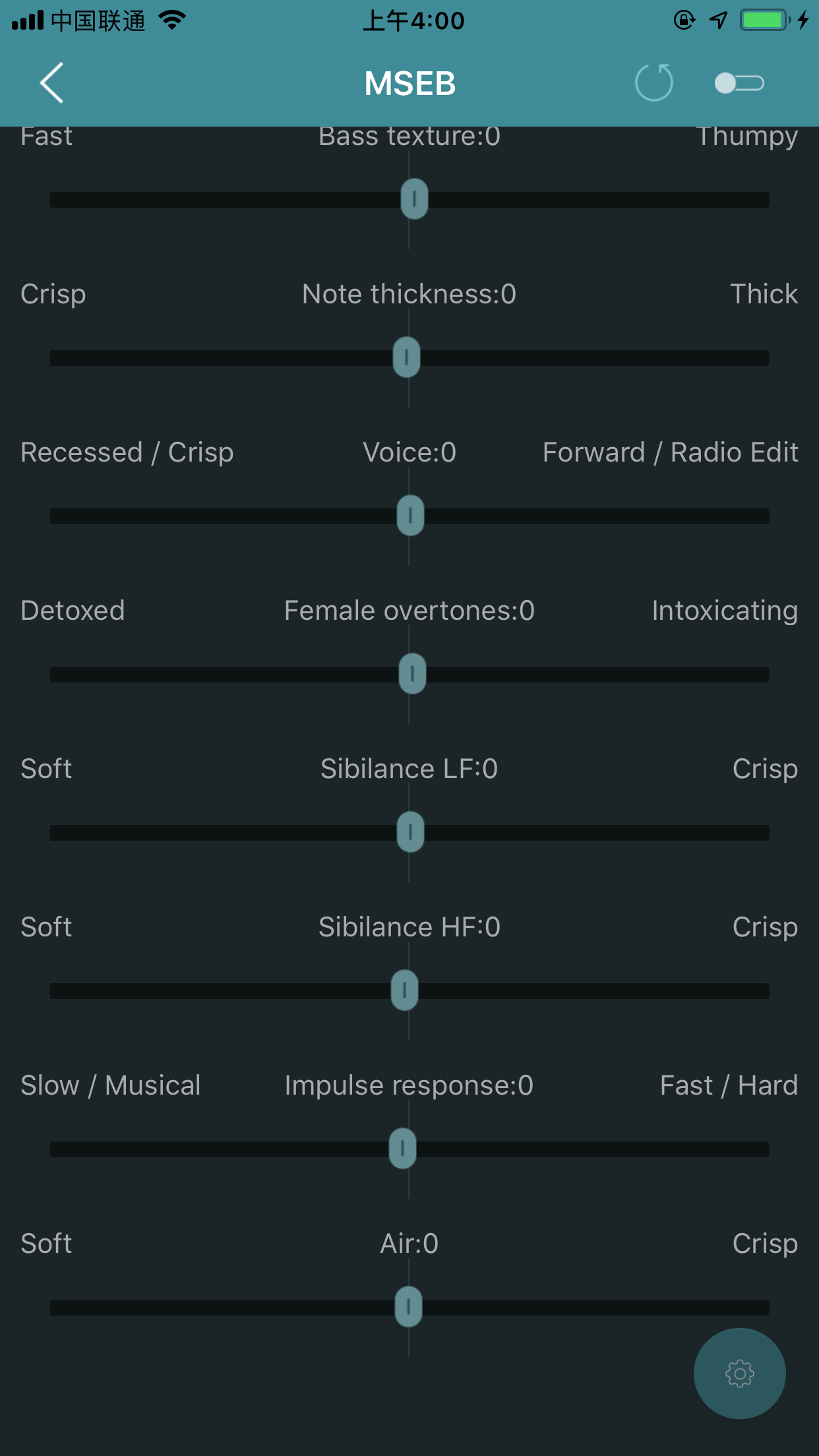
Mseb has 10 options.
1. Overall Temperature : this option increases low and a part of mid( maybe below 2K)when slide left to right.
2. Bass extension :this increases or decreases sub low(maybe mainly below 50hz).
3. Bass texture : this increases or decreases mid low(mainly around 80hz maybe)
4. Note thickness: I think thick means increasing something range from 1khz to 2kHz for female voice and crisp means increasing something range from 3khz to 5kHz for female voice.
5. Voice : this increases or decrease mid.
6. Female overtones : female voice will become sweet when this option is intoxicating.
7 and 8 Sibilance : affects sibilance.
9 Impulse response : I found the female voice wet when this option is fast/hard. It is hard to describe it in English.
10 Air: changes the high and extreme high.
EA20F492-11B2-4B31-B6CD-94C7AEC198E7.png
28D0825D-0013-44D7-871C-6B6973C3482A.png
 
Does anyone know what MSEB is actually doing. Hiby states:

'MSEB (Mage Sound 8-ball Tuning) based on parametric equalizer (PEQ) and sound filed adjustment'

What does 'sound filed' mean?
 
Does anyone know what MSEB is actually doing. Hiby states:

'MSEB (Mage Sound 8-ball Tuning) based on parametric equalizer (PEQ) and sound filed adjustment'

What does 'sound filed' mean?
maybe it is a spelling mistake,sound field is correct?
 
Are you happy with MSEB in lieu of normal EQ?
Neither EQ nor MSEB I use when I listen to music,I only try MSEB to study, I think MSEB can help to share my sound impressions with others easily.
 
MageSound 8-ball (MSEB):

1 -- Overall Temperature is a tilt of the whole line towards treble (cool) or bass (warm)
2 -- Bass extension 70Hz and below
3 -- Bass texture 100Hz (medium)
4 -- Note thickness 200Hz (wide)
5 -- Vocals 650Hz (very wide)
6 -- Female overtones 3kHz (tight)
7 -- Sibilance LF 5.8kHz (medium)
8 -- Sibilance HF 9.2kHz (medium)
9 -- Impulse response 7.5kHz (very wide)
10 - Air 10kHz sloped all the way to 20kHz
 
Last edited:
MageSound 8-ball (MSEB):

1 -- Overall Temperature is a tilt of the whole line towards treble (cool) or bass (warm)
2 -- Bass extension 70Hz and below
3 -- Bass texture 100Hz (medium)
4 -- Note thickness 200Hz (wide)
5 -- Vocals 650Hz (very wide)
6 -- Female overtones 3kHz (tight)
7 -- Sibilance LF 5.8kHz (medium)
8 -- Sibilance HF 9.2kHz (medium)
9 -- Impulse response 7.5kHz (very wide)
10 - Air 10kHz sloped all the way to 20kHz
Is this your opinion or the official's?
Did you test it in pro device?
How did you make it so accurately?
Due to the difference between our viewpoints,I will check it according to your words.
I am not an expert, just an audiophile,and enjoy discuss it with others,thank you for sharing this.
 
Is this your opinion or the official's?
Did you test it in pro device?
How did you make it so accurately?
Due to the difference between our viewpoints,I will check it according to your words.
I am not an expert, just an audiophile,and enjoy discuss it with others,thank you for sharing this.

its official, its by the guy who created it, who works at hiby. he released it may 2 2022

personally i think its good to release the exact frequency information because the MSEB can be confusing to the point of being useless. so spam the information all over the whole internet as much as possible. hiby OS is on hiby, hidizs and android devices

so for my first gen sony mdr-100a headphones i dropped bass texture by 13% and i raised female overtones by 13%. in attempt to correct its sound signature

to me it sounds better with these two mseb adjustments. i would have also dropped 'impulse response' as well to handle that 8khz spike but impulse response is set to very wide so its not tight enough to pull the 8khz spike down without also pulling down the lower parts around it

1660396537212.png


he also says:

based on a parametric EQ:

Overall Temperature is a tilt of the whole FR line towards treble (cool) or bass (warm) Think of it as keeping the FR a straight line on a dB to log frequency plot but turning it clockwise or anticlockwise.

Bass extension is a critically damped parametric low shelf at 70Hz and below.

Air is a critically damped parametric high shelf with corner frequency at 10kHz (which should then slope all the way to 20kHz)

The rest are parametric point EQs of varying Q

All the bands are in general wide enough that they blend into and affect each other evenly for you to be able to craft a wide variety of shapes.


Chosen to best capture the corresponding description, rather than taking a regular EQ with evenly spaced out bands of equal Q and trying to describe each band.
 
Last edited:
its official, its by the guy who created it, who works at hiby. he released it may 2 2022

personally i think its good to release the exact frequency information because the MSEB can be confusing to the point of being useless. so spam the information all over the whole internet as much as possible. hiby OS is on hiby, hidizs and android devices

so for my first gen sony mdr-100a headphones i dropped bass texture by 13% and i raised female overtones by 13%. in attempt to correct its sound signature

to me it sounds better with these two mseb adjustments. i would have also dropped 'impulse response' as well to handle that 8khz spike but impulse response is set to very wide so its not tight enough to pull the 8khz spike down without also pulling down the lower parts around it

View attachment 223964

he also says:

based on a parametric EQ:

Overall Temperature is a tilt of the whole FR line towards treble (cool) or bass (warm) Think of it as keeping the FR a straight line on a dB to log frequency plot but turning it clockwise or anticlockwise.

Bass extension is a critically damped parametric low shelf at 70Hz and below.

Air is a critically damped parametric high shelf with corner frequency at 10kHz (which should then slope all the way to 20kHz)

The rest are parametric point EQs of varying Q

All the bands are in general wide enough that they blend into and affect each other evenly for you to be able to craft a wide variety of shapes.


Chosen to best capture the corresponding description, rather than taking a regular EQ with evenly spaced out bands of equal Q and trying to describe each band.
Thank you,I learned a lot.
It's been a long time since the last time I studied EQ,I got a so wrong conclusion about the Note Thickness.And I am very confused now,though I knew the correct answer,I can't get it,the frequencies near 200hz truely affect too much.Maybe next time I should pay attention to a single particular part of the sound only instead ,not the whole sound,also I learned not to be too confident,and don't care too much about the meaning of the word "thickness",because audiophiles around me tend to describe the word "thickness" in Chinese a sound enhanced around 1khz,the stereotype of sound impressions made me go astray.
 
MageSound 8-ball (MSEB):

1 -- Overall Temperature is a tilt of the whole line towards treble (cool) or bass (warm)
2 -- Bass extension 70Hz and below
3 -- Bass texture 100Hz (medium)
4 -- Note thickness 200Hz (wide)
5 -- Vocals 650Hz (very wide)
6 -- Female overtones 3kHz (tight)
7 -- Sibilance LF 5.8kHz (medium)
8 -- Sibilance HF 9.2kHz (medium)
9 -- Impulse response 7.5kHz (very wide)
10 - Air 10kHz sloped all the way to 20kHz
do you have the official link for documentation.
 
There was never any official page put up with the above descriptions documented, but I can confirm as the author that I did give out those descriptions in private.
 
Sorry to necro an old thread, but for anyone else who lands here, PragmaticAudio (@Jeromeof) has some extremely helpful measurements of MSEB here, taken on the Hiby R1 DAP (but I presume this is applicable to MSEB on all HibyOS devices?), which provide a useful visual of the Q-factor/slope for each of the filters. If there's a record of the rough Q-factors anywhere, that would also be very helpful for mapping out EQ profiles on tools like Squig, REW etc...
 
MSEB is an only available on HiBy products (DAPs, HiByMusic) and others using HiBy SW—so, not exactly widely known/used. Although MSEB appears to be nothing more than a set of well-crafted PEQ filters, it is always very well received by audiophiles & influencers who don’t like EQ in general and even hate PEQ sometime...
This is where MSEB has some untapped potential IMO: it could be used to “normalize” the audiophile language. For example, users could express their headphones preference over a target in MSEB terms: 2pt “Warm” for Overall Temperature, 3pt “Fast” for Bass Texture, 1pt “Slow/Musical” for Impulse Response, etc.
Headphones/IEM measurements delta to a reference could also be expressed in MSEB terms, using an AutoEQ-type algorithm combining the MSEB filters to approximate the difference: the end result would be an MSEB preset characterizing this difference in MSEB terms understood/accepted by audiophiles. Add some AI-generated summary and the review is done.

Ok… Time for me to wake up and stop dreaming! :)
 
Agreed. I think MSEB is hugely underrated. In fact the acronym itself is vague and misleading, and probably a massive turnoff for the more analytical gatekeepers that eschew fluff, and that Hiby would benefit from attracting. If you have some phones/IEMs that respond well to EQ, you can achieve some really great, relatively targeted results - especially with the frequency and slope data above to hand. Not "mage" stuff at all... I do wonder, however, how MSEB is implemented under the hood and whether you can "hack" some of these Hiby DAPs and tinker with the frequency and slope of each band. As far as I'm aware, they're based on Linux. Time for me to wake up and stop dreaming too!
 
I do wonder, however, how MSEB is implemented under the hood and whether you can "hack" some of these Hiby DAPs and tinker with the frequency and slope of each band. As far as I'm aware, they're based on Linux.
I think it’s quite obvious, based on @Jeromeof measurements, that MSEB is ‘just’ a set of PEQ filters with predetermined Freq. & Q, the Gain being the MSEB parameter adjustment. The only one I have a doubt is the the “Overall Temperature”: it’s a tilt-type adjustment, I don’t know if it’s a unique DSP effect, or a combination of two very low-Q peak or shelf filters at the lower and upper end of the freq. range.
 
As far as I'm aware, they're based on Linux.
True for HiBy entry-level DAPs (+Tempotec, and a couple of others), but the R-series are Android-based and, HiByMusic for iOS does include MSEB as well. This supports the idea that MSEB is not based on very complex DSP functions…
 
Last edited:
I think it’s quite obvious, based on @Jeromeof measurements, that MSEB is ‘just’ a set of PEQ filters with predetermined Freq. & Q, the Gain being the MSEB parameter adjustment. The only one I have a doubt is the the “Overall Temperature”: it’s a tilt-type adjustment, I don’t know if it’s a unique DSP effect, or a combination of two very low-Q peak or shelf filters at the lower and upper end of the freq. range.
Yes I agree that they were mostly all PEQ filters, but I do love the idea of providing a relatively simple 'subjective' way to create PEQ filters. I was thinking of adding something like this to my devicePEQ tool (but graphically show the filter changes in real-time) as another way to get more people into PEQ.

And yes the overall Temperature was a tilt.
 
Back
Top Bottom