• Welcome to ASR. There are many reviews of audio hardware and expert members to help answer your questions. Click here to have your audio equipment measured for free!

Snake Oil Department, Top This

29722.jpg


https://www.phileweb.com/sp/review/article/202608/31/6648.html (Japanese, but browser translation deals ok with it)

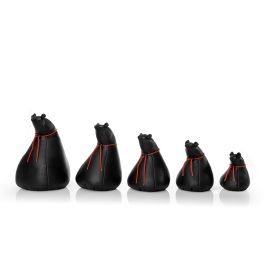
A "mouse statue" filled with magic pixie dust that does something to those evil rays that make your audio sound bad - or something like that. From Entreq, maker of "grounding solutions", so the only surprising thing is that they make the joke that their products always are explicit here.
 
...PS Jah as in Hallelujah. "Praise God"...:cool:
Close --> my rusty understanding of the Rastafari theology is that "Jah" is rooted in the OldTestament, with other biblical-speak in Marley-esque.
English-esque Bibles supposedly translated the Hebrew "Adonai"YHWH to "Lord".
Then, the scholars decided to take the vowel-less YHWH and call it "Jehovah" (Vah bien, merci!).
The --forever-- stoner Marely (RIP) musta abbreviated it to "Jah", because it "rolls" off his tongue easier.
 
as is Hallelujah. Old school Hebrew.
Yeah, yeah, the tetragrammaton. Note to any orthodox folks here, I do, seriously, apologize for using the name;
Protestantism'll do that to you. ;)
Oh, there's a good (well, I like it...), fairly early short story by Arthur C. Clarke called The Nine Billion Names of God.
 
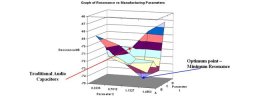
The sonic differences that capacitors introduce into the signal paths are audible and measurable. Perhaps not to the extent that many "audiophiles" proclaim, but, as with ghosts, "I don't believe in them, but they exist."

I still own an old JBL LE14C cabinet; the original crossover capacitors were PIO 6 Mfd. Several years ago, I replaced them with Clarity Capacitors. Instead of 6.0 Mfd, CP manufactures 6.2 Mfd capacitors, so I installed those. After modifying only one of them, I placed the two cabinets in the center of my listening room, with the amplifier in mono, and after prolonged listening to various recordings—alternating between the left and right channels—I came to my conclusion: more detailed midrange and treble, more controlled bass with CP. Better than with the PIO capacitors? That depends on each person's ear and taste. I didn't take any measurements, but I'm not one to doubt Clarity Cap's graphs. And when, after that experience, I built the Troels Gravesen DTQWTII, I chose the capacitor line that best fit my budget. Without hesitation.

 

Attachments

  • esa-graph.jpg
    esa-graph.jpg
    22.1 KB · Views: 33

Electrolytic capacitors age with ripple current which degrades measurable parameters. Special case that deserves attention for audiophiles. I have seen bipolar capacitors in passive speakers deformed from overheating.
 
You're saying the imperfections of some cheap capacitors with regard to impedance are out of the audio band? That could well be. I seem to recall some tiny cheapies not really working optimally for small automotive coaxials but maybe I'm conflating that versus the definitely non ideal tiny inductors. On the gripping hand* don't some other types last longer than cheap electrolytics?

Maybe I can start a company making special capacitors from gold foil plates and only the finest virgin olive oil...

*The Mote in God's Eye
pick capacitors of the correct type, with correct specs - from a reputable source.
These are not going to be the cheap ones with imperfections.

Sure - if the desinger has done a bad job, and designed a poor crossover with crap parts. then it might be possible to redesign it and get an audible improvement. But not by swapping capacitors with "audiophile" versions of the same thing at ten times the price.

Allow me to roll my eyes at this sort of nonsense.

s-l1600.jpg
 
Last edited:
The sonic differences that capacitors introduce into the signal paths are audible and measurable. Perhaps not to the extent that many "audiophiles" proclaim, but, as with ghosts, "I don't believe in them, but they exist."

I still own an old JBL LE14C cabinet; the original crossover capacitors were PIO 6 Mfd. Several years ago, I replaced them with Clarity Capacitors. Instead of 6.0 Mfd, CP manufactures 6.2 Mfd capacitors, so I installed those. After modifying only one of them, I placed the two cabinets in the center of my listening room, with the amplifier in mono, and after prolonged listening to various recordings—alternating between the left and right channels—I came to my conclusion: more detailed midrange and treble, more controlled bass with CP. Better than with the PIO capacitors? That depends on each person's ear and taste. I didn't take any measurements, but I'm not one to doubt Clarity Cap's graphs. And when, after that experience, I built the Troels Gravesen DTQWTII, I chose the capacitor line that best fit my budget. Without hesitation.

So you changed the values ? We have an excellent tread on this forum where one of our members made painstaking efforts the replace capacitors with the exact same values within tight tolerances and then measured the results.

This one referred to by another poster.


Changing values from 6 to 6.2 may be a bigger difference not counting in parasitic effects like ESR or similar ?
Actually changing the circuit is both audible and measurable :)

I would not modify a passive crossover without the means to measure the acoustic output of the speaker before and after.
The original designer may very well countered for all the properties of the chosen components not only catalog values.

Ofcourse i would repair a clearly broken speaker with components with as close match as possible, you have no choice what else to do.
But I would try to match the component values as close as possibly.
 
So you changed the values ? We have an excellent tread on this forum where one of our members made painstaking efforts the replace capacitors with the exact same values within tight tolerances and then measured the results.

This one referred to by another poster.


Changing values from 6 to 6.2 may be a bigger difference not counting in parasitic effects like ESR or similar ?
Actually changing the circuit is both audible and measurable :)

I would not modify a passive crossover without the means to measure the acoustic output of the speaker before and after.
Thee original designer may very well countered for all the properties of the chosen components not only catalog values.

Ofcourse i would repair a clearly broken speaker with components with as close match as possible, you have no choice what else to do.
But I would try to match the component values as close as possibly.
@ctrl did the tests using alligator/crocodile clamps. I tested several of these and at best they provide 0.1 to 0.2 Ohm resistence. In a circuit, this can add up to a significant additional load of 10 to 20 percent (0.4 up to 0.8 Ohm), assuming the DUT is in the range of usual 4 to 8 Ohms.
This might taint the conclusions ...
(Btw. 6.0 or 6.2 mH or µF would do no audible effect, but may look a little smoother, the driver's tolerance variation is much more to look at)
 
So you changed the values ? We have an excellent tread on this forum where one of our members made painstaking efforts the replace capacitors with the exact same values within tight tolerances and then measured the results.
...............
Changing values from 6 to 6.2 may be a bigger difference not counting in parasitic effects like ESR or similar ?
Actually changing the circuit is both audible and measurable :)
.............

I rushed to write this when I saw that the exact 6.0 mfd value of the JBL LX2-1 crossover wasn't listed on Clarity Cap...
Then I remembered that I had actually put two 3.0 mfd capacitors in parallel and achieved the exact 6.0 mfd. I found the local forum where I posted the process, but the photos are gone. My username there was "tanofarabute," but the administrators deleted my photos and changed me to "Guest." I never found out why, nor did I ask for an explanation, because, as they say,

"if you argue with a fool, not only will you fail to convince him, but you'll end up on his level."

 
The --forever-- stoner Marely (RIP) musta abbreviated it to "Jah", because it "rolls" off his tongue easier.
Rastafarianism and the Jamaican use of the name Jah for G_d originated in the 1930s. Bob Marley was born in 1945.
(Deeper still, "Jah" or "Yah" is an abbreviation even appears in the bible a few times...)
 
Last edited:
View attachment 555496

https://www.phileweb.com/sp/review/article/202608/31/6648.html (Japanese, but browser translation deals ok with it)

A "mouse statue" filled with magic pixie dust that does something to those evil rays that make your audio sound bad - or something like that. From Entreq, maker of "grounding solutions", so the only surprising thing is that they make the joke that their products always are explicit here.
Found it. Only $200 and comes in different sizes

From the site: ‘Vibb eaters’ consist largely of our own dedicated copper-based sand mixture with the addition of small quantities of, amongst other things , specific precious metals. The properties of this mixture offers very interesting characteristics, particularly in the areas of magnetic fields, field effects, as well as dealing with physical vibration & surface energy. When you place a ‘Vibb eater’ on top of your loudspeaker speaker or on top of your electronic equipment the vibrations and various magnetic fields that come from the box's are absorbed, then through the mechanical friction between the copper granular mixture the excess energy is converted into very low level heat.
It improves the sound and reduces your heating bill. It’s a win-win!
 
Copper based sand?
Found it. Only $200 and comes in different sizes

From the site: ‘Vibb eaters’ consist largely of our own dedicated copper-based sand mixture with the addition of small quantities of, amongst other things , specific precious metals. The properties of this mixture offers very interesting characteristics, particularly in the areas of magnetic fields, field effects, as well as dealing with physical vibration & surface energy. When you place a ‘Vibb eater’ on top of your loudspeaker speaker or on top of your electronic equipment the vibrations and various magnetic fields that come from the box's (sic) are absorbed, then through the mechanical friction between the copper granular mixture the excess energy is converted into very low level heat.
Beautiful, I was nearly sold... but:
Dedicated copper-based sand, with small quantities of precious metals; these absorb various magnetic fields and convert them into heat via mechanical friction.

Haven't they revealed the secret formula here?
Placing a gold watch or a silver trinket in a bowl of sand, then placing said bowl on top of my amp--won;t I achieve identical effects???
 
Copper based sand?

Beautiful, I was nearly sold... but:
Dedicated copper-based sand, with small quantities of precious metals; these absorb various magnetic fields and convert them into heat via mechanical friction.

Haven't they revealed the secret formula here?
Placing a gold watch or a silver trinket in a bowl of sand, then placing said bowl on top of my amp--won;t I achieve identical effects???
Not exactly. Like fine power cords though, no one here would tell the difference! :D
 
Copper based sand?

Beautiful, I was nearly sold... but:
Dedicated copper-based sand, with small quantities of precious metals; these absorb various magnetic fields and convert them into heat via mechanical friction.

Haven't they revealed the secret formula here?
Placing a gold watch or a silver trinket in a bowl of sand, then placing said bowl on top of my amp--won;t I achieve identical effects???
OMG, what your proposition fails to grasp is the secret unicorn juice that is used to coat the precious metals first.
Now if you had that secret juice and coated your gold watch it may work, but the surface area of the watch and secret juice would be too small.
 
Back
Top Bottom