• Welcome to ASR. There are many reviews of audio hardware and expert members to help answer your questions. Click here to have your audio equipment measured for free!

SMSL RAW-MHA1 Stereo Amplifier Review

Rate this stereo amplifier:

  • 1. Poor (headless panther)

    Votes: 20 8.8%
  • 2. Not terrible (postman panther)

    Votes: 140 61.4%
  • 3. Fine (happy panther)

    Votes: 62 27.2%
  • 4. Great (golfing panther)

    Votes: 6 2.6%

  • Total voters
    228
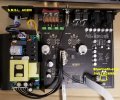
The switching power supply is not connected to mains earth, and the components required to make that connection are not populated.
It wouldn't have to if it is double insulated. Countless AVRs for example have the same IEC sock with the protective earth missing.
Consequently, the EMI filters are not connected to mains earth either, rendering them ineffective.
??? Either the device is EMI certified or not. How that gets done is not a concern for the customer.

Heck, with terrestrial TV and Radio dying, I am not sure EMI radiation is as much of a thing as it once was.

They key is whether it is safety rated.
 
It wouldn't have to if it is double insulated. Countless AVRs for example have the same IEC sock with the protective earth missing.

??? Either the device is EMI certified or not. How that gets done is not a concern for the customer.

Heck, with terrestrial TV and Radio dying, I am not sure EMI radiation is as much of a thing as it once was.

They key is whether it is safety rated.
Please don't shoot the messenger.
I have simply described the technical details I observed and measured with several Infineon-based SMSL amplifiers using this power supply.

The situation in the EU is quite different from that in the USA or other countries.
When an EU-based manufacturer or distributor affixes the CE mark to a device, they are declaring that the device complies with all legal regulations and that an EU Declaration of Conformity exists for it. No device with a mains power connection may be sold in the EU without this CE marking.
Even for standard devices, there are no certificates that carry legal weight or offer any protection to the EU-based manufacturer or distributor.

In the EU, there are only two relevant protection classes for such mains-powered devices—Protection Class I (circle with a grounding symbol) and Protection Class II (two interlocking squares)—and the corresponding symbols must be displayed on the device.
So far, I haven't found either of these symbols on any of these amplifiers—neither on the back nor on the bottom; this applies to the RAW-MHA1 as well.

The key points are as follows:
- The presence of a grounding pin on the mains connector classifies it as a Protection Class I device.
- However, the fact that the grounding pin is not connected to the chassis effectively makes it a Protection Class II device.
And here is the critical issue:
If the DC ground terminal of the power supply (the two middle pins of the DC supply voltage) has electrical continuity with the chassis of the RAW-MHA1—which has been the case with several Infineon-based SMSL amplifiers I've examined—a very dangerous situation could arise in the event of a fault. If a catastrophic failure occurs in the switching power supply, the amplifier's chassis could become fully live with mains voltage without tripping the RCD or the fuse in the distribution box.

Any owner can use a multimeter to check whether this is the case for the RAW-MHA1.
IMPORTANT: Unplug the mains cable and leave the unit switched on at the rear (to allow the capacitors to discharge)!
Measure the continuity of the ground connection from the amplifier board/SMPS connector (GND) to the chassis. The best points to measure are the board mounting screws and the chassis screws—especially those securing the front panel.

 
Please don't shoot the messenger.
I have simply described the technical details I observed and measured with several Infineon-based SMSL amplifiers using this power supply.

The situation in the EU is quite different from that in the USA or other countries.
When an EU-based manufacturer or distributor affixes the CE mark to a device, they are declaring that the device complies with all legal regulations and that an EU Declaration of Conformity exists for it. No device with a mains power connection may be sold in the EU without this CE marking.
Even for standard devices, there are no certificates that carry legal weight or offer any protection to the EU-based manufacturer or distributor.

In the EU, there are only two relevant protection classes for such mains-powered devices—Protection Class I (circle with a grounding symbol) and Protection Class II (two interlocking squares)—and the corresponding symbols must be displayed on the device.
So far, I haven't found either of these symbols on any of these amplifiers—neither on the back nor on the bottom; this applies to the RAW-MHA1 as well.

The key points are as follows:
- The presence of a grounding pin on the mains connector classifies it as a Protection Class I device.
- However, the fact that the grounding pin is not connected to the chassis effectively makes it a Protection Class II device.
And here is the critical issue:
If the DC ground terminal of the power supply (the two middle pins of the DC supply voltage) has electrical continuity with the chassis of the RAW-MHA1—which has been the case with several Infineon-based SMSL amplifiers I've examined—a very dangerous situation could arise in the event of a fault. If a catastrophic failure occurs in the switching power supply, the amplifier's chassis could become fully live with mains voltage without tripping the RCD or the fuse in the distribution box.

Any owner can use a multimeter to check whether this is the case for the RAW-MHA1.
IMPORTANT: Unplug the mains cable and leave the unit switched on at the rear (to allow the capacitors to discharge)!
Measure the continuity of the ground connection from the amplifier board/SMPS connector (GND) to the chassis. The best points to measure are the board mounting screws and the chassis screws—especially those securing the front panel.

With the very first generations of amplifiers—such as the MA5532 and the AO200—SMSL did not skimp on the PSU implementation, ensuring compliance with safety standards... The negligence set in when they stopped using Mornsun power supplies.

Example see attached file
 

Attachments

  • SMSL_A0200__inside_002b.jpg
    SMSL_A0200__inside_002b.jpg
    337.7 KB · Views: 131
The situation in the EU is quite different from that in the USA or other countries.
When an EU-based manufacturer or distributor affixes the CE mark to a device, they are declaring that the device complies with all legal regulations and that an EU Declaration of Conformity exists for it. No device with a mains power connection may be sold in the EU without this CE marking.
I am well aware of the situation in EU. This product most definitely has CE mark, both underneath the unit itself and on the cardboard box. Since EU allows self-certification, the requirement is met and no further evidence is required to be provided lest a complain is filed and regulatory agency chooses to investigate.
 
The key points are as follows:
- The presence of a grounding pin on the mains connector classifies it as a Protection Class I device.
The grounding pin is optional on class II product. Inclusion of it doesn't automatically force the device to be class I.
 
If the DC ground terminal of the power supply (the two middle pins of the DC supply voltage) has electrical continuity with the chassis of the RAW-MHA1—which has been the case with several Infineon-based SMSL amplifiers I've examined—a very dangerous situation could arise in the event of a fault. If a catastrophic failure occurs in the switching power supply, the amplifier's chassis could become fully live with mains voltage without tripping the RCD or the fuse in the distribution box.

Huh. So measuring continuity, which is usually indicative of a properly implemented earth connection, will instead tell you that the device is even more hazardous.

Basically there is no way to tell if you're safe without opening the chassis and verifying yourself, which is something a user really shouldn't do since you would be exposing the power supply.

It is a mystery to me why SMSL does not use this approved version.

They have admitted they do this because they want to get rid of noise, which isn't a worthwhile tradeoff in my book.

What is extremely weird is that their DACs/HP amps are in another league, both in terms of performance and design (they usually connect the protective earth wire on those). It is unclear to me why ground-related noise would be deemed acceptable in those products. I suspect two different design teams are at work.
 
Are the Infineon chips inherently balanced (like the 3255)? If so, does anyone take advantage of balanced? Balanced DACs are easy but four gang volume (& tone) control are expensive. Perhaps the JRC volume/tone/buffer chips might provide an economic solution?
 
Are the Infineon chips inherently balanced (like the 3255)? If so, does anyone take advantage of balanced? Balanced DACs are easy but four gang volume (& tone) control are expensive. Perhaps the JRC volume/tone/buffer chips might provide an economic solution?

If you're referring to the MA5532: it natively supports fully balanced configurations. But It can also accept single-ended (unbalanced) inputs.
 
Please don't shoot the messenger.
I have simply described the technical details I observed and measured with several Infineon-based SMSL amplifiers using this power supply.

The situation in the EU is quite different from that in the USA or other countries.
When an EU-based manufacturer or distributor affixes the CE mark to a device, they are declaring that the device complies with all legal regulations and that an EU Declaration of Conformity exists for it. No device with a mains power connection may be sold in the EU without this CE marking.
Even for standard devices, there are no certificates that carry legal weight or offer any protection to the EU-based manufacturer or distributor.

In the EU, there are only two relevant protection classes for such mains-powered devices—Protection Class I (circle with a grounding symbol) and Protection Class II (two interlocking squares)—and the corresponding symbols must be displayed on the device.
So far, I haven't found either of these symbols on any of these amplifiers—neither on the back nor on the bottom; this applies to the RAW-MHA1 as well.

The key points are as follows:
- The presence of a grounding pin on the mains connector classifies it as a Protection Class I device.
- However, the fact that the grounding pin is not connected to the chassis effectively makes it a Protection Class II device.
And here is the critical issue:
If the DC ground terminal of the power supply (the two middle pins of the DC supply voltage) has electrical continuity with the chassis of the RAW-MHA1—which has been the case with several Infineon-based SMSL amplifiers I've examined—a very dangerous situation could arise in the event of a fault. If a catastrophic failure occurs in the switching power supply, the amplifier's chassis could become fully live with mains voltage without tripping the RCD or the fuse in the distribution box.

Any owner can use a multimeter to check whether this is the case for the RAW-MHA1.
IMPORTANT: Unplug the mains cable and leave the unit switched on at the rear (to allow the capacitors to discharge)!
Measure the continuity of the ground connection from the amplifier board/SMPS connector (GND) to the chassis. The best points to measure are the board mounting screws and the chassis screws—especially those securing the front panel.
Interesting, thanks. Actually I have never seen the Class I mark on an audio device, even if it is class I. E. g. my Naim and Audiophonics Power amp have not.
 
Some of their dacs and headphone amps are really great. I love my dl200 (dac+headphone amp) and plan to get d200 dac+preamp for a different set up. I may even get h200 headphone + preamp too. However, when it comes to their power amplifier, I would just simply stay away.
Agreed. I have the DL200 and it's excellent, but it's feeding a stack of Bryston and Yamaha amplifiers.
 
Interesting, thanks. Actually I have never seen the Class I mark on an audio device, even if it is class I. E. g. my Naim and Audiophonics Power amp have not.
Protection Class I is the circle with the earth symbol, II is the two squares, and III is the rhombus.

Bildschirmfoto 2026-09-30 um 14.43.18.png
Bildschirmfoto 2026-09-30 um 14.43.37.png
Bildschirmfoto 2026-09-30 um 14.43.54.png
 
If you're referring to the MA5532: it natively supports fully balanced configurations. But It can also accept single-ended (unbalanced) inputs.
Does anyone produce a DAC & amp (or integrated) with truly balanced IO? Is the four gang potentiometer the stumbling block?
 
never seen Class 3 Symbol in Italy at least, Class 1 Symbol seen sometime near the point when an earth wire is connected or screwed/bolted, for example inside a device chassis or a wall socket, but nowhere on the visible side of an electrical device

Here is an example:

Screenshot 2026-10-01 at 05.17.34.png


It's true that the Class I symbol is omitted many times, though. But usually you don't have to wonder if the earth wire is connected internally... o_O
 
never seen Class 3 Symbol in Italy at least, Class 1 Symbol seen sometime near the point when an earth wire is connected or screwed/bolted, for example inside a device chassis or a wall socket, but nowhere on the visible side of an electrical device
It depends on the manufacturers and devices, and the extent to which they comply with regulations—especially if they have their own branch or distribution operations within the EU.
Examples include Class II devices from Marantz and Yamaha that feature proper AC plugs and appropriate labeling.

Class III devices are indeed rarely labeled as such, or the marking appears only on the external power supply or charger.

Bildschirmfoto 2026-10-01 um 16.01.48.png
Bildschirmfoto 2026-10-01 um 16.02.10.png
 
I am well aware of the situation in EU. This product most definitely has CE mark, both underneath the unit itself and on the cardboard box. Since EU allows self-certification, the requirement is met and no further evidence is required to be provided lest a complain is filed and regulatory agency chooses to investigate.
its not the 1st time we see the probleme of security with little thing chinese .. perhaps open a topic about product et problem for all : i says that for all spécialiste contributor who have picture , proff and legitimate question
 
its not the 1st time we see the probleme of security with little thing chinese .. perhaps open a topic about product et problem for all : i says that for all spécialiste contributor who have picture , proff and legitimate question
That would be a bottomless pit and would break down into several areas:

- Missing, incorrect, or mandatory safety markings
- Fundamental electrical faults or issues regarding the grounding connection (e.g., a grounding pin that is present but not connected, though posing no threat to human life)
- Major faults or issues involving an unconnected mains earth and insufficiently insulated housings
- Major faults or issues involving an unconnected mains earth and non-compliant switched-mode power supplies (including their connection) for Protection Class II equipment
 
Back
Top Bottom