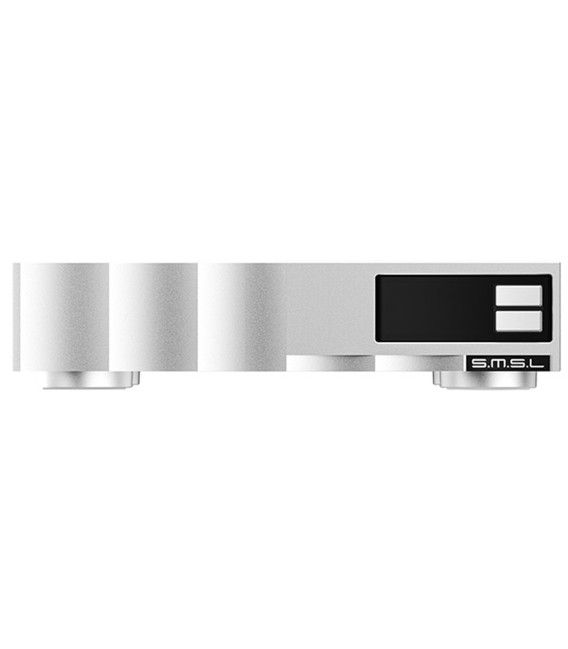
Hello Everyone, this is a review and measurements of the SMSL R100.

It was kindly sent to me by SMSL, and its price comes in at under $300.
SMSL R100 - Presentation
The SMSL R100 uses a very old DAC from Analog Devices, the AD1861 in its most linear version "J". This DAC was released 36 years ago! It has a resolution of 18bits and is a good old classic R2R converter.
Of course, the AD1861-J is obsolete, but I love the fact that SMSL allows us to access such old tech, so we get to know what these were capable of, at a time max available resolution via the CDA/DAT was 16bits.
At the time this was a "high-end" DAC, that benefited from laser trimming of the thin-film resistors to improve linearity and reduce distortion.

That said, from the above specs, the THD+N at full scale was "only" 0.003% = -90.4db and monotonicity (understand linearity) was only 15bits, or -90dB. The SNR is said to be 110dB at best which corresponds to the max possible with 18bits (exact formula is 6.02x18 + 1.76 = 110.12dB). I'll of course check all of that.
The back of the unit offers all that is desired from a pure DAC:

We get RCA and XLR outputs. On the input side, we have the standard optical and coaxial SPDIF inputs and USB. No external power supply, as you can see.
By the shape of the back, you can guess that it is a dual mono DAC because... the AD1861-J is a mono DAC. So there are two of them in the R100. Actually, you can see them from the top of the R100, with a clear indication of right and left channels, in case you get lost:

The Analog Devices AD1861-J is a DAC only, no integrated oversampling/filtering, this is done by SMSL prior to feeding the chip. So, the AD1861-J is here only to convert an 18bits digital word into an output voltage, end of the story.
User experience
This one is easy to use, one button on the front to power it on/off and select the source, the other one to select the EQ (Off, EQ1, EQ2).
There a web interface called DSP Tuner to tune the EQ. The interface is intuitive, but missing a one button to make the EQ flat (I might have missed it though). Setting a curve can be done graphically with the mouse or by entering the parameters, practical. The web interface is updated live when going from one curve to the other by pressing the front button (for that, you need to have the R100 connected to the PC and set to USB input, of course).
If I may ask SMSL, I would love to have the possibility to adjust the digital volume, because I’ve seen that when the EQ is active, and because it needs to have digital headroom to process the curve, then it becomes fully resistant to intersample overs (more on that later).
The curve is very precisely applied as per the settings in DSP Tuner, as per my measurements, see below:

About the DAC itself, and even if really obsolete, I love the fact I can get to know for real what this old tech can deliver. With the usual flawless implementation of SMSL, I thought this is a good opportunity. These R2R DACs created some sort of a legend, and I reviewed many of them in old CD Players, but I was limited by the media these would swallow. This time, I can send 24bits signal into it and even if 6 of them must be disregarded, I was eager to test it and report. SMSL accepted my request to review it, so I'm grateful.
One cool feature of the AD1861 is that it offers a fine tuning of the MSB (Most Significant Bit) via external adjustment. And SMSL added the necessary trimming pots (circled in red below) for that, and I love it. I already played several times with these adjustments, on the Sony CDP-557ES, Denon DCD-3560, Accuphase DP-70, and the Teac VRDS 25x which uses the successor of the AD1861, the AD1862 (20bits mono DAC).

SMSL says all the R100-AD1861 MSB are adjusted using an AP 555 before leaving factory, which is nice, but I would have preferred an easier access to the trimming pot. I know users are likely to screw up to original setting, but after all, why not? Some might prefer heavy distortion and lower linearity(?). And I suppose it would not be too complex to mark the initial setting so the user could go back to it in an instant.
Anyways, as you understand from the above, I am happy to get the opportunity to review what that pure DAC only can do (no integrated oversampling filter in that one). And it took me quite an amount of time to get there. This is a unusual DAC with some specificities and I wanted to review it in full, which required more time than I thought.
SMSL R100 - Measurements (XLR/RCA out)
All measurements performed with an E1DA Cosmos ADCiso (grade 0) in mono mode, the Cosmos Scaler (100kohms from unbalanced input) for analog outputs.
From XLR outs, I measured 3.483Vrms from the Right Channel, and 3.510Vrms from the Left one, ie 0.06dB channel imbalance, which is reasonable. Balanced outputs preserve absolute polarity, and phase is dead flat. From RCA outs, I measured 1.742Vrms from the Right channel, and 1.755Vrms from the left one, ie again 0.06dB more. Similar to XLR, unbalanced RCA are non-inverting, and the phase is dead flat.
Note that besides the output voltage, XLR and RCA have the exact same performances, so I show only one of them below. Same with USB, Coax and Optical inputs, I got the same results, so no need for me to differentiate them in that review.
The R100 accepts input signals up to 768kHz, but I see that it will limit the bandwidth to 22kHz maximum, with a relatively sharp filter, what ever is the sampling (except with 44.1kHz). I guess this is to compensate non-linearities of the AD1861 which was not designed to go beyond Audio band, even if it accepts 16x oversampled sampling rate.
----
Let’s start with the standard 1kHz at 0dBFS (20Hz to 20kHz span):

We get the published specs of Analog Devices, that is 0.003%, which is the best case scenario. So that's a low SINAD of 90.4dB. The second harmonic is the one limiting the THD+N score.
Note that the calculated SNR is 108dB in the presence of that high level sine, meaning SMSL managed to get the most of the AD1861.
Let's try at -6dBFS since I'm used to show that:

THD+N is almost identical to the one at full scale, and that means the AD1861 does not like very much to be playing at or near full scale. The 2dB improvement here is negligible.
With 6dB less, the SNR improved to 103.4dB +6dB = 109.4dB, close to the max possible, SMSL managed to extract all of the AD1861.
----
Stereophile was often showing the below trace and I like it too, so I'm used to reuse it. It is a view from 20Hz to 1kHz with a 1kHz sine at 0dBFS:

The linear frequency scale better reveals potential power supply related noise (leakages) and here there's nothing. I had to do 0 effort to get there, meaning the SMSL is well isolated on power supply perspective. I got the same results from RCA outputs, nice.
Like I said, the R100 is limiting the bandwidth to 22kHz max, whatever is the initial sampling rate. Look below with 384kHz input:

I suppose there is a reason, since even if the AD1861 could accept 16x44.1kHz oversampling input, it might not be much linear in that case.
Staying on the bandwidth, it is flat within less than 0.1dB, something that was not granted at the time:

Note the 0.06dB deviation between the two mono channels (quite good).
To finish on the filter (SMSL custom), let me show its attenuation this time at 48kHz Sampling Rate:

This is an overlay with the IMD AES test (18kHz&20kHz 1:1) which shows a good attenuation of -90dB. The filter is relatively sharp (fully active at around 24kHz with 48kHz SR input).
----
Let's talk jitter now (J-Test at 48kHz, 512k FFT. 32 averages), and...:

Ok, we have some jitter here. The side bands go as high as -110dBr, not enough to be heard, but of course much more than best in class of today. To put the above into perspective and since it was performed at 24bits, let’s run the same test with 16bits source file:

The red trace is the original WAV file directly analysed by REW (no conversion). The blue trace is from the R100. What could have appeared as jitter in the previous trace is now barely going above the intended signal (the blue spikes), meaning that the jitter the R100 creates is below the Jitter test stressor when running at 16bits, which this DAC was designed for.
And it is a bit technical, but these two views tell me that when presented with 24bits data, the R100 does not stupidly drip the last 6bits, there is a bit depth decrease performed live, else we would have seen the stressor trace in the graph before this one. At the same time, 16bits data is left untouched, that is what this test reveals, and the 3DC at 16bits should confirm that too.
----
Let’s go to the Multitone test (48kHz SR, 256k FFT, 16 averages):

Excluding few spikes from 3kHz, we indeed get 18bits of distortion-free range
----
Next is the THD+N vs Frequency (192kHz, 512k FFT 4 averages, 3PPO (20Hz to 20kHz), XLR 3.5Vrms output:

This is entirely dominated by distortion which is H2 driven. Noise is way below that, even when all included up to 90kHz. For the era and the tech, this is good. You’re also unlikely to hear that level of distortion, being H2 driven.
But know what? Let’s try almost the same a -12dBFS, as I always show when I review a CD player. This is from a sweep at 16bits, the one I use when I test a CD Player. Old DACs like this one had difficulties to stay linear as the level was going down:

This time, it is excluding noise, but since the graph is driven by distortion only, this is it. Like I said before, the SNR with that level is the max 110dB that this 18bits can achieve. So, in terms of dynamic range, it is good.
----
The IMD SMPTE sweep vs level, which can't be compared to the one of Amir because this measurement is based on FFT analysis of IMD distortion only (192kHz, 128k FFT 4 averages, 1dB step, scaler in auto mode), is the below:

Clearly, this is nowhere near what we’d call best-in-class today, but that’s what makes it interesting. Intermodulation distortion is generally easier to hear, although with levels between 0.01% and 0.05% from -30 dB relative to max output, picking it out by ear should still be quite a challenge. Anyone willing to give it a try?
There’s also that little “hump” on both channels between -20 dBFS and -10 dBFS. Back in 1990, we probably would have spent pages discussing it... if anyone had actually measured it, and if forums like ASR had existed
----
Dynamic range is good for an old 18bits R2R DAC (0dBFS = 3.5Vrms):


The first CCIR measurement above was created 10 years after the release of that DAC Note the very good balance between the two channels.
The DR is not equal to SNR because there is a little distortion at -60dBFS (it must must included into the calculation), and that is typical of these old R2R DACs which had difficulties to stay linear at the lowest levels.
----
And now let's have a look at other less usual measurements. The one that I like is the resistance to intersample-overs.
This test is performed with dedicated test tones with a specific phase shift to generate digital overs. If anything in the digital path (oversampling filter /DSP / ASRC) does not have enough headroom for digital overs, it will generate clipping within the interpolator. For that, I'm using a test tone of 11'025Hz with a phase shift of 45° that goes up to +3.01dB over, by 1dB steps. This allows me to process what's the headroom of the digital interpolator of the DAC. Here are the results (THD+N measurement up to 90kHz):
I combined the results of XLR+EQ Off and RCA+EQ On.
The above means that the interpolator of the SMSL has no headroom. Too bad that SMSL did not attenuated by default, for instance by -3dB. Indeed, as you can see, when activating the EQ which adds a lot of headroom (nearly 15dB per my tests), we get full resistance to ISOs. That's why I'd love SMSL to add to their DSP Tuner interface a button to lower the digital volume by few dBs, it would not impact the performances.
----
Move on to other measurements (not shown). First, I now regroup all IMD tests as below, sourced from REW's results (IMD distortion and Total Distortion+Noise shown for each):

These are good for that old tech. Considering the low level of distortion, you're very unlikely to hear that into music.
Crosstalk is very good, so good I could not measure it (buried under noise floor) and I suspect the non active DAC just shuts itself down. I shall run again that one with dither in the other channel to force it active.
----
Let's try the linearity test, since Analog Devices documented a monotonicity of 15bits only:

Being nice with the AD1861, ans so considering we lose linearity at 0.5dB deviation, we get almost 16bits of linearity.
----
THAT SAID, this is after I adjusted the MSB via the trimming pots. Yeah, I could not resist to try to do better than SMSL. In fact, it all started from the very old and once upon a time standard 3DC measurement that Stereophile was using when reviewing CD Players. I revived it, for my CD Player reviews The test is from an undithered 997Hz sine at -90.31dBFS. With 16bits, the signal should appear (on a scope) as the 3DC levels of the smallest symmetrical sign magnitude digital signal. Before adjusting the MSB, I got the below:

This is not too bad, but not symmetrical and there's a bit too much distortion. So I tried to do better, and for instance got this:

Less distortion, somewhat improved symmetry, but 0-crossing is a little off. With efforts, it was possible to get to the exact -90.31dBFS, and after that I ran the above linearity test. But you can see from the trace that 15bits is indeed the monotonicity of that DAC.
By the way, Analog Devices documented at the time that this adjustment should be done at -20dBFS or -60dBFS, but I got the most reliable results at -90dBFS. Of course that requires a high precision (ultra low noise) ADC to do that. Actually, after I adjusted at -90dBFS, I did not see a reduction of distortion at 0dBFS, but got 6dB less at -20dBFS input signal:

The graph above is using a linear frequency scale. Not something you see that often, but I find it much easier when looking at distortion and other non-linearities.
Blue is the R100 out of the box. Red is after my second attempt at adjusting the MSB trim. Now look at H3 and the values at the bottom of the graph: 18 dB less distortion on H3. That’s an interesting improvement from just trimming the MSB.
THD drops from -84.7 dB to -90.9 dB, and THD+N improves from -81.6 dB to -84.2 dB. Not bad.
There is a trade-off, though. The red trace has a few more small spikes because the zero-crossing is now slightly off, as I mentioned before. Still, at this signal level, that may well be a better compromise.
Anyway, I’m definitely not done playing with the MSB trim yet. Can I squeeze a little more performance out of it? Challenge accepted
Conclusion
Yes, it’s obsolete technology. I don’t think anyone can seriously argue otherwise. Its measured performance is largely what you’d expect from a DAC chip designed 36 years ago. The limitations clearly aren’t coming from SMSL’s processing or analogue stage, which isn’t exactly surprising considering what SMSL is capable of today.
So why bother? Because it’s an easy way to hear what a genuine vintage R2R DAC can do. With a modern DAC, distortion and low-level linearity are basically non-issues. Here, they aren’t. And that’s arguably the whole appeal of the R100: finding out whether those measurable differences translate into something you can actually hear.
The AD1861-J only appeared in one CD player, the Denon DCD-1550G, which isn’t particularly easy to source. And if you do manage to find one, your source material is, well... CDs.
The R100 was never going to measure like a modern state-of-the-art DAC. Still, its dynamic range is perfectly respectable. Distortion is the main limitation, and that limitation could actually be the fun part. Can you hear it? And if you can, who knows, you might even like it
I hope you enjoyed the review!
Flo
It was kindly sent to me by SMSL, and its price comes in at under $300.
SMSL R100 - Presentation
The SMSL R100 uses a very old DAC from Analog Devices, the AD1861 in its most linear version "J". This DAC was released 36 years ago! It has a resolution of 18bits and is a good old classic R2R converter.
Of course, the AD1861-J is obsolete, but I love the fact that SMSL allows us to access such old tech, so we get to know what these were capable of, at a time max available resolution via the CDA/DAT was 16bits.
At the time this was a "high-end" DAC, that benefited from laser trimming of the thin-film resistors to improve linearity and reduce distortion.
That said, from the above specs, the THD+N at full scale was "only" 0.003% = -90.4db and monotonicity (understand linearity) was only 15bits, or -90dB. The SNR is said to be 110dB at best which corresponds to the max possible with 18bits (exact formula is 6.02x18 + 1.76 = 110.12dB). I'll of course check all of that.
The back of the unit offers all that is desired from a pure DAC:
We get RCA and XLR outputs. On the input side, we have the standard optical and coaxial SPDIF inputs and USB. No external power supply, as you can see.
By the shape of the back, you can guess that it is a dual mono DAC because... the AD1861-J is a mono DAC. So there are two of them in the R100. Actually, you can see them from the top of the R100, with a clear indication of right and left channels, in case you get lost:
The Analog Devices AD1861-J is a DAC only, no integrated oversampling/filtering, this is done by SMSL prior to feeding the chip. So, the AD1861-J is here only to convert an 18bits digital word into an output voltage, end of the story.
User experience
This one is easy to use, one button on the front to power it on/off and select the source, the other one to select the EQ (Off, EQ1, EQ2).
There a web interface called DSP Tuner to tune the EQ. The interface is intuitive, but missing a one button to make the EQ flat (I might have missed it though). Setting a curve can be done graphically with the mouse or by entering the parameters, practical. The web interface is updated live when going from one curve to the other by pressing the front button (for that, you need to have the R100 connected to the PC and set to USB input, of course).
If I may ask SMSL, I would love to have the possibility to adjust the digital volume, because I’ve seen that when the EQ is active, and because it needs to have digital headroom to process the curve, then it becomes fully resistant to intersample overs (more on that later).
The curve is very precisely applied as per the settings in DSP Tuner, as per my measurements, see below:
About the DAC itself, and even if really obsolete, I love the fact I can get to know for real what this old tech can deliver. With the usual flawless implementation of SMSL, I thought this is a good opportunity. These R2R DACs created some sort of a legend, and I reviewed many of them in old CD Players, but I was limited by the media these would swallow. This time, I can send 24bits signal into it and even if 6 of them must be disregarded, I was eager to test it and report. SMSL accepted my request to review it, so I'm grateful.
One cool feature of the AD1861 is that it offers a fine tuning of the MSB (Most Significant Bit) via external adjustment. And SMSL added the necessary trimming pots (circled in red below) for that, and I love it. I already played several times with these adjustments, on the Sony CDP-557ES, Denon DCD-3560, Accuphase DP-70, and the Teac VRDS 25x which uses the successor of the AD1861, the AD1862 (20bits mono DAC).
SMSL says all the R100-AD1861 MSB are adjusted using an AP 555 before leaving factory, which is nice, but I would have preferred an easier access to the trimming pot. I know users are likely to screw up to original setting, but after all, why not? Some might prefer heavy distortion and lower linearity(?). And I suppose it would not be too complex to mark the initial setting so the user could go back to it in an instant.
Anyways, as you understand from the above, I am happy to get the opportunity to review what that pure DAC only can do (no integrated oversampling filter in that one). And it took me quite an amount of time to get there. This is a unusual DAC with some specificities and I wanted to review it in full, which required more time than I thought.
SMSL R100 - Measurements (XLR/RCA out)
All measurements performed with an E1DA Cosmos ADCiso (grade 0) in mono mode, the Cosmos Scaler (100kohms from unbalanced input) for analog outputs.
From XLR outs, I measured 3.483Vrms from the Right Channel, and 3.510Vrms from the Left one, ie 0.06dB channel imbalance, which is reasonable. Balanced outputs preserve absolute polarity, and phase is dead flat. From RCA outs, I measured 1.742Vrms from the Right channel, and 1.755Vrms from the left one, ie again 0.06dB more. Similar to XLR, unbalanced RCA are non-inverting, and the phase is dead flat.
Note that besides the output voltage, XLR and RCA have the exact same performances, so I show only one of them below. Same with USB, Coax and Optical inputs, I got the same results, so no need for me to differentiate them in that review.
The R100 accepts input signals up to 768kHz, but I see that it will limit the bandwidth to 22kHz maximum, with a relatively sharp filter, what ever is the sampling (except with 44.1kHz). I guess this is to compensate non-linearities of the AD1861 which was not designed to go beyond Audio band, even if it accepts 16x oversampled sampling rate.
----
Let’s start with the standard 1kHz at 0dBFS (20Hz to 20kHz span):
We get the published specs of Analog Devices, that is 0.003%, which is the best case scenario. So that's a low SINAD of 90.4dB. The second harmonic is the one limiting the THD+N score.
Note that the calculated SNR is 108dB in the presence of that high level sine, meaning SMSL managed to get the most of the AD1861.
Let's try at -6dBFS since I'm used to show that:
THD+N is almost identical to the one at full scale, and that means the AD1861 does not like very much to be playing at or near full scale. The 2dB improvement here is negligible.
With 6dB less, the SNR improved to 103.4dB +6dB = 109.4dB, close to the max possible, SMSL managed to extract all of the AD1861.
----
Stereophile was often showing the below trace and I like it too, so I'm used to reuse it. It is a view from 20Hz to 1kHz with a 1kHz sine at 0dBFS:
The linear frequency scale better reveals potential power supply related noise (leakages) and here there's nothing. I had to do 0 effort to get there, meaning the SMSL is well isolated on power supply perspective. I got the same results from RCA outputs, nice.
Like I said, the R100 is limiting the bandwidth to 22kHz max, whatever is the initial sampling rate. Look below with 384kHz input:
I suppose there is a reason, since even if the AD1861 could accept 16x44.1kHz oversampling input, it might not be much linear in that case.
Staying on the bandwidth, it is flat within less than 0.1dB, something that was not granted at the time:
Note the 0.06dB deviation between the two mono channels (quite good).
To finish on the filter (SMSL custom), let me show its attenuation this time at 48kHz Sampling Rate:
This is an overlay with the IMD AES test (18kHz&20kHz 1:1) which shows a good attenuation of -90dB. The filter is relatively sharp (fully active at around 24kHz with 48kHz SR input).
----
Let's talk jitter now (J-Test at 48kHz, 512k FFT. 32 averages), and...:
Ok, we have some jitter here. The side bands go as high as -110dBr, not enough to be heard, but of course much more than best in class of today. To put the above into perspective and since it was performed at 24bits, let’s run the same test with 16bits source file:
The red trace is the original WAV file directly analysed by REW (no conversion). The blue trace is from the R100. What could have appeared as jitter in the previous trace is now barely going above the intended signal (the blue spikes), meaning that the jitter the R100 creates is below the Jitter test stressor when running at 16bits, which this DAC was designed for.
And it is a bit technical, but these two views tell me that when presented with 24bits data, the R100 does not stupidly drip the last 6bits, there is a bit depth decrease performed live, else we would have seen the stressor trace in the graph before this one. At the same time, 16bits data is left untouched, that is what this test reveals, and the 3DC at 16bits should confirm that too.
----
Let’s go to the Multitone test (48kHz SR, 256k FFT, 16 averages):
Excluding few spikes from 3kHz, we indeed get 18bits of distortion-free range
----
Next is the THD+N vs Frequency (192kHz, 512k FFT 4 averages, 3PPO (20Hz to 20kHz), XLR 3.5Vrms output:
This is entirely dominated by distortion which is H2 driven. Noise is way below that, even when all included up to 90kHz. For the era and the tech, this is good. You’re also unlikely to hear that level of distortion, being H2 driven.
But know what? Let’s try almost the same a -12dBFS, as I always show when I review a CD player. This is from a sweep at 16bits, the one I use when I test a CD Player. Old DACs like this one had difficulties to stay linear as the level was going down:
This time, it is excluding noise, but since the graph is driven by distortion only, this is it. Like I said before, the SNR with that level is the max 110dB that this 18bits can achieve. So, in terms of dynamic range, it is good.
----
The IMD SMPTE sweep vs level, which can't be compared to the one of Amir because this measurement is based on FFT analysis of IMD distortion only (192kHz, 128k FFT 4 averages, 1dB step, scaler in auto mode), is the below:
Clearly, this is nowhere near what we’d call best-in-class today, but that’s what makes it interesting. Intermodulation distortion is generally easier to hear, although with levels between 0.01% and 0.05% from -30 dB relative to max output, picking it out by ear should still be quite a challenge. Anyone willing to give it a try?
There’s also that little “hump” on both channels between -20 dBFS and -10 dBFS. Back in 1990, we probably would have spent pages discussing it... if anyone had actually measured it, and if forums like ASR had existed
----
Dynamic range is good for an old 18bits R2R DAC (0dBFS = 3.5Vrms):
The first CCIR measurement above was created 10 years after the release of that DAC
Note the very good balance between the two channels.The DR is not equal to SNR because there is a little distortion at -60dBFS (it must must included into the calculation), and that is typical of these old R2R DACs which had difficulties to stay linear at the lowest levels.
----
And now let's have a look at other less usual measurements. The one that I like is the resistance to intersample-overs.
This test is performed with dedicated test tones with a specific phase shift to generate digital overs. If anything in the digital path (oversampling filter /DSP / ASRC) does not have enough headroom for digital overs, it will generate clipping within the interpolator. For that, I'm using a test tone of 11'025Hz with a phase shift of 45° that goes up to +3.01dB over, by 1dB steps. This allows me to process what's the headroom of the digital interpolator of the DAC. Here are the results (THD+N measurement up to 90kHz):
| Intersample-overs tests THD+N 20Hz - 90kHz | Peak = -0.99dBFS | Peak = +0.01dBFS | Peak = +1.01dBFS | Peak = +2.01dBFS | Peak = +3.01dBFS |
| SMSL R100 EQ Off (XLR) | -88.5dB | -85.7dB | -26.9dB | -20.9dB | -17.8dB |
| SMSL R100 EQ on (RCA) | -77.9dB | -78.4dB | -79.6dB | -79.9dB | -85.8dB |
I combined the results of XLR+EQ Off and RCA+EQ On.
The above means that the interpolator of the SMSL has no headroom. Too bad that SMSL did not attenuated by default, for instance by -3dB. Indeed, as you can see, when activating the EQ which adds a lot of headroom (nearly 15dB per my tests), we get full resistance to ISOs. That's why I'd love SMSL to add to their DSP Tuner interface a button to lower the digital volume by few dBs, it would not impact the performances.
----
Move on to other measurements (not shown). First, I now regroup all IMD tests as below, sourced from REW's results (IMD distortion and Total Distortion+Noise shown for each):
These are good for that old tech. Considering the low level of distortion, you're very unlikely to hear that into music.
Crosstalk is very good, so good I could not measure it (buried under noise floor) and I suspect the non active DAC just shuts itself down. I shall run again that one with dither in the other channel to force it active.
----
Let's try the linearity test, since Analog Devices documented a monotonicity of 15bits only:
Being nice with the AD1861, ans so considering we lose linearity at 0.5dB deviation, we get almost 16bits of linearity.
----
THAT SAID, this is after I adjusted the MSB via the trimming pots. Yeah, I could not resist to try to do better than SMSL. In fact, it all started from the very old and once upon a time standard 3DC measurement that Stereophile was using when reviewing CD Players. I revived it, for my CD Player reviews
The test is from an undithered 997Hz sine at -90.31dBFS. With 16bits, the signal should appear (on a scope) as the 3DC levels of the smallest symmetrical sign magnitude digital signal. Before adjusting the MSB, I got the below:This is not too bad, but not symmetrical and there's a bit too much distortion. So I tried to do better, and for instance got this:
Less distortion, somewhat improved symmetry, but 0-crossing is a little off. With efforts, it was possible to get to the exact -90.31dBFS, and after that I ran the above linearity test. But you can see from the trace that 15bits is indeed the monotonicity of that DAC.
By the way, Analog Devices documented at the time that this adjustment should be done at -20dBFS or -60dBFS, but I got the most reliable results at -90dBFS. Of course that requires a high precision (ultra low noise) ADC to do that. Actually, after I adjusted at -90dBFS, I did not see a reduction of distortion at 0dBFS, but got 6dB less at -20dBFS input signal:
The graph above is using a linear frequency scale. Not something you see that often, but I find it much easier when looking at distortion and other non-linearities.
Blue is the R100 out of the box. Red is after my second attempt at adjusting the MSB trim. Now look at H3 and the values at the bottom of the graph: 18 dB less distortion on H3. That’s an interesting improvement from just trimming the MSB.
THD drops from -84.7 dB to -90.9 dB, and THD+N improves from -81.6 dB to -84.2 dB. Not bad.
There is a trade-off, though. The red trace has a few more small spikes because the zero-crossing is now slightly off, as I mentioned before. Still, at this signal level, that may well be a better compromise.
Anyway, I’m definitely not done playing with the MSB trim yet. Can I squeeze a little more performance out of it? Challenge accepted
Conclusion
Yes, it’s obsolete technology. I don’t think anyone can seriously argue otherwise. Its measured performance is largely what you’d expect from a DAC chip designed 36 years ago. The limitations clearly aren’t coming from SMSL’s processing or analogue stage, which isn’t exactly surprising considering what SMSL is capable of today.
So why bother? Because it’s an easy way to hear what a genuine vintage R2R DAC can do. With a modern DAC, distortion and low-level linearity are basically non-issues. Here, they aren’t. And that’s arguably the whole appeal of the R100: finding out whether those measurable differences translate into something you can actually hear.
The AD1861-J only appeared in one CD player, the Denon DCD-1550G, which isn’t particularly easy to source. And if you do manage to find one, your source material is, well... CDs.
The R100 was never going to measure like a modern state-of-the-art DAC. Still, its dynamic range is perfectly respectable. Distortion is the main limitation, and that limitation could actually be the fun part. Can you hear it? And if you can, who knows, you might even like it
I hope you enjoyed the review!
Flo
Last edited: